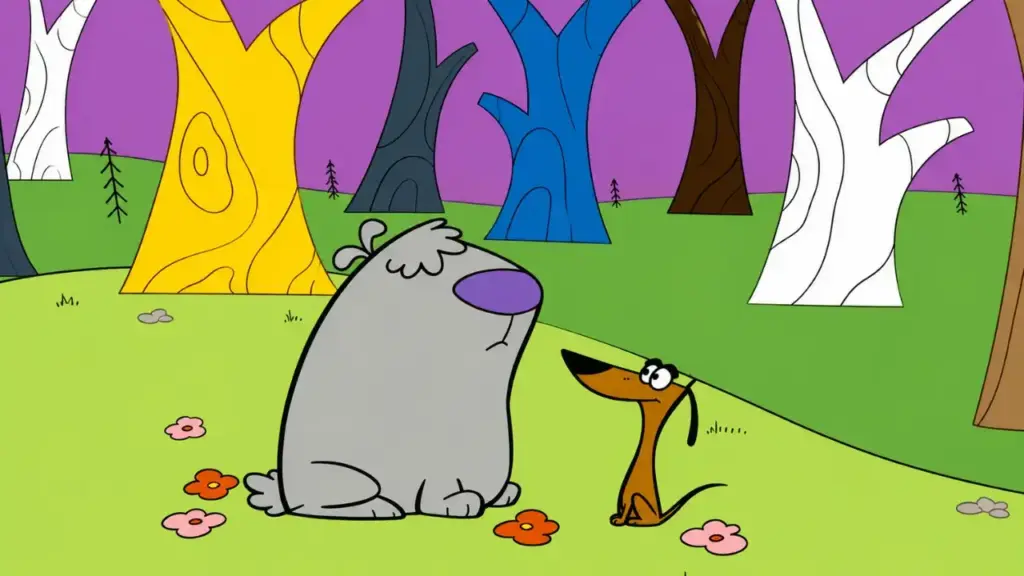
In 1993, Hanna-Barbera premiered a wonderfully strange cartoon that looked simpler than almost anything else on television: 2 Stupid Dogs.
The series followed a nervous little Dachshund and a slow-moving Old English Sheepdog through ordinary situations that quickly collapsed into absurdity.
Its flat designs, dry timing and booming “BUT IT’S WRONG!” punchline made it memorable. Behind the comedy, however, the show also brought together a remarkable group of young artists who would soon help define Cartoon Network.
2 Stupid Dogs did not single-handedly save Hanna-Barbera, but it became an important early step in the studio’s creative revival.
2 Stupid Dogs: Fast Facts
| Key Detail | Information |
|---|---|
| Creator | Donovan Cook |
| Original Run | 1993 to 1995 on TBS and in syndication |
| Episodes | 26 half-hour episodes across two seasons |
| Production Studio | Hanna-Barbera Cartoons |
| Notable Crew Members | Genndy Tartakovsky, Craig McCracken, Rob Renzetti and Butch Hartman |
How 2 Stupid Dogs Helped Revive Hanna-Barbera
By the early 1990s, Hanna-Barbera still owned one of animation’s greatest libraries, but the studio was struggling to find a new creative identity.
After Turner acquired the company, Fred Seibert became president of Hanna-Barbera in 1992. His approach was to give artists more room to develop their own ideas instead of relying entirely on executive-built formulas.
2 Stupid Dogs was the first series Seibert greenlit at the studio. It did not become a giant franchise, but its production helped establish the talent-first approach that later powered Hanna-Barbera’s revival.
- The stray-dog origin: In an interview about the series, Donovan Cook said the idea began after he saw two stray dogs wandering around his apartment complex. Their carefree behavior inspired the basic concept.
- The Seibert method: Seibert wanted the studio to attract younger artists and let strong creators shape the work. His account of the production identifies 2 Stupid Dogs as his first cartoon greenlight at Hanna-Barbera.
- The talent pipeline: Several crew members later contributed shorts to What a Cartoon!, the program that produced early versions of Dexter’s Laboratory, The Powerpuff Girls and other Cartoon Network originals.
| Animator | Role on 2 Stupid Dogs | Later Best Known For |
|---|---|---|
| Genndy Tartakovsky | Storyboard artist and animation director | Dexter’s Laboratory, Samurai Jack |
| Craig McCracken | Art director | The Powerpuff Girls, Foster’s Home for Imaginary Friends |
| Butch Hartman | Character designer | The Fairly OddParents, Danny Phantom |
| Rob Renzetti | Storyboard artist, writer and director | My Life as a Teenage Robot |
The series also arrived in the shadow of Ren & Stimpy, and critics quickly compared the two shows. John Kricfalusi later received a creative-consultant credit on the three recurring Red shorts, where the closing credits thanked him for supplying “tidbits of poor taste.”
Big Dog vs. Little Dog: A Study in Minimalist Design
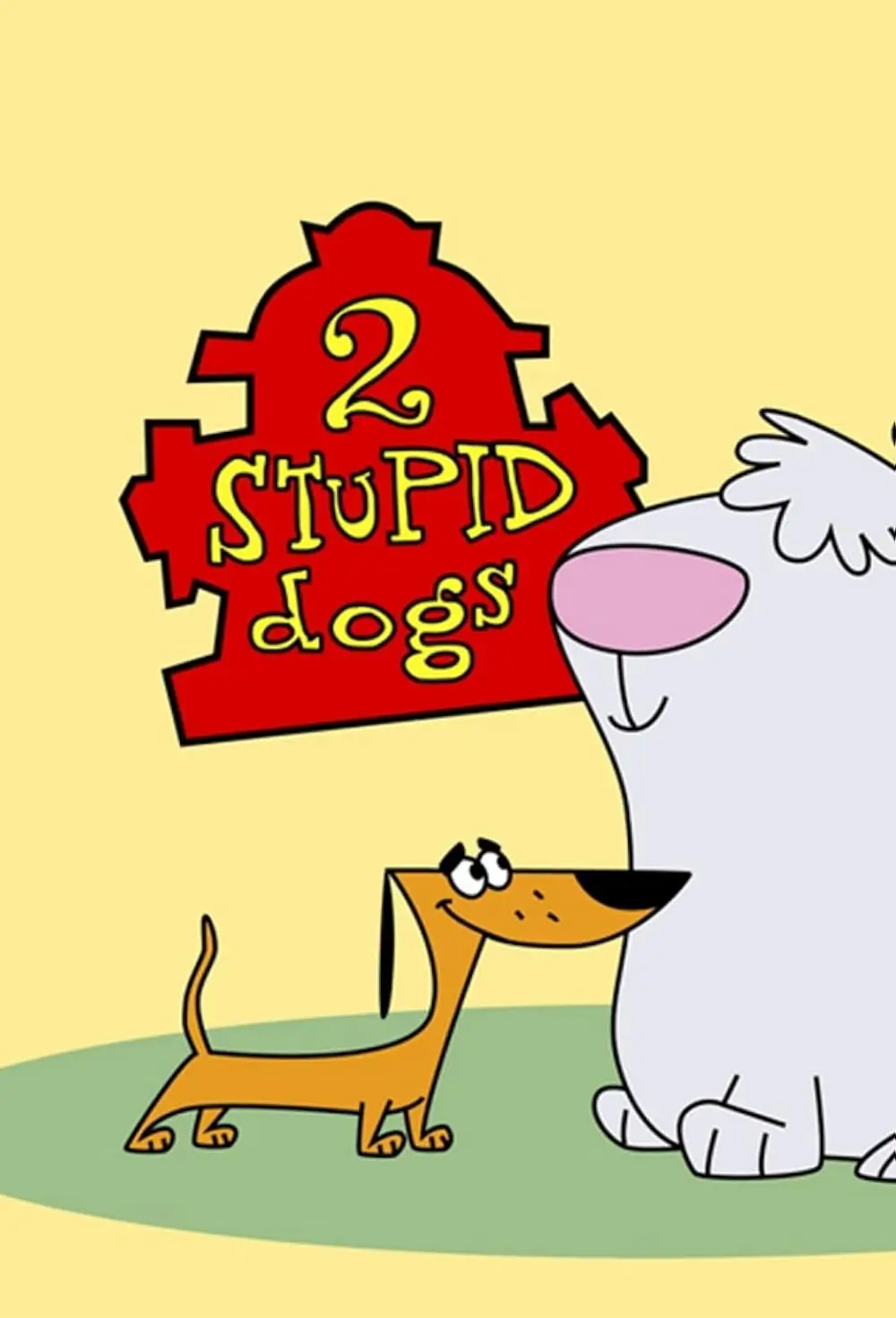
The brilliance of the show’s design comes from how little it needs.
The first season uses a deliberately flat style that recalls Hanna-Barbera’s limited-animation work from the 1950s and 1960s. Instead of packing every frame with detail, the artists built the comedy around clear poses, strong silhouettes and carefully timed reactions.
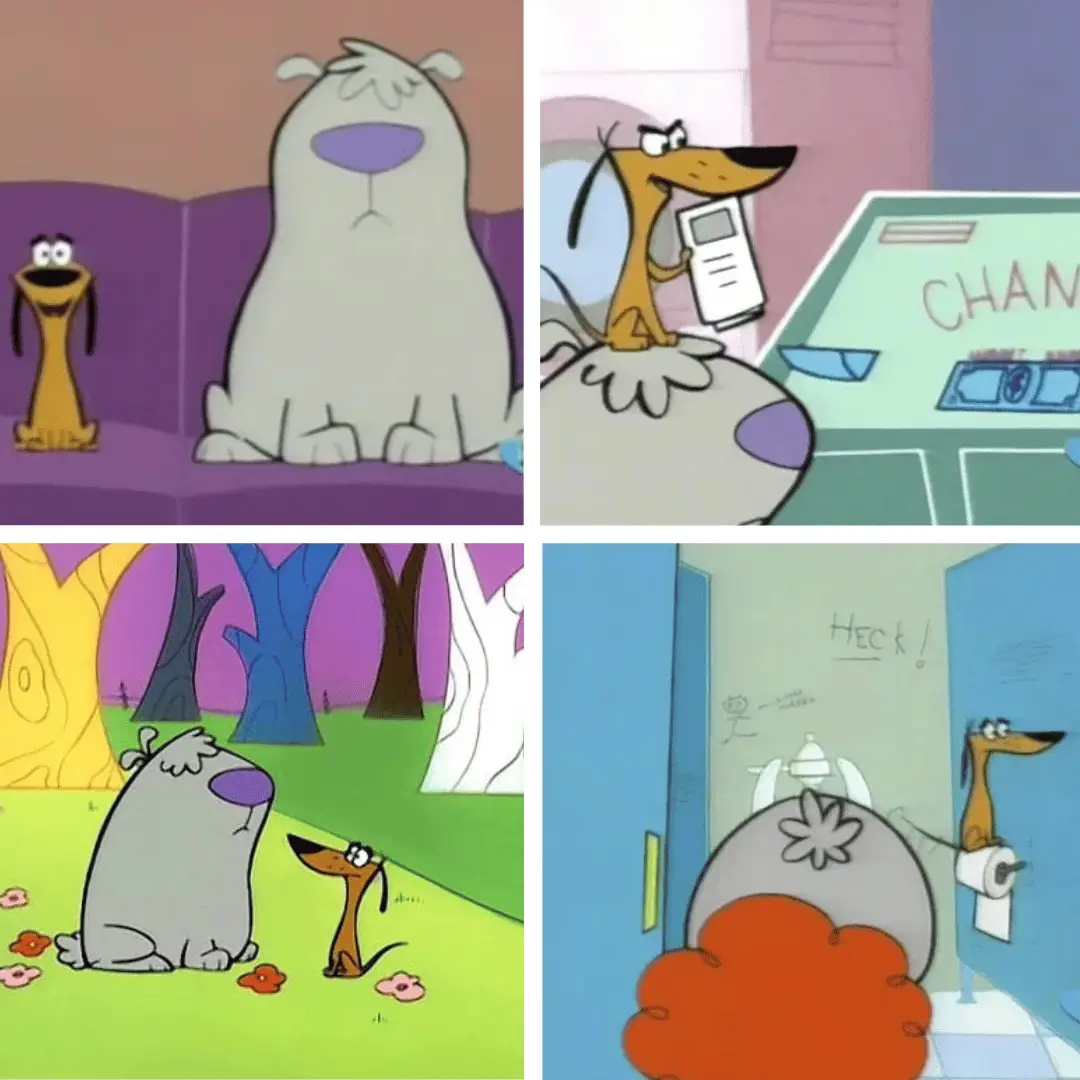
The central visual joke is immediate: one dog is enormous, heavy and almost motionless, while the other is small, sharp and constantly nervous.
- Big Dog: A large grey Old English Sheepdog with a purple nose, a deep voice and an almost permanently calm expression. He rarely speaks, and food is usually his main concern.
- Little Dog: A small tan Dachshund with darting eyes, a high voice and endless nervous energy. He usually talks enough for both of them.
- The visual contrast: Big and rounded against small and angular, slow against frantic, quiet against loud. Much of the joke works before either character says anything.
A Tale of Two Seasons
The seasons have noticeably different energy. The first is flatter and more restrained, while the second often pushes the poses and movement further. The basic design remains simple, but the animation becomes looser and more exaggerated.
Mr. Hollywood and the Show’s Biggest Catchphrase
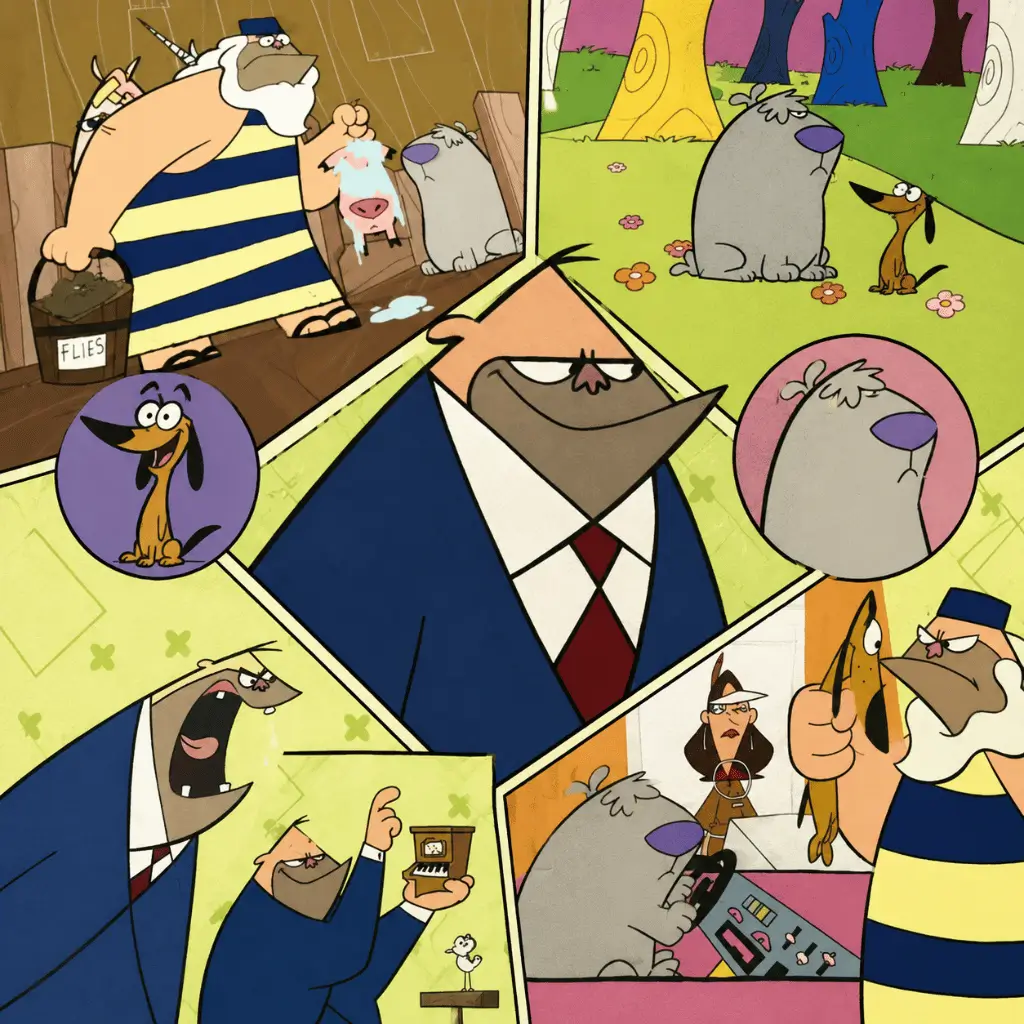
Mr. Hollywood was not a conventional cartoon villain. He was a recurring authority figure who seemed to have a different job every time the dogs met him.
Whether he was working as a teacher, farmer, casino manager or pet-shop owner, the routine was usually the same. He would notice something the dogs had done, pause just long enough for the scene to go quiet and then deliver the show’s most famous line.
BUT IT’S WRONG!
Brian Cummings gave the character a booming voice that made the punchline impossible to miss. The foghorn only made it louder.
The joke worked because Mr. Hollywood treated every tiny mistake as a major offence. He turned adult certainty and authority into something ridiculous.
Barking Up the Character Tree
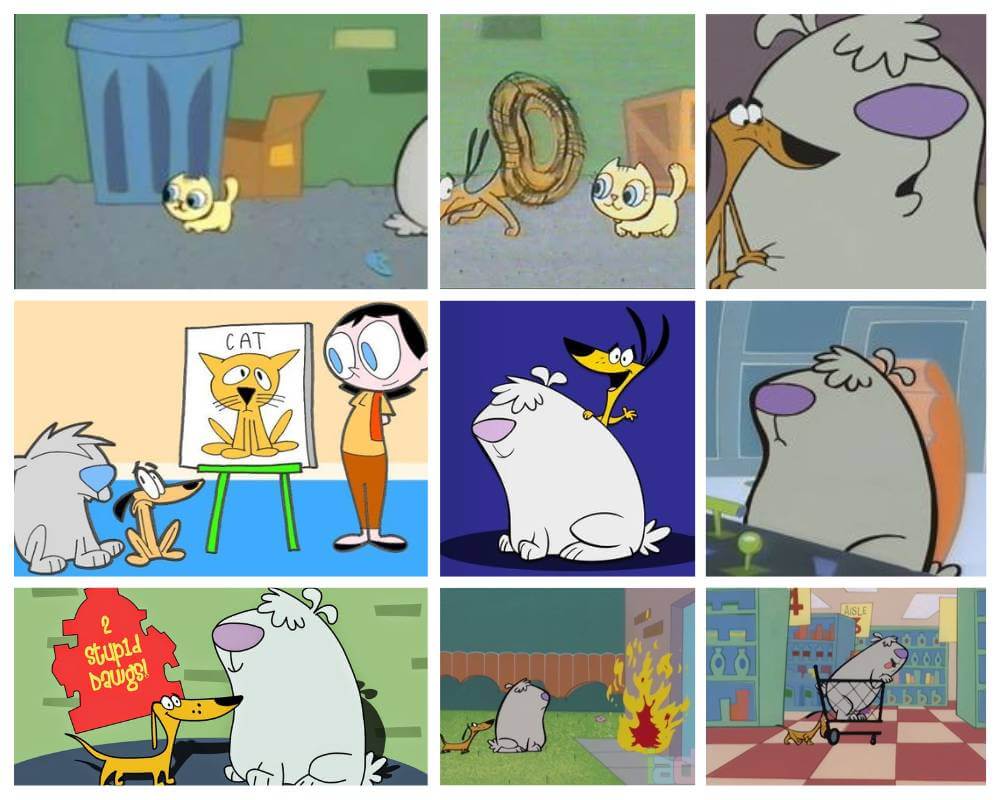
Big Dog and Little Dog carried the series, but the supporting cast gave them a steady supply of strange people, animals and situations to misunderstand.
Voice Actor Trivia: Brad Garrett voiced Big Dog several years before Everybody Loves Raymond made him a television star. Comedian Mark Schiff supplied Little Dog’s fast, anxious delivery.
The Main Stars
The Supporting Cast
The Lasting Pawprint of 2 Stupid Dogs
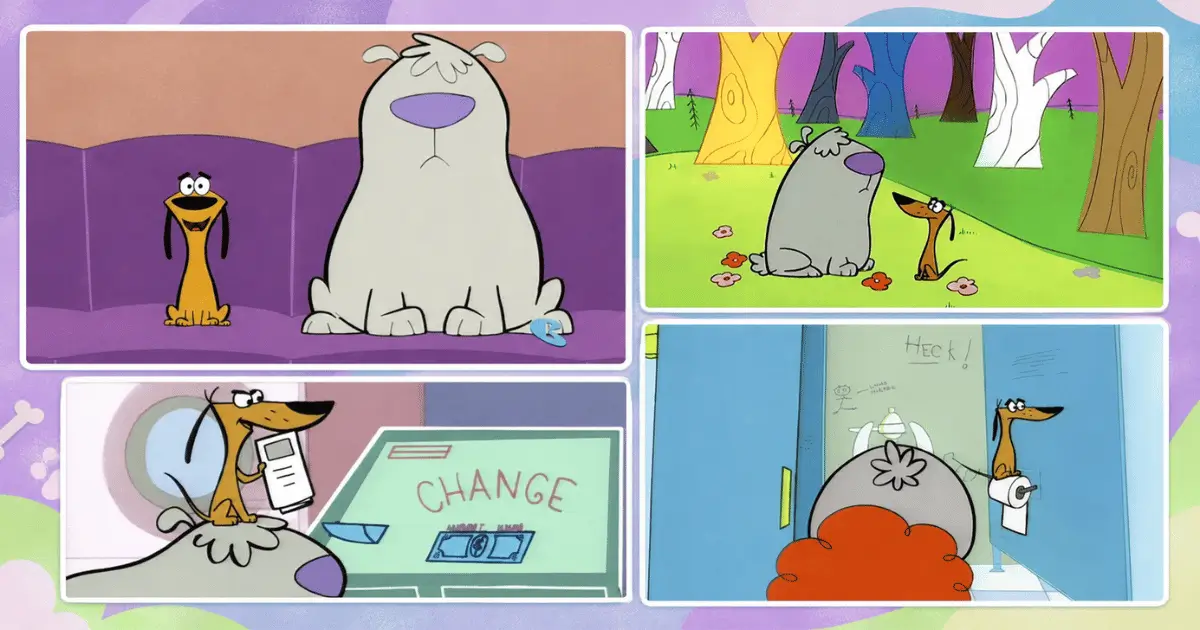
Looking back, 2 Stupid Dogs was more than a brief piece of 1990s weirdness. It helped connect the older, production-line era of Hanna-Barbera cartoons with the creator-driven shows that followed.
The series was Fred Seibert’s first greenlight at the studio, and its crew included artists who later became central to Cartoon Network, Nickelodeon and Disney television animation. Rob Renzetti’s official biography, for example, identifies 2 Stupid Dogs as his first Hanna-Barbera storyboard job.
That does not mean the show rescued Hanna-Barbera by itself. Its real importance is that it helped prove the studio could still attract young talent, take visual risks and produce something that did not feel like another recycled franchise.
It also proved that a cartoon did not need complicated plots or overloaded artwork to be memorable.
Sometimes, two clueless dogs, a foghorn and one perfectly timed reaction are enough.
Over to You: What’s Your Favorite Memory?
Were you team Big Dog or team Little Dog? Did you ever shout “BUT IT’S WRONG!” after watching the show? Share your favorite memory in the comments below.