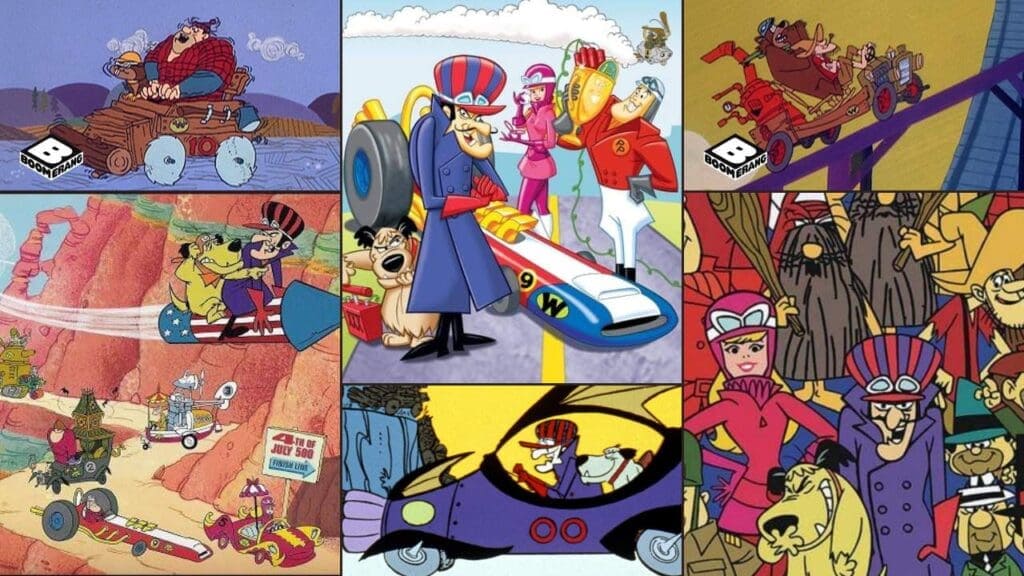
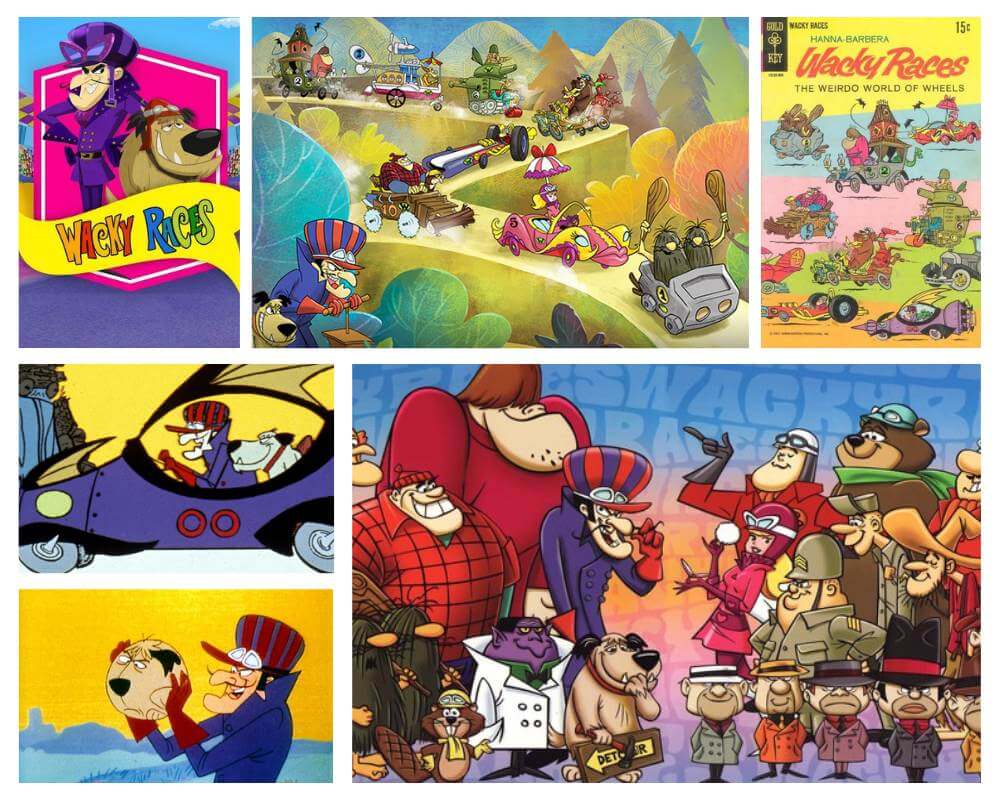
Wacky Races is a Hanna-Barbera animated series that originally aired on CBS from 1968 to 1969.
The premise is beautifully simple: 11 ridiculous cars, each driven by an equally strange team, race across a changing series of courses while Dick Dastardly tries to sabotage everyone in sight.
Most articles introduce the drivers and leave it there. I wanted to take the idea one step further.
What happens when you treat Wacky Races like a real motorsport season and count every first-, second-, and third-place finish across all 34 race segments?
I went through the results, built an unofficial podium table, and then ranked the cars that made the original series so memorable.
The Official Wacky Races Standings
The original series contains 34 individual race segments, but it never names an overall season champion.
The narrator announces the first three finishers after each race, yet the results are never combined into an official championship table.
That leaves enough information to build an unofficial one.
Under a simple system based on total podium finishes, Dick Dastardly ends the season without a single top-three result, while the rest of the field is surprisingly competitive.
Here is how the teams rank by total podium appearances:
| Car # | Vehicle & Drivers | 1st | 2nd | 3rd | Total Podiums |
|---|---|---|---|---|---|
| #1 | Boulder Mobile (The Slag Brothers) | 3 | 8 | 3 | 14 |
| #10 | Buzzwagon (Rufus Ruffcut & Sawtooth) | 3 | 6 | 4 | 13 |
| #2 | Creepy Coupe (The Gruesome Twosome) | 3 | 3 | 6 | 12 |
| #7 | Bulletproof Bomb (The Ant Hill Mob) | 4 | 5 | 2 | 11 |
| #5 | Compact Pussycat (Penelope Pitstop) | 4 | 2 | 5 | 11 |
| #4 | Crimson Haybaler (The Red Max) | 3 | 4 | 3 | 10 |
| #3 | Convert-a-Car (Prof. Pat Pending) | 3 | 2 | 5 | 10 |
| #8 | Arkansas Chuggabug (Luke & Blubber Bear) | 4 | 1 | 4 | 9 |
| #9 | Turbo Terrific (Peter Perfect) | 4 | 2 | 2 | 8 |
| #6 | Army Surplus Special (Blast & Meekly) | 3 | 1 | 0 | 4 |
| #00 | Mean Machine (Dastardly & Muttley) | 0 | 0 | 0 | 0 |
The result needs one important explanation. The Slag Brothers lead the table with 14 podiums, but only three of those finishes were victories. Their advantage comes from eight second-place results, more than any other team recorded.
If the championship is decided by wins alone, the title becomes a four-way tie. The Ant Hill Mob, Penelope Pitstop, Lazy Luke, and Peter Perfect each won four races.
My vote still goes to the Boulder Mobile.
Finishing in the top three in 14 of 34 races is the strongest record of consistency in the series. There is also something wonderfully appropriate about a rolling boulder becoming the most dependable machine on the grid.
Tier 1: The Podium Dominators
These are the most consistent teams in the series. They may not own the most victories, but they appear near the front of the finishing order more often than anyone else.
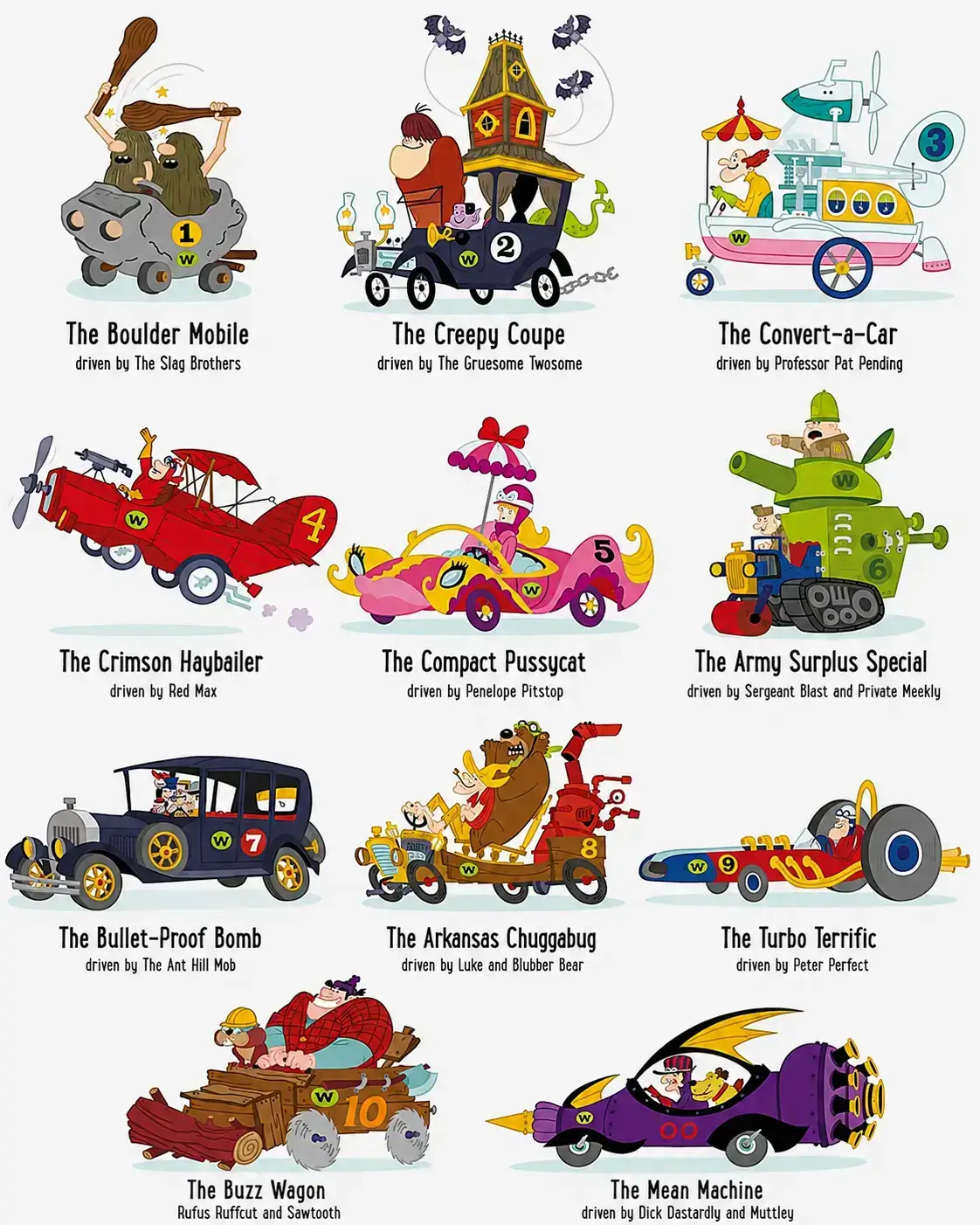
Car #1: The Boulder Mobile (Rock Slag and Gravel Slag)
Rock Slag and Gravel Slag drive the Boulder Mobile, car #1. The vehicle is exactly what its name suggests: a giant rolling rock powered by two cavemen and their clubs.
The Boulder Mobile records 14 podium finishes, the highest total in this ranking. Even destroying it rarely helps the competition, because the brothers can hammer a nearby boulder into a replacement. They also call on prehistoric creatures, including a pteranodon, whenever the race demands it.
The pairing works because the brothers are less like drivers and more like a two-man pit crew from the Stone Age.
Car #10: The Buzzwagon (Rufus Ruffcut and Sawtooth)
The #10 Buzzwagon is built almost entirely from logs and rolls on circular saw blades instead of ordinary wheels. Rufus Ruffcut supplies the lumberjack muscle, while his beaver partner, Sawtooth, handles much of the cutting.
Those blades allow the pair to carve through trees, barriers, and occasionally another racer’s vehicle. The Buzzwagon is especially effective against the Boulder Mobile, although the Slag Brothers usually rebuild before the advantage lasts very long.
Car #2: The Creepy Coupe (Big Gruesome and Little Gruesome)
Big Gruesome, voiced by Daws Butler, and Little Gruesome race in the horror-themed Creepy Coupe. The #2 car resembles a hearse topped with a small belfry and carries an entire collection of monsters inside.
Depending on the problem, the Gruesome Twosome can release bats, ghosts, or a fire-breathing dragon. The dragon can even provide enough thrust to lift the car briefly into the air. It is less a racing vehicle than a haunted house that happens to have wheels.
Tier 2: The Victory Chasers
Tier 1 rewards consistency. This group rewards outright victories.
These four teams share the series lead with four wins each, although they reached the remaining podium positions less often than the cars ranked above them.
Car #7: The Bulletproof Bomb (The Ant Hill Mob)
The Ant Hill Mob races in the #7 Bulletproof Bomb, a compact gangster car driven by Clyde and packed with his six pint-sized partners.
Their best-known speed boost is “getaway power.” The gang sticks its feet through the floor and runs beneath the car, turning a mob getaway into a Flintstones-style engine. In the opening race, “See-Saw to Arkansas,” they also disguise themselves as the Seven Dwarfs while trying to avoid a police officer.
The joke is always the same, but it works: seven tiny gangsters somehow operate like one very disorganized machine.
Car #5: The Compact Pussycat (Penelope Pitstop)
Penelope Pitstop is the only woman in the original starting lineup, and she drives the #5 Compact Pussycat.
Her car doubles as a mobile beauty salon, complete with automated grooming tools, sprays, and an ejector seat for unwanted passengers. The design could easily have reduced Penelope to a single joke, but she is also one of the strongest racers in the field. Her four victories tie the series record.
Iwao Takamoto and Jerry Eisenberg helped shape Penelope and her unmistakable pink car, creating one of the few racers whose popularity quickly grew beyond the original show.
Car #8: The Arkansas Chuggabug (Lazy Luke and Blubber Bear)
The #8 Arkansas Chuggabug is little more than a wooden platform with a pot-bellied stove mounted at the back. Lazy Luke steers with his bare feet while Blubber Bear rides beside him.
The vehicle looks too primitive to finish a race, let alone win four of them. That is part of the joke. Luke solves mechanical problems with whatever is nearby, including animals, improvised fuel, and a level of calm that makes every other driver look exhausted.
Car #9: The Turbo Terrific (Peter Perfect)
The #9 Turbo Terrific looks like the most conventional racing car in the lineup, but it has one major flaw: it regularly falls apart, often just after Peter Perfect praises its construction.
Peter is confident, polite, and hopelessly impressed with both himself and Penelope Pitstop. Their light romantic subplot gives him something to do between breakdowns. Despite the car’s poor reliability, he still wins four races, which says as much about Peter’s luck as it does about his driving.
Tier 3: The Midfield Specialists
These machines have some of the most inventive designs in the field, but their results place them firmly in the middle of the unofficial standings.
Car #4: The Crimson Haybaler (The Red Max)
Red Max, voiced by Daws Butler, drives the #4 Crimson Haybaler. The vehicle combines a race car with a First World War biplane and can manage short bursts of flight when the road becomes inconvenient.
Its front propeller provides speed, lift, and the occasional cutting tool. Red Max himself is a broad parody of the daring flying ace, with a name that combines the Red Baron image with the famous “Blue Max” nickname.
He wins three races and earns ten podiums, making him competitive even when his airborne shortcuts fail.
Car #3: The Convert-a-Car (Professor Pat Pending)
Professor Pat Pending drives the #3 Convert-a-Car, the most adaptable vehicle in the competition. It can transform into almost anything the course requires, including a motorcycle, boat, flying carpet, blimp, or rocket.
The car gives Pat Pending an answer for nearly every obstacle, although the invention often takes longer than simply driving around the problem. Even so, three wins and ten podiums give him a respectable place in the middle of the table.
Car #6: The Army Surplus Special (Private Meekly and Sergeant Blast)
The #6 Army Surplus Special combines a tank, a Jeep, and a small steamroller. Sergeant Blast gives the orders, while Private Meekly usually absorbs the consequences.
Its rotating cannon can fire in either direction, although the ammunition is often more comic than military. The vehicle records three victories but only one additional podium, giving it the strangest results in the field: dangerous enough to win, yet rarely close when it does not.
Tier 4: The Zero-Point Tragedy

Car #00: The Mean Machine (Dick Dastardly and Muttley)
Finally, there is Dick Dastardly and his snickering partner Muttley in the deep-purple Mean Machine.
The #00 car is packed with rockets, traps, hidden devices, and enough speed to move Dastardly near the front whenever the story requires it. The problem is not the vehicle. It is the driver.
Dastardly and Muttley finish the series with exactly zero wins and zero podiums.
Dastardly repeatedly gains a strong position, then abandons the race to build a trap for everyone behind him. The plan fails, the field passes him, and Muttley laughs as the Mean Machine falls apart.
He comes closest in “Creepy Trip to Lemon Twist.” Dastardly appears to cross the finish line first, but a replay shows him extending the nose of the Mean Machine. The judges disqualify him and award the victory to Penelope Pitstop.
It is easy to understand why viewers sometimes feel sorry for him. The Mean Machine is clearly capable of competing, and Dastardly’s schemes are often more work than simply finishing the race.
That is the real tragedy of car #00.
Dastardly does not lose because every opponent is faster. He loses because he cannot stop cheating long enough to win.
Wacky Races’ Timeless Humor
Wacky Races relies on a simple style of comedy: quick slapstick, oversized reactions, and one absurd roadside problem after another.
The cast keeps that formula alive.
Dick Dastardly supplies the theatrical frustration, usually ending a failed plan with some variation of “Drat! Drat! And double drat!” Muttley barely needs words at all. His wheezing snicker tells us exactly what he thinks of his partner.
The names add another layer. Characters such as Professor Pat Pending and Peter Perfect sound like jokes before they even enter the race, while locations such as Lemon Twist and Upsan Downs give every course the rhythm of a comic strip.
Beneath the noise, the series also delivers one dependable lesson: Dastardly works much harder at cheating than everyone else works at winning.
Wacky Races: Episode Guide & Voice Cast
Quick Production Facts
- First Episode Date: September 14, 1968 (USA)
- Network: CBS
- Final Episode Date: January 4, 1969
- Spin-offs: Dastardly and Muttley in Their Flying Machines, The Perils of Penelope Pitstop
- Composer: Hoyt Curtin
Episodes of Wacky Races (17 Double-Segment Episodes)
- See-Saw to Arkansas / Creepy Trip to Lemon Twist
- Why Oh Why Wyoming / Beat the Clock to Yellow Rock
- Mish Mash Missouri Dash / Idaho a Go-Go
- The Baja-Ha-Ha Race / Real Gone Ape
- Scout Scatter / Free Wheeling to Wheeling
- By Rollercoaster to Upsan Downs / The Speedy Arkansas Traveler
- The Zippy Mississippi Race / Traffic Jambalaya
- Hot Race at Chillicothe / The Wrong Lumber Race
- Rhode Island Road Race / The Great Cold Rush Race
- Wacky Race to Ripsaw / Oils Well That Ends Well
- Whizzin’ to Washington / The Dipsy Doodle Desert Derby
- Eeny, Miny Missouri Go! / The Super Silly Swamp Sprint
- The Dopey Dakota Derby / Dash to Delaware
- Speeding for Smogland / Race Rally to Raleigh
- Ballpoint, Penn. or Bust! / Fast Track to Hackensack
- The Ski Resort Road Race / The Overseas Hi-Way Race
- Race to Racine / The Carlsbad or Bust Bash
Voice Cast
- Daws Butler – Peter Perfect, Sergeant Blast, Big Gruesome, Rock Slag, Rufus Ruffcut, and Red Max
- Don Messick – Muttley, Little Gruesome, Gravel Slag, Professor Pat Pending, Sawtooth, and Ring-a-Ding
- John Stephenson – Lazy Luke and Blubber Bear
- Janet Waldo – Penelope Pitstop
- Paul Winchell – Dick Dastardly, Clyde, and Private Meekly
- Dave Willock – The Narrator/Announcer
The Post-Race Debrief: Why the 1968 Season Still Holds Pole Position
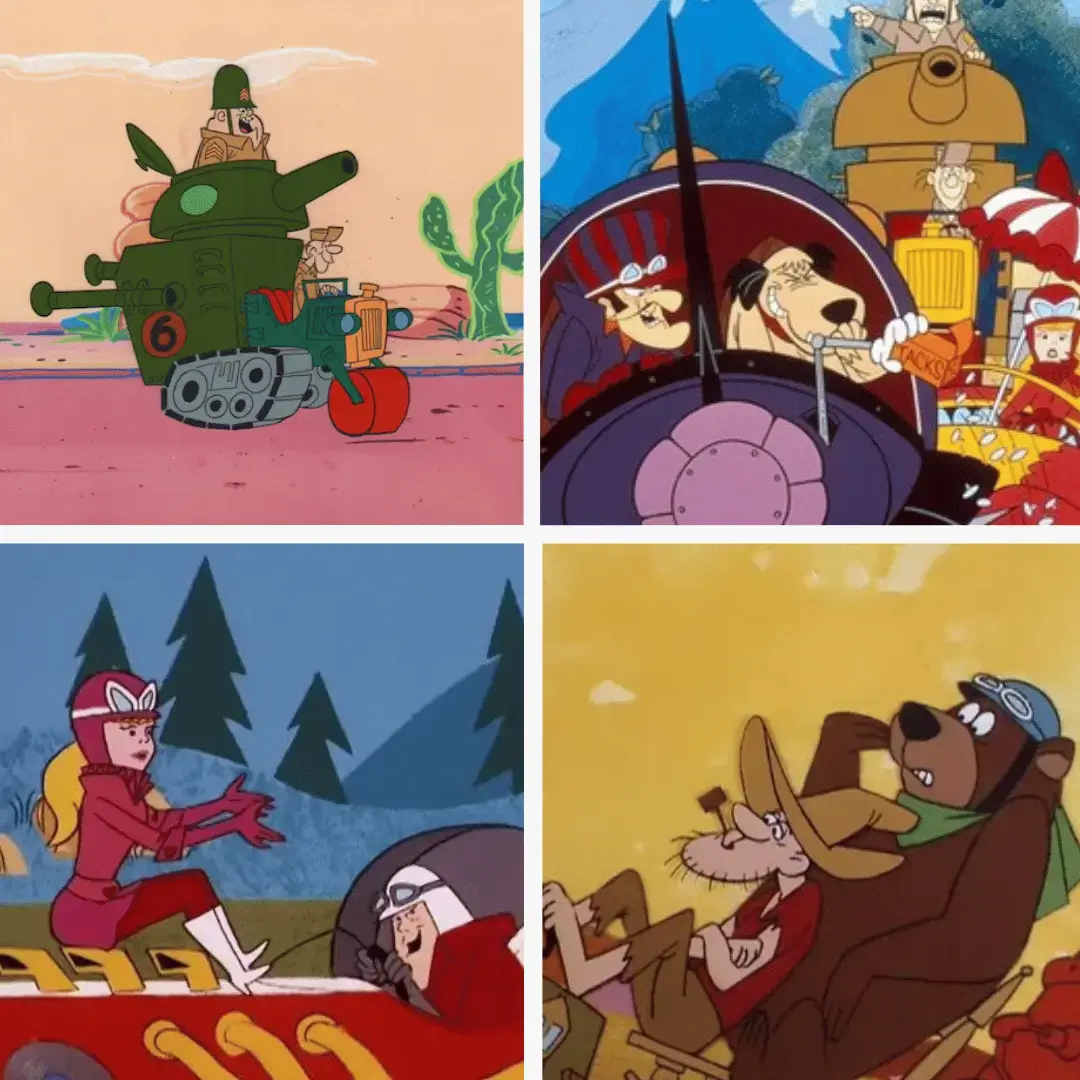
Strip away the childhood nostalgia and Wacky Races still has to answer the same question as any other cartoon: does it hold up?
For me, the answer is yes. Not every race feels fresh, but the designs, voices, and comic timing remain strong enough to carry the formula.
Visual Horsepower: The Genius of Iwao Takamoto
The real engine of the show is its character and vehicle design, shaped by artists including Iwao Takamoto and Jerry Eisenberg. A racing cartoon has an obvious problem: eleven cars can easily become eleven moving shapes that all look the same.
Wacky Races solves that problem through silhouette.
Remove the color and the Creepy Coupe, Compact Pussycat, and Boulder Mobile are still instantly recognizable. Each vehicle explains its driver before anyone speaks.
Hanna-Barbera relied heavily on limited-animation shortcuts, including repeated backgrounds and recycled movement. The show makes those limits less noticeable by giving the cars so much personality. Even when the scenery repeats, the machines never feel interchangeable.
The movement is simple, but the poses are clear, the reactions are readable, and the visual jokes arrive quickly.
The Sound of the Engine: Brassy Jazz and Iconic Snickers
The sound is just as important as the artwork. Hoyt Curtin’s fast, brassy score gives the races energy even when the animation is repeating a background or holding a pose.
Dave Willock’s rapid narration keeps the action moving and gives the series the feel of a sports broadcast that has completely lost control.
Then there is Don Messick’s performance as Muttley. The character’s low, wheezing laugh communicates mockery, annoyance, and satisfaction without needing a full sentence.
Giving a sidekick that much personality through one sound is difficult. It is also a major reason Muttley became more famous than many of the racers who actually won.
The Endurance Test: Repetition Done Right
The obvious weakness is repetition. Most races follow the same basic pattern: Dastardly moves ahead, stops to build a trap, watches it backfire, and loses while another team reaches the podium.
That structure can feel predictable when several episodes are watched in a row.
At the same time, predictability is part of the appeal. Wacky Races is comfort viewing, closer to a familiar comic strip than a continuing adventure.
The destination rarely matters. The fun comes from seeing what unnecessary machine Dastardly builds next and how quickly it collapses on top of him.
The Final Verdict: Still in the Race. Wacky Races takes one simple premise and gets an impressive amount of comedy from it. The stories repeat, but the cars remain distinctive, the voices are memorable, and the pace rarely slows. It is easy to see why the series became one of Hanna-Barbera’s most recognizable creations.
Who is Your Champion?
Do you give the championship to the Slag Brothers for consistency, or to one of the four teams tied for the most victories? And should Dick Dastardly’s disqualified finish count for anything?
Drop your pick in the comments below. And if you want more high-speed animated action, check out our roundup of the best cars and racing anime.