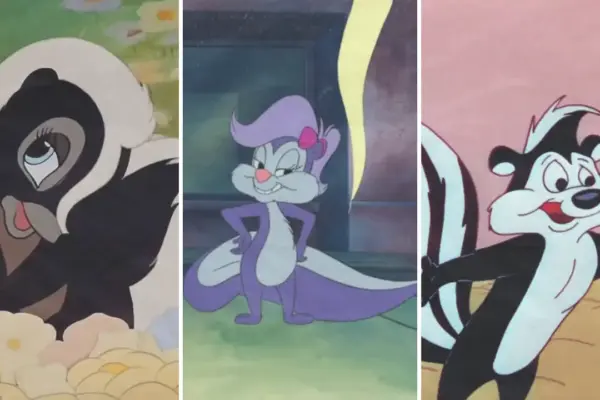
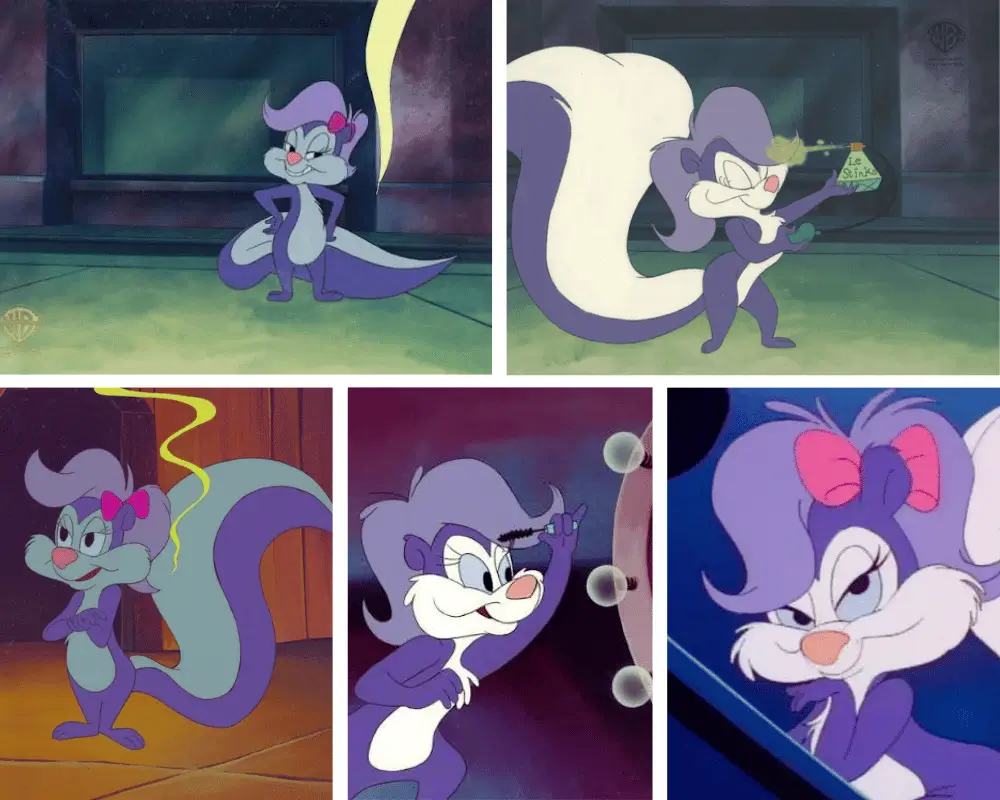
Fifi La Fume is the purple-and-white skunk from Tiny Toon Adventures, and most descriptions reduce her to one sentence: she is the female version of Pepé Le Pew.
That is accurate, but it misses what makes her memorable.
Fifi inherits Pepé’s French accent, overpowering scent and habit of pursuing anyone she mistakes for another skunk. The difference is that the original series sometimes lets her recognize rejection, feel embarrassed and become genuinely upset.
She is still part of the same uncomfortable chase-gag tradition. She is simply written with more emotional range than the character who inspired her.
That extra layer helped Fifi become more than a one-joke parody.
Fifi La Fume at a glance
- Series: Tiny Toon Adventures
- Species: Skunk
- Home: An abandoned Cadillac in the Acme Acres junkyard
- School: Acme Looniversity
- Original voice: Kath Soucie
- Looniversity voice: Marieve Herington
- Character inspiration: Pepé Le Pew
- Clearest mutual love interest: Hamton J. Pig
Who Is Fifi La Fume?
Fifi La Fume is a recurring student character from Tiny Toon Adventures, the Warner Bros. Animation and Amblin Entertainment series developed by Tom Ruegger and executive produced by Steven Spielberg.
The original show debuted on September 14, 1990, and produced 98 episodes across three seasons.
Fifi attends Acme Looniversity, where the younger characters learn the art of cartoon comedy from established Looney Tunes stars.
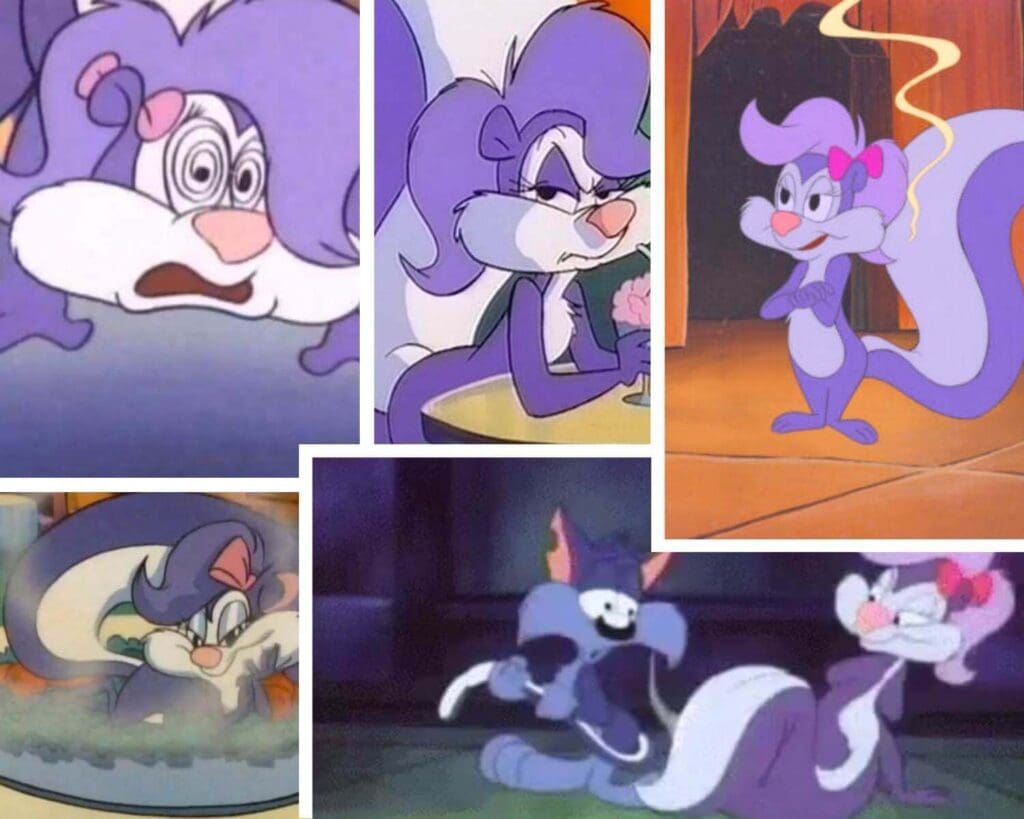
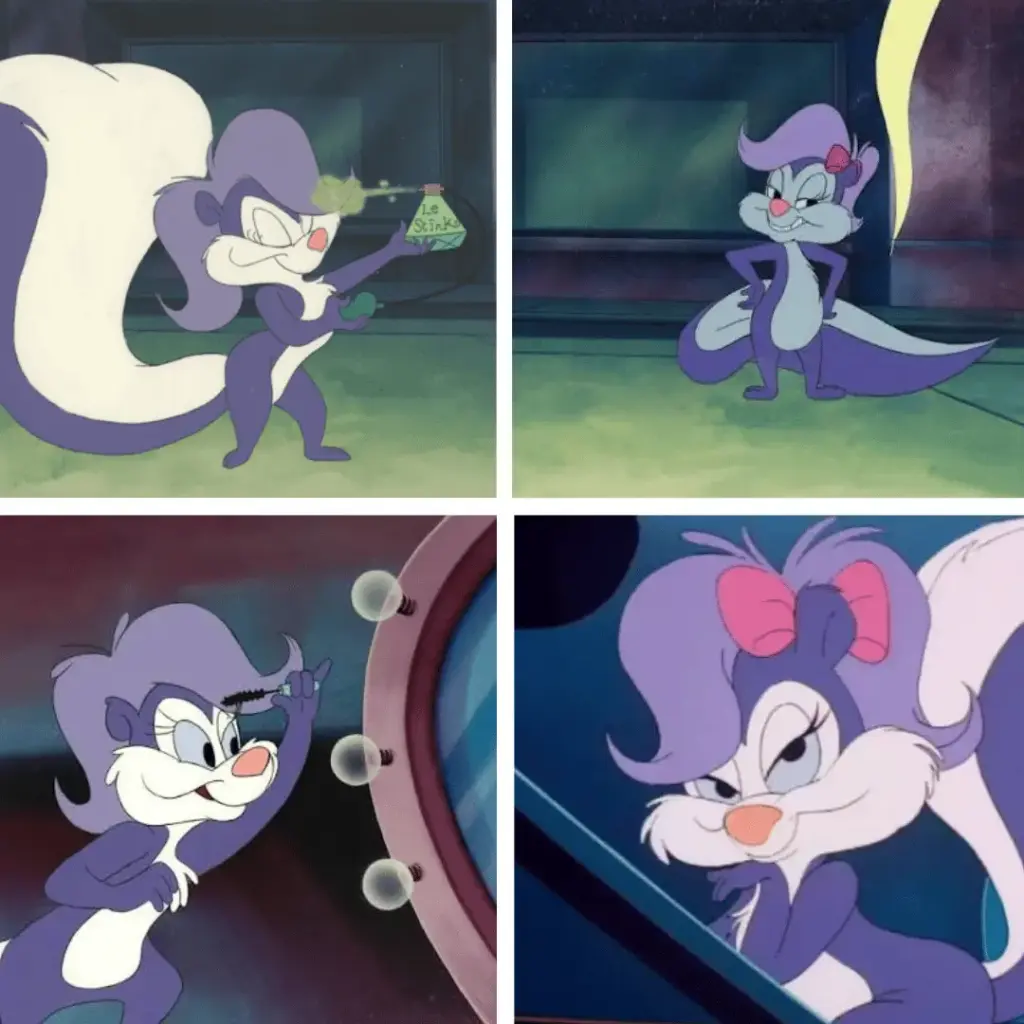
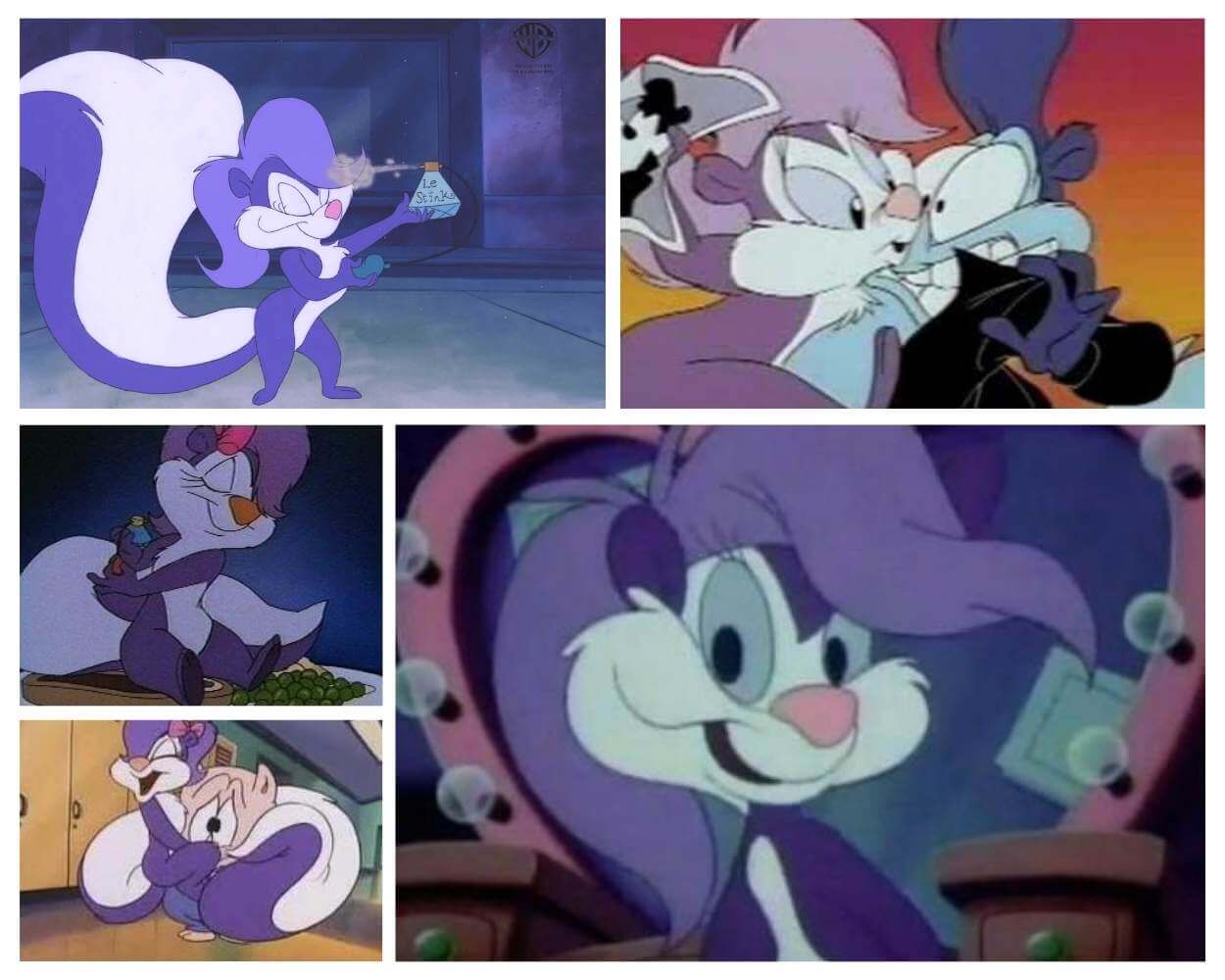
Her design is easy to recognize:
- Purple-and-white fur instead of a real skunk’s black-and-white coloring
- A large pink bow that pulls part of her hair across one eye
- A small body dominated by an enormous striped tail
- A glamorous, romantic look that contrasts with her junkyard home
The oversized tail does most of the visual work.
It identifies her species, supplies physical comedy and can be used as a pillow, scarf, snare or dramatic prop depending on the scene.
Who voices Fifi La Fume?
- Kath Soucie voiced Fifi in the original series, specials and related productions.
- Marieve Herington voices the redesigned character in Tiny Toons Looniversity.
Soucie gave the original Fifi an exaggerated French accent and a breathless romantic delivery. Herington uses a French-Canadian characterization in the reboot.
Fifi La Fume and Pepé Le Pew
The Pepé Le Pew influence is impossible to miss.
Both characters:
- Speak with exaggerated French or French-influenced accents
- Fall in love immediately
- Pursue animals who appear to have skunk stripes
- Misread escape attempts as romantic hesitation
- Produce an odor that drives nearly everyone away
Fifi is not simply Pepé with the gender reversed, however.
The original series gives her moments of hurt and disappointment. When a potential boyfriend escapes, she may cry or wonder what went wrong. Other characters occasionally feel guilty after seeing how upset she becomes.
That does not erase the consent problem built into the chase gag. Furrball and Calamity Coyote are clearly trying to escape her, and Fifi usually interprets that panic as playing hard to get.
The important difference is narrower: the writers let Fifi have an emotional reaction once the joke ends.
My take
Fifi is more sympathetic than Pepé, but she is not a complete correction of the formula. The show improves the character by giving her feelings; it does not fully question the pursuit itself.
The White-Stripe Gag Behind Her Best-Known Episodes
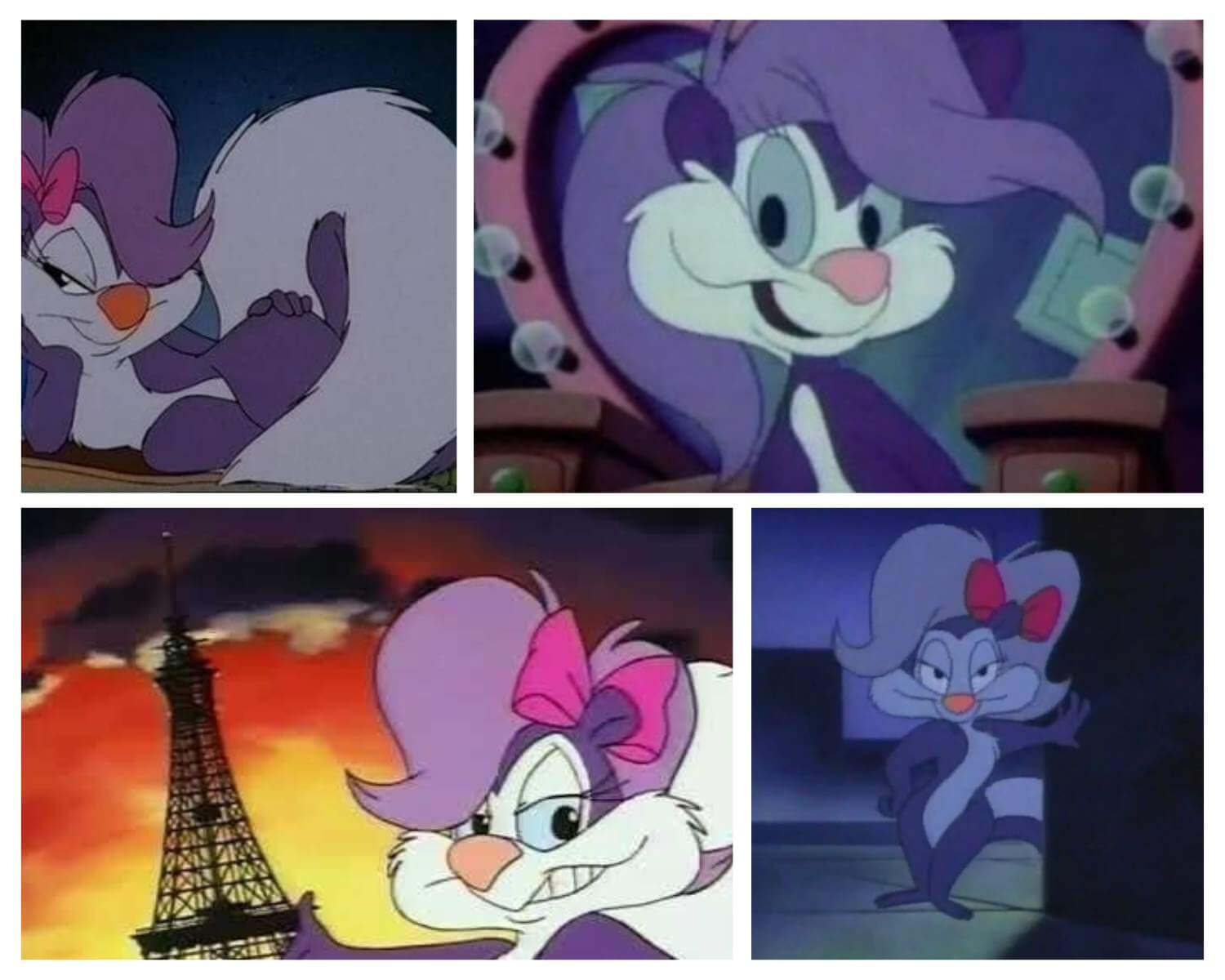
Fifi’s best-known romantic stories begin when another animal accidentally acquires a white stripe.
She sees the stripe, assumes she has found a handsome male skunk and begins the chase.
The two clearest examples are:
- “Aroma Amore”: A street-painting vehicle leaves a white stripe down Furrball’s back.
- “Love Stinks”: Calamity Coyote is covered in black tar and white feathers after another failed attempt to catch Little Beeper.
In “Aroma Amore,” Furrball initially seems interested in Fifi before noticing her tail and smelling her scent. He then spends the rest of the segment trying to escape.
When Furrball finally removes the stripe, he sees how disappointed Fifi is. Feeling guilty, he redirects her attention toward the two alley cats who had been tormenting him.
“Love Stinks” uses the same setup with Calamity Coyote. At the end, Little Beeper is accidentally covered in the same skunk-like pattern, transferring Fifi’s attention to a new target.
Why the stripe gag worked
It created an immediate visual setup that children could understand without exposition: white stripe equals skunk, Fifi sees romance, and everyone else sees trouble.
Can Fifi La Fume Control Her Smell?
The original series is not perfectly consistent about how Fifi’s scent works.
In her romance-driven stories, the odor often becomes stronger when she is excited or attracted to someone. At other times, she can stand beside the rest of the cast without anyone reacting.
That flexibility allows her to participate in ordinary group scenes instead of turning every appearance into the same smell joke.
The series shows her using the scent in several ways:
- Driving other characters out of a room
- Melting or weakening objects during exaggerated gags
- Producing stronger fumes when emotionally excited
- Using her tail to direct or contain the effect
It is best to treat the odor as cartoon logic rather than a carefully defined superpower.
The intensity changes according to what the joke requires.
Why Fifi’s Tail Matters
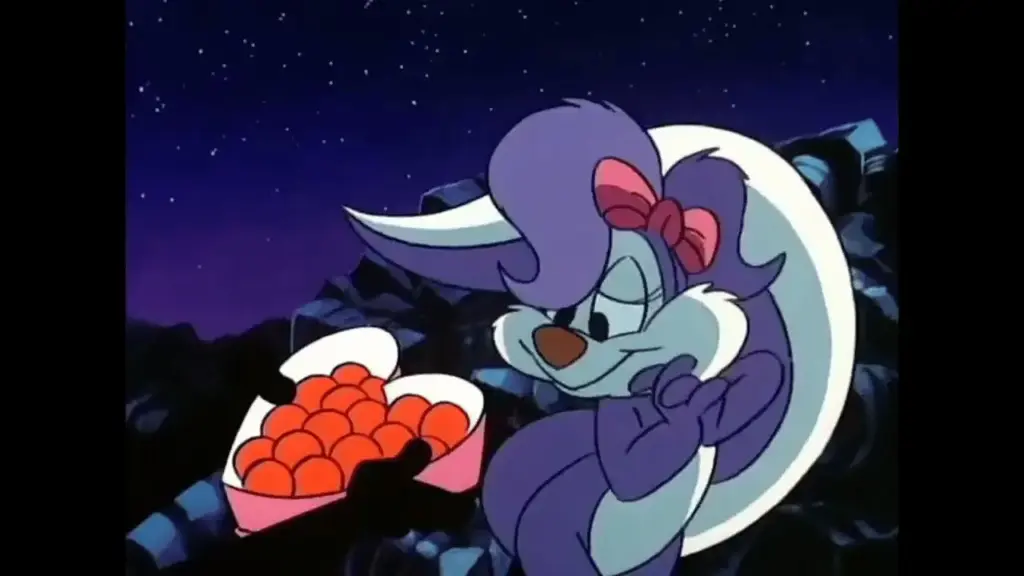
Fifi’s tail is not merely an identification mark.
It is almost a second character.
Animators use it to:
- Wrap around reluctant love interests
- Function as a pillow or blanket
- Frame her face during romantic poses
- Expand suddenly when she becomes emotional
- Fill the screen with scent clouds
Without the tail, Fifi would be a small purple character with a French accent.
With it, she has one of the clearest silhouettes in the supporting cast. The tail makes her look glamorous, dangerous and ridiculous at the same time.
Where Does Fifi La Fume Live?
Fifi lives in an abandoned Cadillac in the Acme Acres junkyard.
Reference guides commonly identify it as a late-1950s Cadillac, and the interior is shown as far roomier than the outside should allow.
Her home contains the usual signs of a romance-obsessed teenager:
- Romance novels
- A telephone
- Music and personal decorations
- A bed and dressing area
- Space to daydream about finding a boyfriend
The location creates one of the funniest contrasts in her design.
Fifi carries herself like a sophisticated French romantic heroine, but she lives inside a discarded car surrounded by scrap metal.
What the junkyard quietly adds
The show never turns Fifi’s circumstances into a serious storyline, but her home gives her a slightly scrappier quality than the glamorous accent and ribbon initially suggest.
Who Are Fifi La Fume’s Love Interests?
Fifi does not have one consistent boyfriend throughout the original series.
Most of her romantic stories involve brief crushes, mistaken identities or characters trying to escape her.
Her best-known love interests include:
- Furrball: Mistaken for a skunk after receiving a painted white stripe
- Calamity Coyote: Mistaken for a skunk after being covered in tar and feathers
- Little Beeper: Becomes her next target at the end of “Love Stinks”
- Johnny Pew: A real skunk and famous movie star
- Hamton J. Pig: Her clearest mutual romantic pairing
Johnny Pew, the Skunk Fifi Rejects
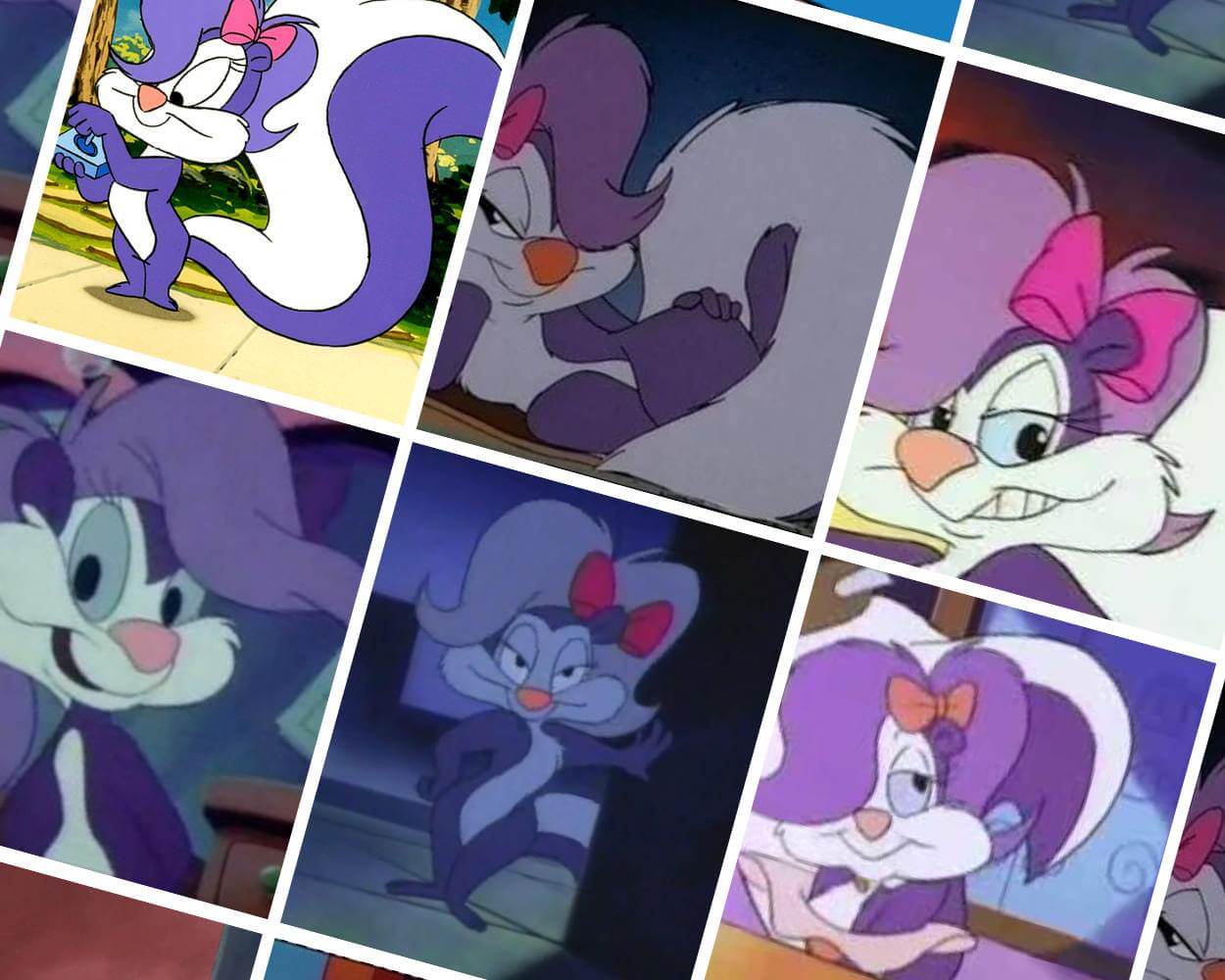
Johnny Pew appears in the 1992 animated film Tiny Toon Adventures: How I Spent My Vacation.
He is a famous blue skunk voiced by Rob Paulsen, and Fifi is determined to get his autograph.
After she reaches his hotel room, Johnny allows her to serve him and cater to his demands. Fifi initially accepts the treatment because she is starstruck.
The relationship changes when Johnny gives the autograph she wanted to another skunk named Bimbette.
Fifi finally recognizes that he is selfish and throws him out.
Why the Johnny Pew story matters
This time, Fifi is not rejected. She is the one who decides that the boy is not worth chasing. It is a small but satisfying reversal of her usual role.
Is Hamton J. Pig Fifi’s Boyfriend?
Hamton is the closest the original series comes to giving Fifi a mutual romantic partner.
In “Prom-ise Her Anything,” Hamton nervously tries to ask her to the Acme Looniversity prom. Fifi initially dismisses the entire idea of a prom before realizing that Hamton is asking her personally.
She immediately accepts, wraps him in her tail and kisses him on the forehead.
The two attend the prom together.
That does not establish a permanent relationship, and later stories do not consistently treat them as an official couple.
Still, Hamton is different from the animals Fifi mistakes for skunks:
- He approaches her voluntarily.
- He is openly interested in her.
- She accepts rather than chasing him.
- The scene presents the attraction as mutual.
To me, that is why the pairing works better than the chase stories. Fifi does not need to overpower or misread anyone. Someone simply likes her and asks her out.
For more animated relationships, see my list of cartoon couples.
Fifi’s Friendships Outside the Romance Stories
Fifi is more than a collection of failed crushes.
She frequently appears with Babs Bunny and Shirley the Loon in group stories, school scenes and social situations.
Away from the romance plots:
- She joins Babs and Shirley during girls’ outings.
- She participates in school events and group performances.
- She appears alongside Buster, Plucky, Hamton and the larger cast.
- She can function as an ordinary friend without her odor driving the story.
Elmyra Duff is sometimes described as Fifi’s enemy, but “hazard” is more accurate.
Elmyra attempts to hug, capture and keep nearly every animal she meets. Her treatment of Fifi is part of that general obsession rather than a personal rivalry.
Fifi La Fume in Tiny Toons Looniversity
Fifi returned in Tiny Toons Looniversity.
The reboot premiered on Max on September 8, 2023, followed by its Cartoon Network debut on September 9. Steven Spielberg returned as an executive producer, with Erin Gibson and Nate Cash serving as showrunners.
This is a new continuity rather than a direct fourth season of the original cartoon.
The reboot places its cast at an actual university, with Babs, Buster, Hamton, Plucky and Sweetie presented as freshmen learning professional cartoon skills.
Fifi is a supporting student rather than part of the central five-character group.
Her updated version includes:
- A French-Canadian characterization
- Marieve Herington replacing Kath Soucie as her voice
- A black sweater added to her design
- A somewhat smaller and more controlled tail
- Far less emphasis on chasing unwilling love interests
The new series keeps her flirtatious confidence and dramatic personality without making romance her only function.
The reboot’s smartest change
It does not pretend the old pursuit gag never existed. It simply gives Fifi other things to do, allowing the character to remain recognizable without rebuilding every appearance around someone trying to escape her.
Why Fifi La Fume Feels Different Today
The romantic chase routine has aged unevenly.
Some viewers still see it as broad cartoon exaggeration. Others understandably find a character repeatedly pursuing frightened people uncomfortable, regardless of which gender is doing the chasing.
Both reactions are part of Fifi’s modern reputation.
The original show gives her more vulnerability than Pepé Le Pew, but it still treats refusal as part of the chase.
The reboot takes a quieter approach. It retains the accent, confidence, tail and skunk identity while reducing the behavior that now distracts from the rest of her personality.
That was probably the best way to handle her.
Fifi does not need to become a completely different character. She only needs enough room to be funny when she is not searching for a boyfriend.
For more characters from the same species, see my guide to skunk cartoon characters.
Why Fifi La Fume Remains Memorable
Fifi began as an obvious Pepé Le Pew reversal, but the details gave her a life beyond the premise.
She had:
- A recognizable purple-and-white design
- An oversized tail that could carry an entire gag
- A junkyard Cadillac that told its own story
- A voice performance that made every emotion enormous
- Enough vulnerability to make viewers feel sorry for her
She could be overbearing, ridiculous and difficult to defend in the middle of a chase.
She could also be funny, lonely and unexpectedly easy to root for.
That contradiction is more interesting than calling her “female Pepé Le Pew” and moving on.
Fifi La Fume lasted because the writers occasionally allowed the joke to stop and showed the teenager underneath it, a character who wanted somebody to like her back, even if she had a very poor understanding of how to make that happen.
For more purple animated characters, explore my guide to cartoon characters with purple hair and coloring.