
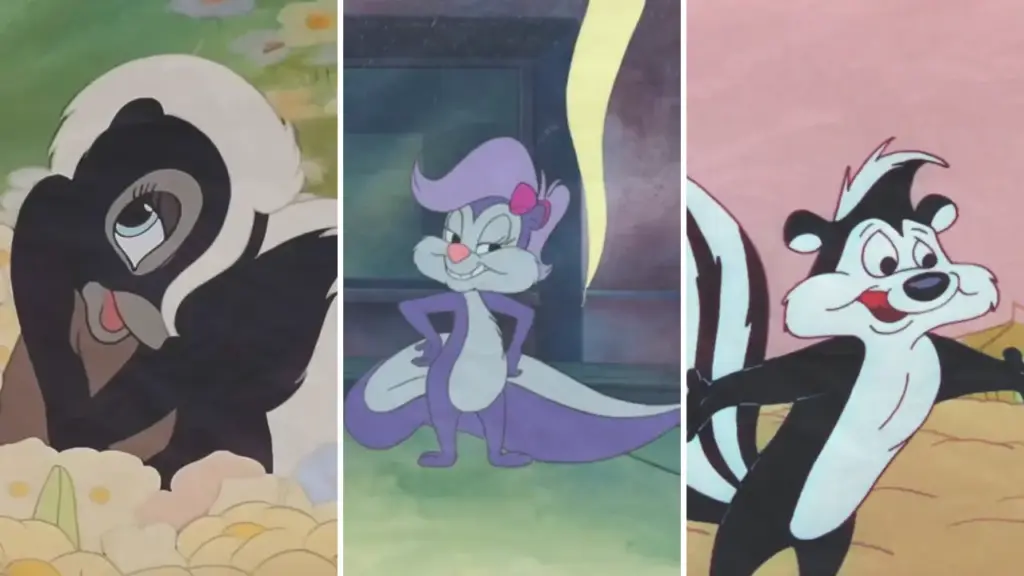
Skunk cartoon characters enter a scene with one major advantage: the audience already knows the joke.
Before the character says a word, we expect:
- A black-and-white stripe
- An enormous fluffy tail
- A smell powerful enough to clear a room
- Someone running in the opposite direction
The lazy approach is to repeat that joke.
The better approach is to ask what else a skunk can represent.
Some animators make the smell a superpower. Others turn it into a source of embarrassment, romance, confidence or social isolation. A few reject the stereotype completely and let the skunk behave like any other member of the cast.
That is what this list is about.
These are not simply the most famous skunk cartoon characters. They are the characters whose designs do something interesting with the expectations attached to the species.
Four ways cartoons use the skunk trope
- Embrace it: The odor becomes the character’s entire comic identity.
- Weaponize it: The spray becomes a defensive power or battle move.
- Reverse it: The skunk is obsessed with cleanliness, beauty or pleasant smells.
- Ignore it: The character is allowed to exist without constant odor jokes.
12 Skunk Cartoon Characters Ranked by Design
Stunky – Pokémon
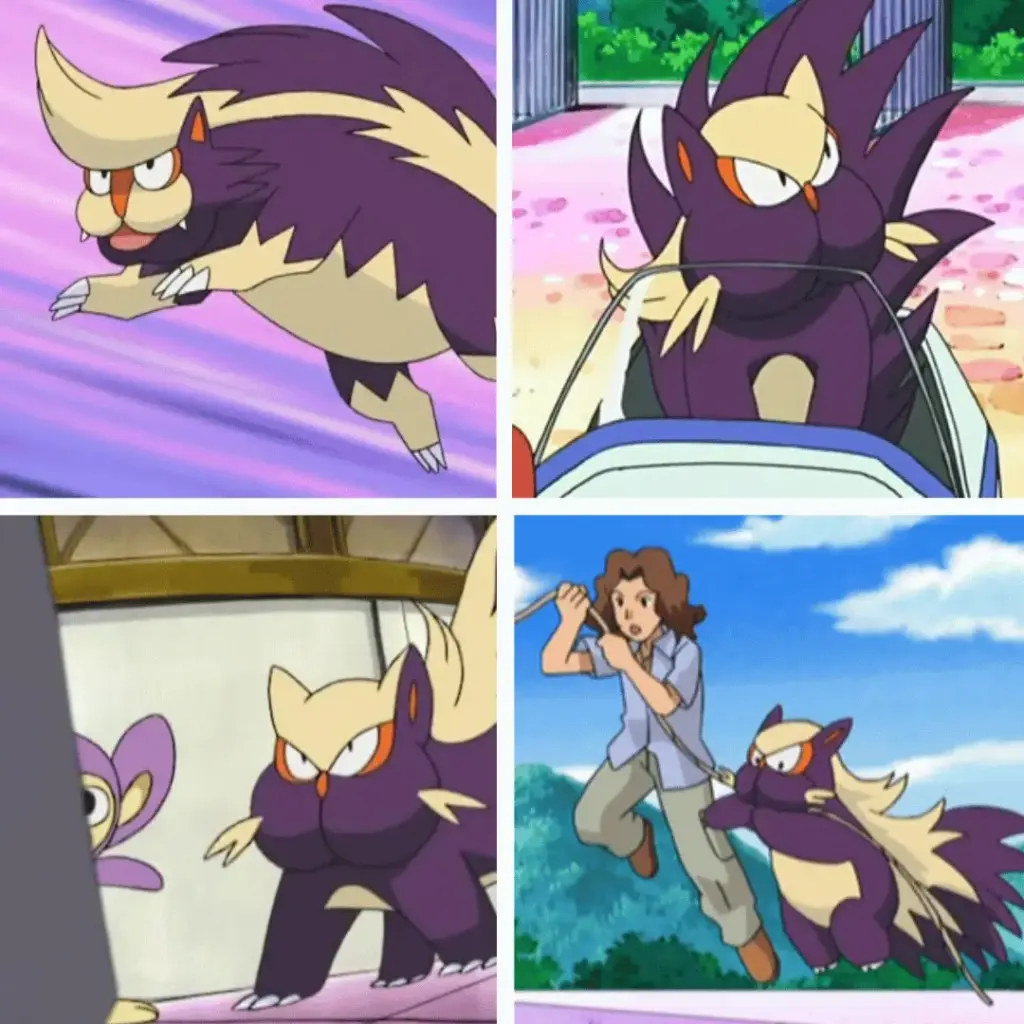
Trope strategy: Turn the smell into a battle mechanic
Stunky is less a traditional cartoon personality than a creature design built around the biology of a skunk.
Its raised rear, pointed face and curled tail communicate its defensive strategy immediately. Even someone unfamiliar with Pokémon can look at Stunky and understand which end of the creature is dangerous.
The official Pokémon Pokédex describes its spray as powerful enough to produce memory loss with a single whiff.
That is cartoon exaggeration, but it grows from recognizable animal behaviour rather than a romance gag.
- Visual signature: A purple body shaped around one permanently raised tail.
- Design move: The warning posture becomes part of the silhouette.
- Why it works: Stunky’s species determines its attacks, posture and personality at once.
Skinnet – LEGO Legends of Chima
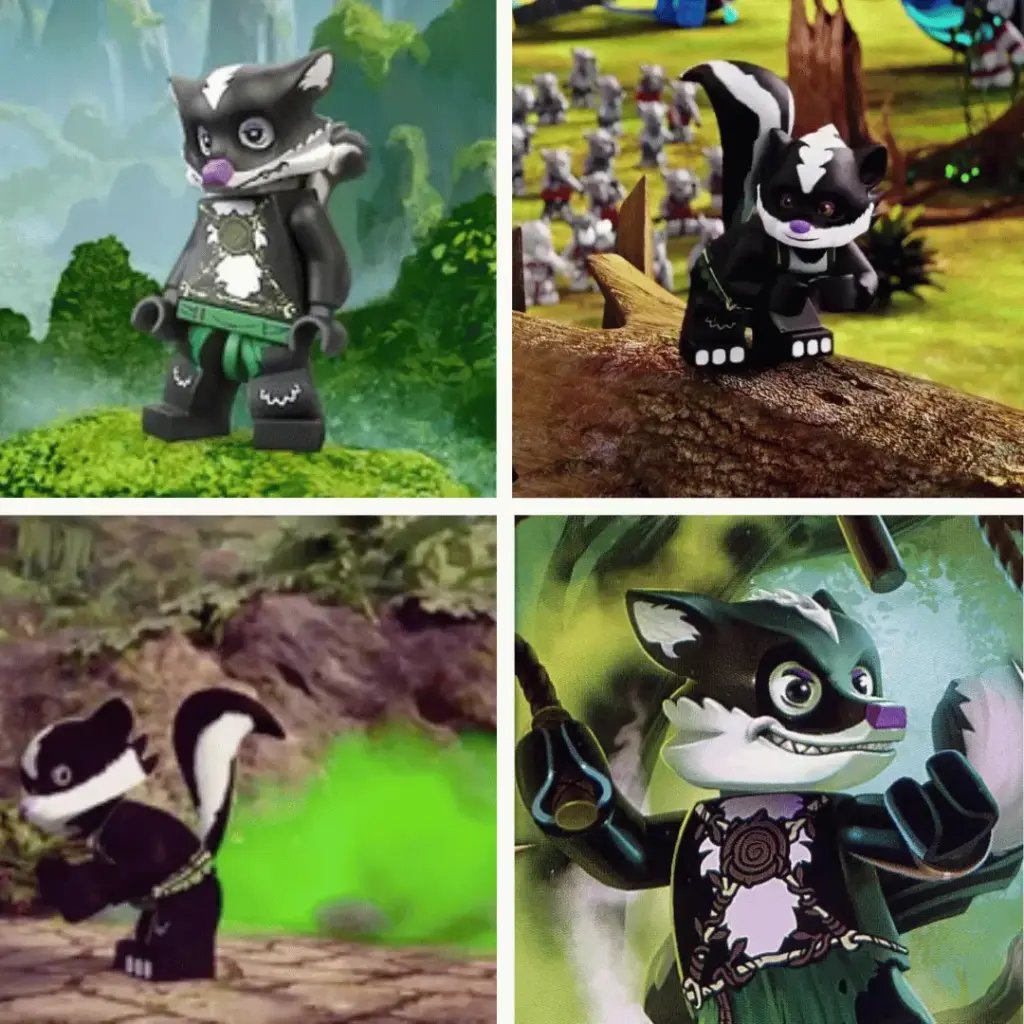
Trope strategy: Turn the stink joke into fantasy-world isolation
Skinnet brings a skunk into the armored animal fantasy of LEGO Legends of Chima.
His black-and-white head markings identify the species within the blocky limits of a LEGO minifigure. Armor, a tribal staff and a glowing CHI emblem suggest a conventional fantasy warrior, but the character’s odor prevents him from fitting comfortably into any tribe.
That contradiction is more interesting than the smell itself.
Skinnet possesses the costume and equipment of someone prepared to join an epic adventure, yet other characters frequently prefer that he remain at a distance.
- Visual signature: A skunk-striped LEGO head beneath fantasy armor.
- Design move: Heroic equipment is contrasted with slumped, lonely body language.
- Why it works: The odor becomes a reason for social isolation instead of only a punchline.
Priscilla Skunk – Sheriff Callie’s Wild West
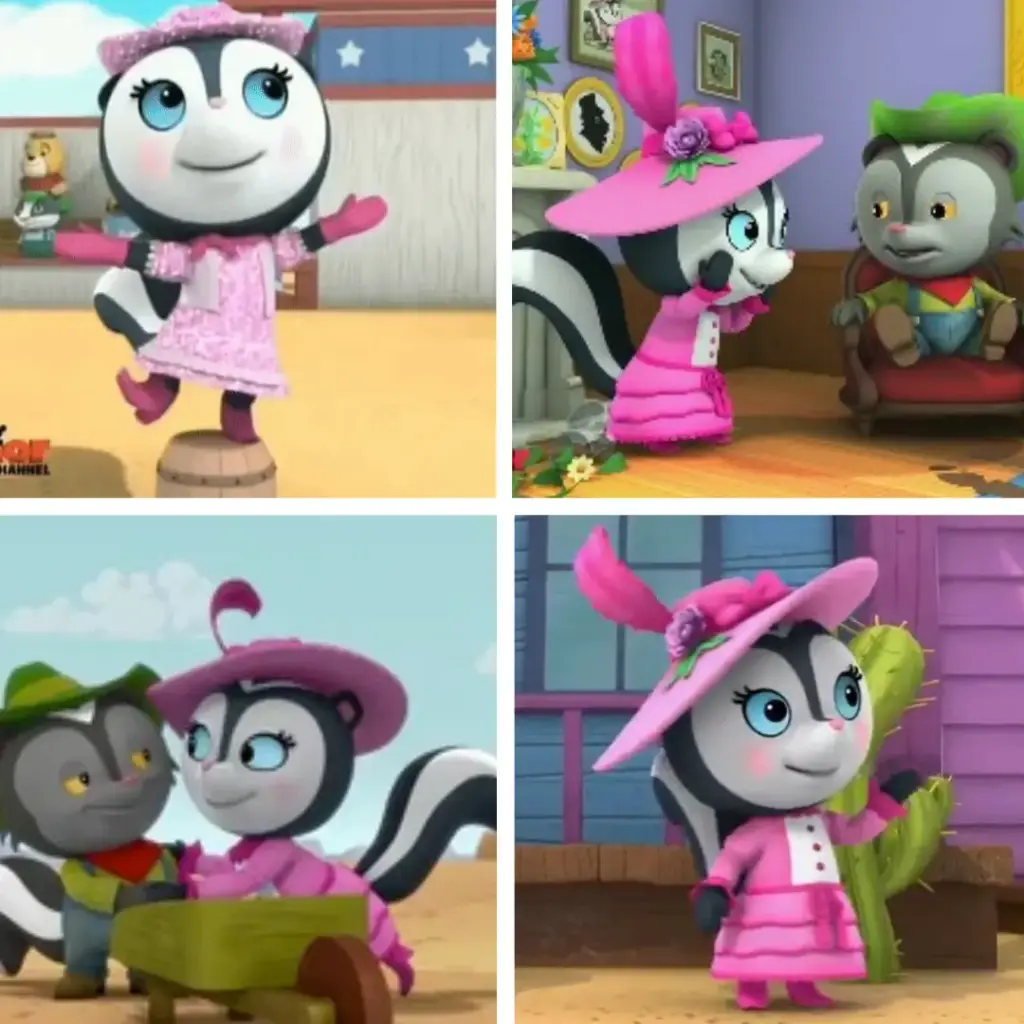
Trope strategy: Make the skunk the cleanest character in town
Priscilla Skunk creates immediate visual irony in Sheriff Callie’s Wild West.
She lives in a dusty frontier town but cares deeply about fashion, manners and maintaining a polished appearance. Her pink bonnet, curled eyelashes and delicate accessories move the design away from the usual dirty or antisocial skunk stereotype.
Priscilla is not ashamed of being a skunk. She simply prefers elegance to mess.
That distinction matters.
Her episodes can still use scent-based jokes, but the design establishes her first as a beauty-conscious socialite rather than a walking stink cloud.
- Visual signature: Pink bonnet, long eyelashes and carefully arranged fur.
- Design move: A spotless character is placed in a dusty Western environment.
- Why it works: The comedy comes from vanity and manners before it reaches the species joke.
Skunk – Franklin
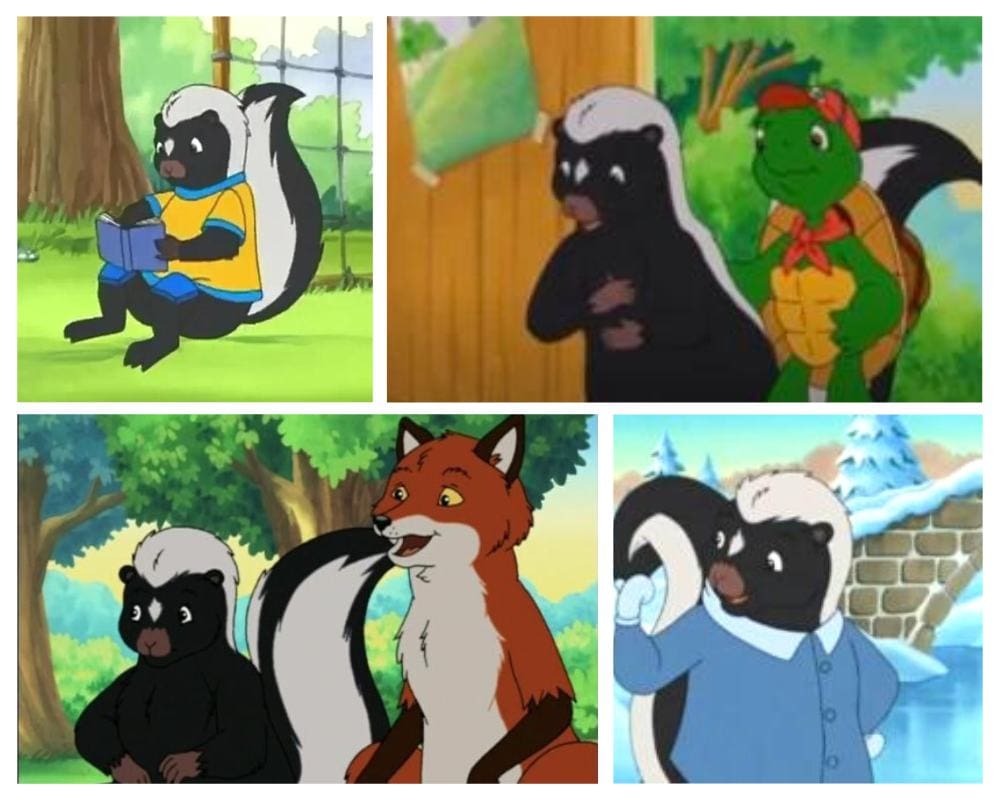
Trope strategy: Ignore the stereotype almost completely
Skunk from Franklin may be the quietest subversion on the entire list.
She is a young female skunk and a supporting friend in Woodland. Her stories involve ordinary childhood concerns such as learning to swim, playing sports, moving house and worrying about what friends think.
The series does not build her identity around odor.
That may not sound revolutionary, but it is unusual. Most animated skunks are introduced through a smell joke within seconds. Franklin simply lets Skunk be another child in the community.
Her design keeps the recognizable stripe and tail while removing the embarrassment normally attached to them.
- Visual signature: Soft black-and-white markings and a rounded preschool design.
- Design move: The stripe identifies the species without controlling the stories.
- Why it works: She is treated as a child first and a skunk second.
Mr. P.U. Skunk – Wild Kratts
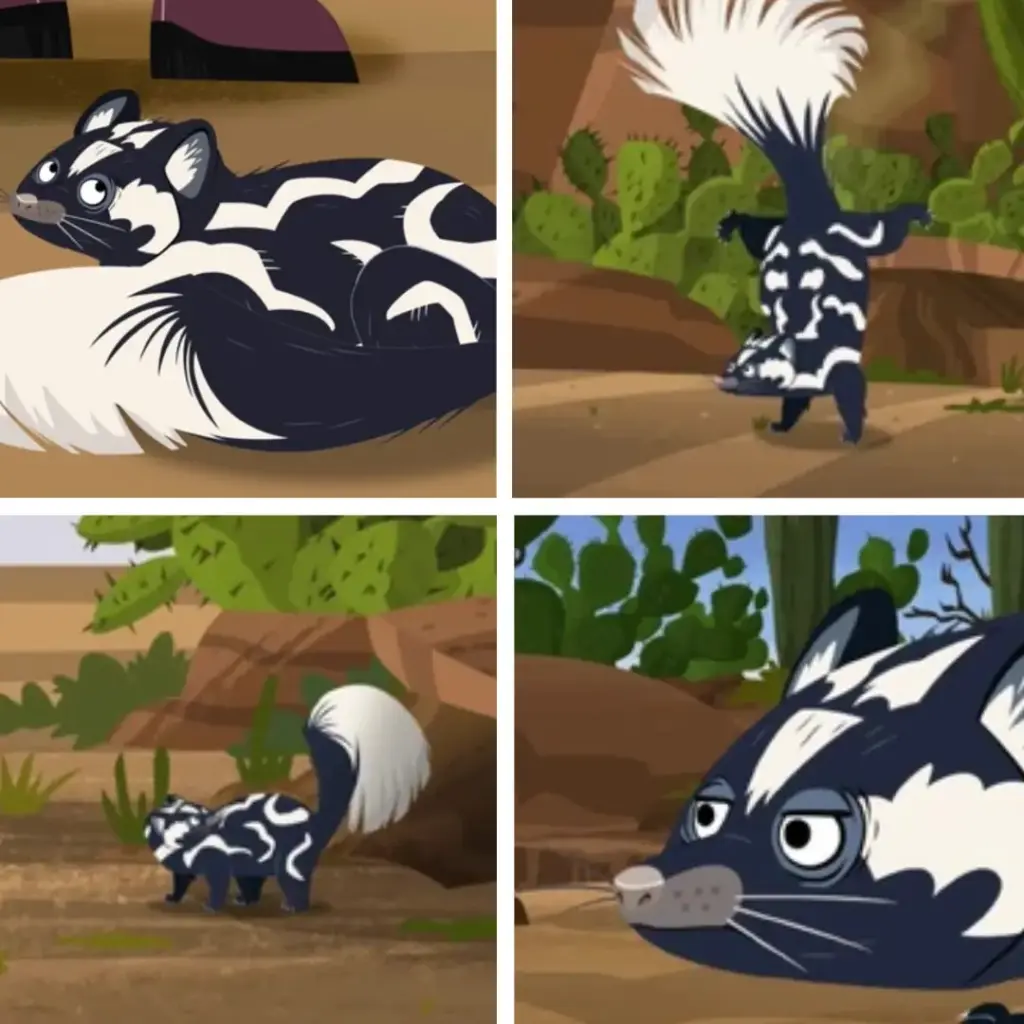
Trope strategy: Replace the joke with real animal behaviour
Mr. P.U. Skunk is a western spotted skunk featured in the Wild Kratts episode “Skunked!”
Instead of treating skunk spray as a random gross-out gag, the series explains it as a precise defensive adaptation.
The most memorable visual is the handstand.
Western spotted skunks really do rise onto their front legs when threatened. ZooAmerica describes the display as part of a warning sequence involving stamping, hissing and a series of handstands.
That real behaviour already looks like something invented by an animator.
Wild Kratts only has to push the movement slightly to turn it into a superhero pose.
- Visual signature: Broken white markings rather than one solid stripe.
- Design move: A real defensive handstand is staged like an action move.
- Why it works: The cartoon makes skunk biology look impressive instead of shameful.
Stinkor – Masters of the Universe
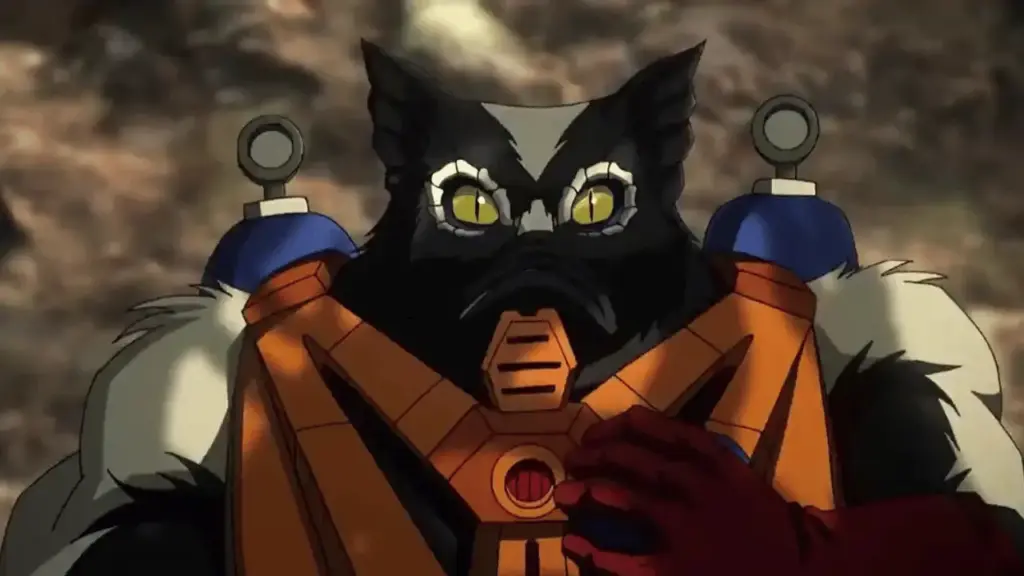
Trope strategy: Embrace the odor so completely that the toy smells too
Stinkor is the “Evil Master of Odors” from the Masters of the Universe franchise.
He began as an action figure in 1985 before receiving later comic and animated appearances. Mattel built the character around smell so completely that the original toy was intentionally scented.
The design resembles a humanoid skunk built from reused action-figure parts. Black-and-white fur markings establish the animal connection, while orange armor and a mask turn the odor into something closer to chemical warfare.
Later versions make the mask especially useful. Mattel’s official Masterverse description calls him a villain whose stench can bring heroes to tears.
- Visual signature: Skunk markings combined with bright orange armor and a gas mask.
- Design move: A natural defense becomes a supervillain weapon.
- Why it works: The concept moves beyond the screen and becomes part of the physical toy.
Pepper Clark – Littlest Pet Shop
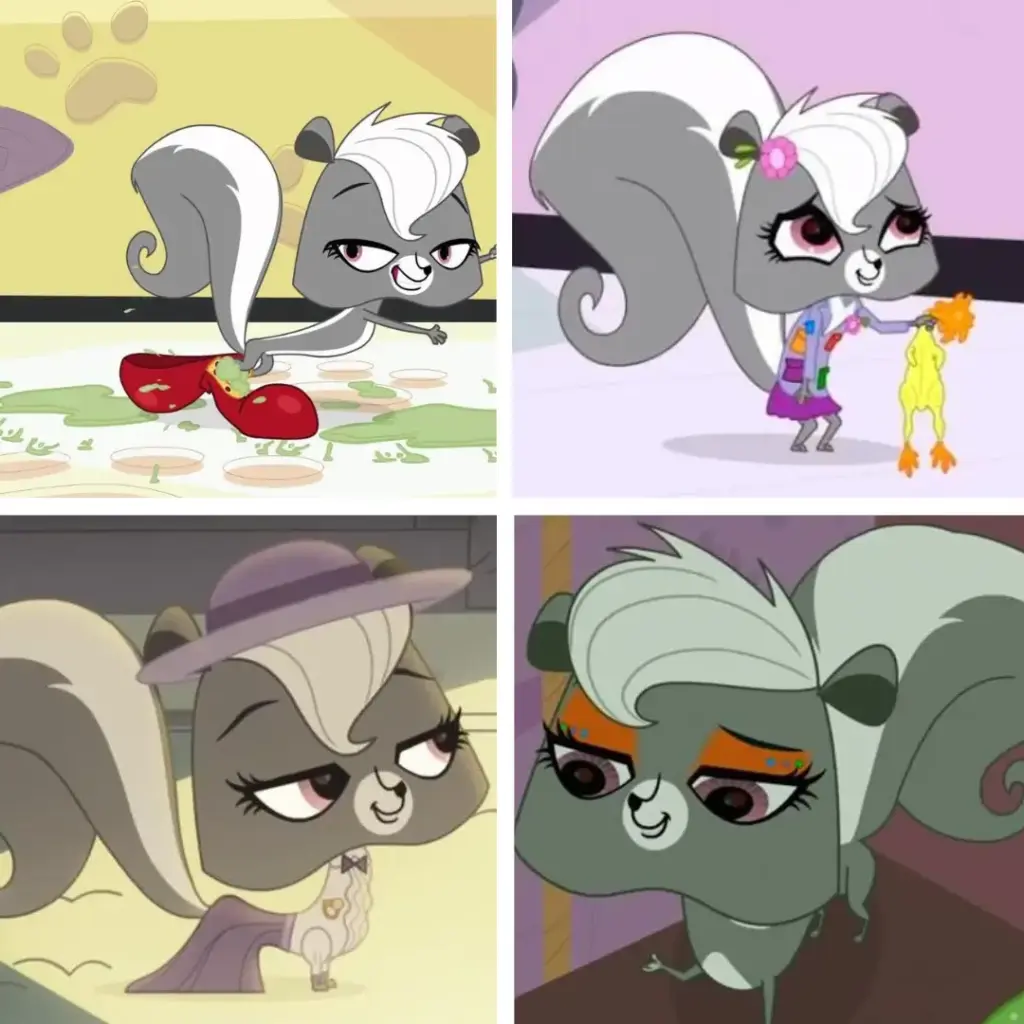
Trope strategy: Make the skunk the person telling the joke
Pepper Clark from the 2012 Littlest Pet Shop series is an aspiring comedian.
That changes the power dynamic immediately.
Older skunk cartoons often make the character the joke. Pepper wants to control the room, choose the setup and deliver the punchline herself.
Her gray fur, bright magenta hair tuft and expressive eyebrows give her the look of a tiny stand-up performer who is permanently waiting for a reaction.
She also incorporates skunk spray into her routines, but the scent is only one tool in a much larger comedy kit involving impressions, props and deliberately bad puns.
- Visual signature: Gray fur punctuated by a bright magenta hair tuft.
- Design move: The color accent functions like a visual exclamation mark.
- Why it works: Pepper owns the joke instead of waiting for another character to react to her smell.
Petunia – Happy Tree Friends
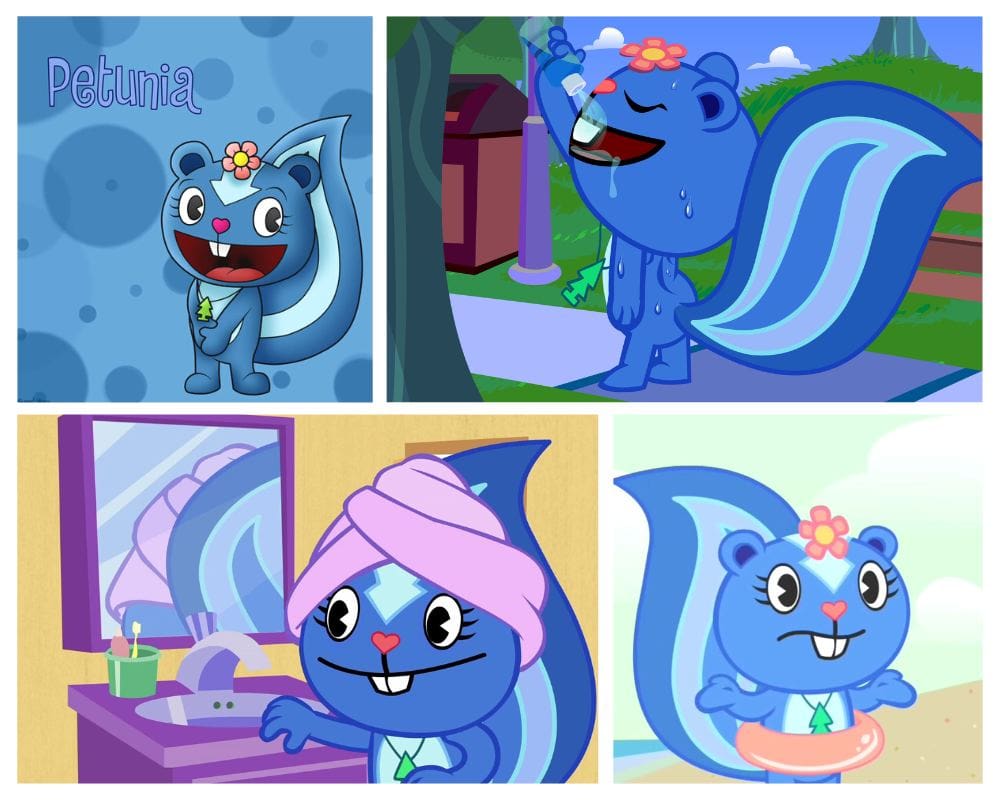
Trope strategy: Make the skunk obsessed with cleanliness
Petunia is a blue female skunk from Happy Tree Friends.
Her design reverses the expected smell joke before an episode begins.
She wears a pink flower and a pine-tree air freshener around her neck. Both accessories suggest fragrance and cleanliness, while the blue palette makes her look soft and harmless.
The cruel joke of Happy Tree Friends is that none of this protects her.
Petunia is fastidious, cautious and generally innocent, yet she remains trapped in the series’ elaborate cartoon violence. Her need for cleanliness can even become a source of panic when the world around her becomes messy.
That contrast fits the show’s dark humor: the character who most wants order lives in a universe designed to create chaos.
- Visual signature: Blue fur, pink flower and a dangling tree-shaped air freshener.
- Design move: Every accessory argues against the “dirty skunk” assumption.
- Why it works: Her obsession with cleanliness becomes both characterization and setup for disaster.
Fifi La Fume – Tiny Toon Adventures
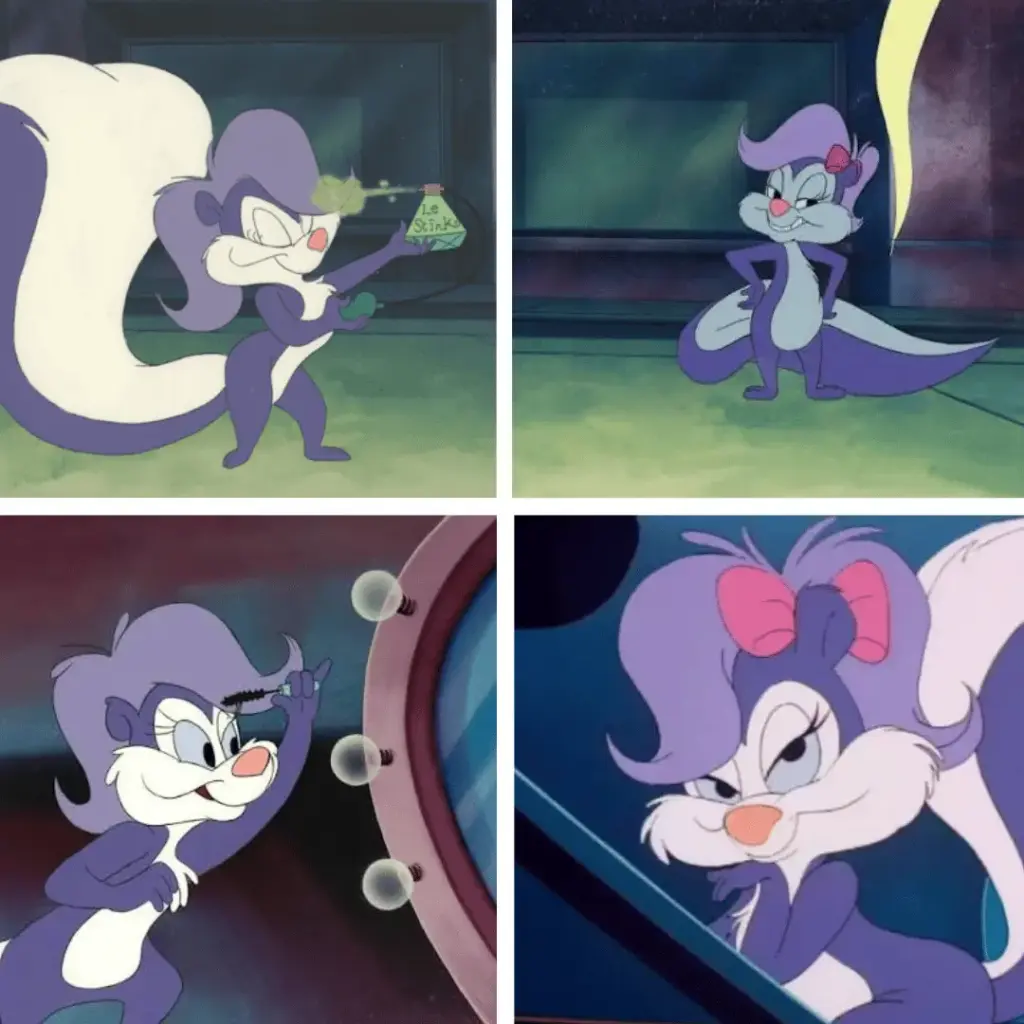
Trope strategy: Reverse Pepé Le Pew and add emotional vulnerability
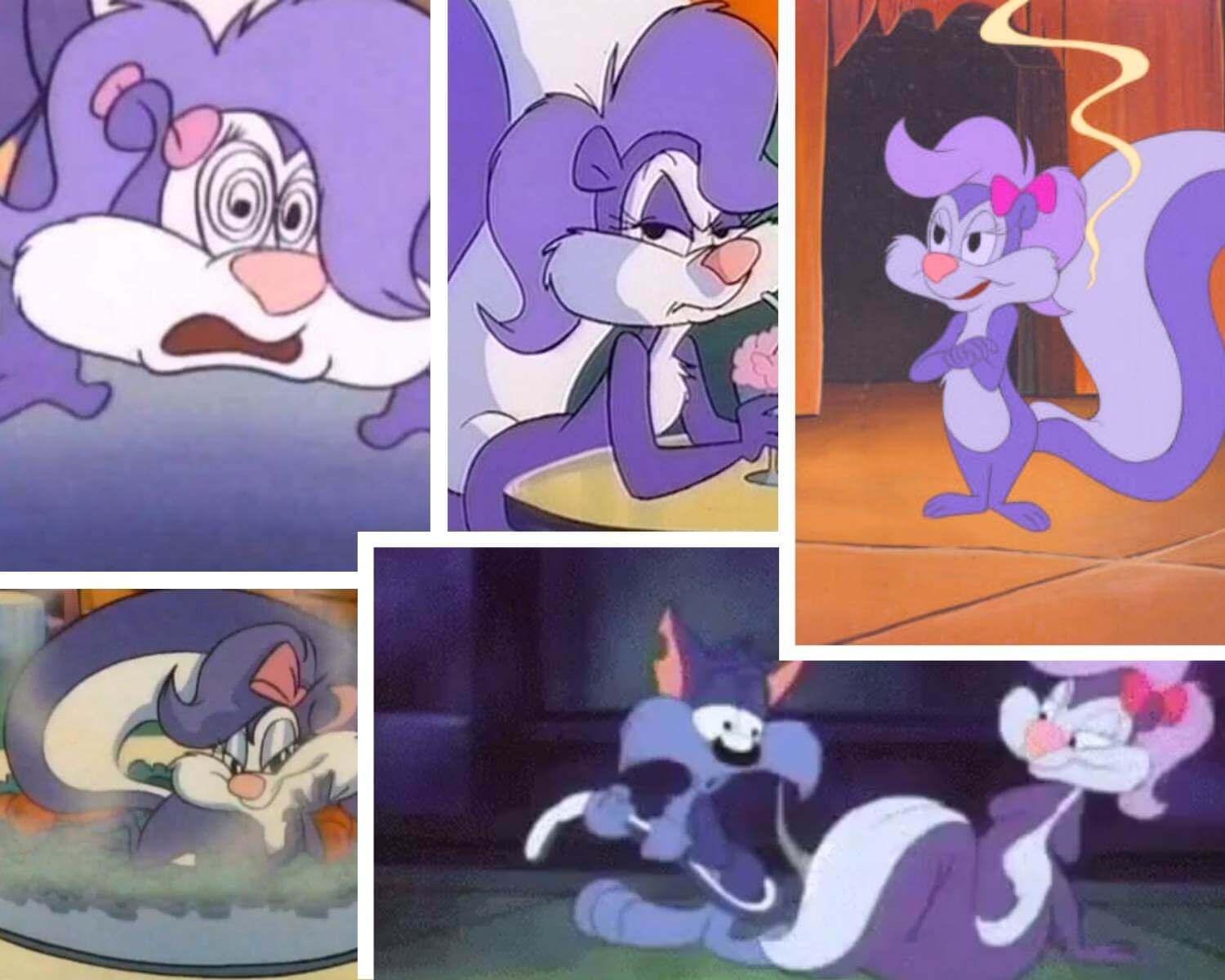
Fifi La Fume is the purple female skunk from Tiny Toon Adventures.
She inherits nearly everything associated with Pepé Le Pew:
- The French accent
- The instant romantic obsession
- The pursuit of animals with painted white stripes
- An overpowering scent
The design changes the tone.
Her purple fur, pink bow and enormous soft tail make her look like a romantic fantasy rather than a threatening adult pursuer. She is also presented as a teenager among other students at Acme Looniversity.
More importantly, Fifi is sometimes allowed to recognize rejection and become genuinely hurt by it.
That does not completely fix the pursuit gag, but it gives her more of an inner life.
My full Fifi La Fume character guide explores her love interests, junkyard Cadillac and return in Tiny Toons Looniversity.
- Visual signature: Purple fur, pink bow and a tail larger than the rest of her body.
- Design move: Pepé’s black-and-white masculinity is remade as soft, colorful romantic excess.
- Why it works: Fifi remains ridiculous, but the writing occasionally lets viewers sympathize with her.
Flower – Bambi
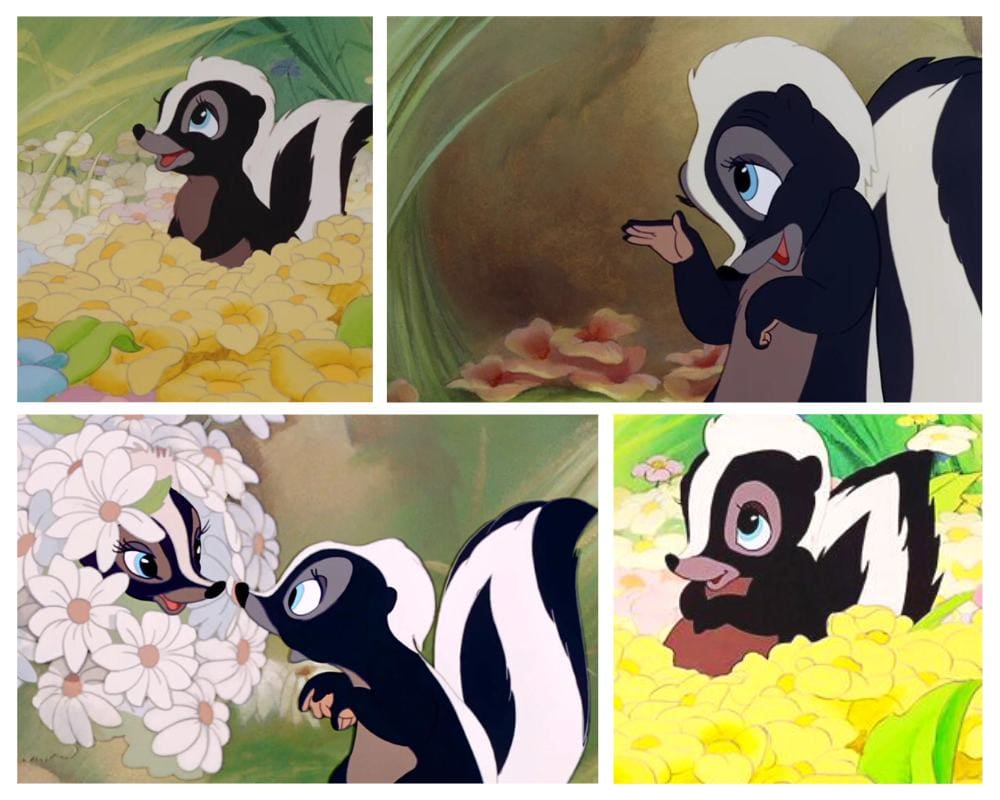
Trope strategy: Reject the stink joke before it begins
Flower is the shy male skunk from Disney’s 1942 film Bambi.
When Bambi first sees him hiding among flowers, he mistakes the skunk for a blossom. Flower is happy enough with the misunderstanding that the name stays.
Disney’s official Bambi page describes him as bashful, which is the key to the entire design.
Flower has the black-and-white coloring and raised tail audiences associate with a skunk, but the face is rounded, the eyes are soft and the movements are cautious.
Nothing about him suggests aggression.
The movie does not define Flower through a smell gag. His species creates a mild visual joke when he is introduced, and then he becomes one of Bambi’s closest friends.
That restraint is why the character still feels unusually gentle.
For more on him, read my full guide to Flower from Bambi.
- Visual signature: A tiny rounded skunk framed by flowers and soft woodland colors.
- Design move: The threatening raised tail is paired with an extremely timid face.
- Why it works: Flower succeeds because the film refuses to make his species his entire personality.
Stella – Over the Hedge
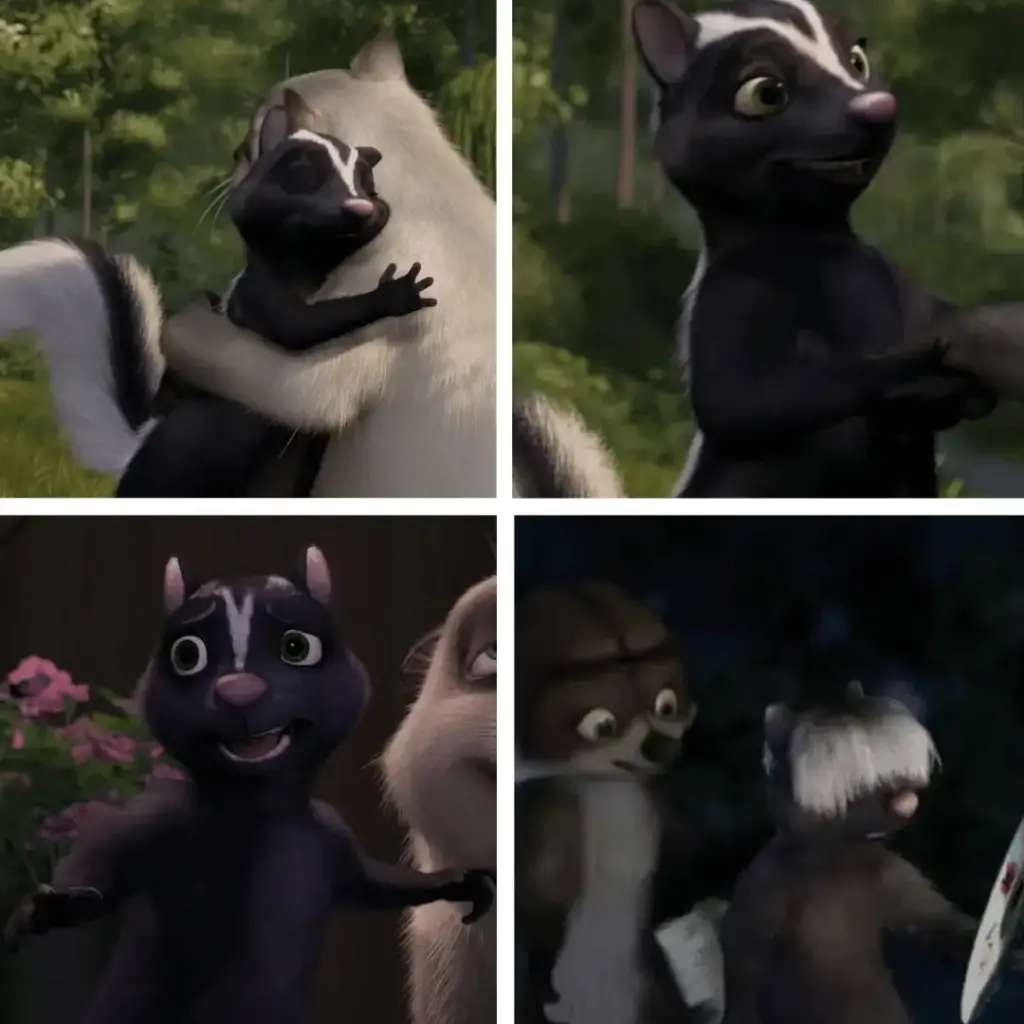
Trope strategy: Reclaim the stink as confidence and power
Stella is the female skunk from DreamWorks’ 2006 film Over the Hedge, voiced by Wanda Sykes.
She initially appears defensive and short-tempered because she expects other animals to react badly to her species.
Unlike Flower, Stella cannot simply ignore the stereotype. The world around her keeps reminding her of it.
Her design responds by making her physically grounded.
Stella has a low center of gravity, heavy brows and sharp hand gestures. She plants herself in a scene and dares anyone to say something foolish.
The film’s heist sequence then turns skunk history inside out.
The other animals disguise Stella as a domestic cat so she can distract Tiger, a pampered Persian cat. Classic Pepé Le Pew cartoons repeatedly turned a cat into a false skunk by painting a stripe on her back.
Over the Hedge reverses it: an actual skunk is deliberately transformed into a cat.
Tiger remains attracted to Stella after learning the truth, giving her the kind of romantic resolution earlier skunk characters rarely received.
- Visual signature: Heavy posture, expressive brows and a thick white stripe.
- Design move: Her makeover temporarily removes the skunk silhouette, then the story restores it.
- Why it works: Stella’s arc is not about becoming acceptable by hiding her species; it is about being accepted after the disguise ends.
Pepé Le Pew – Looney Tunes
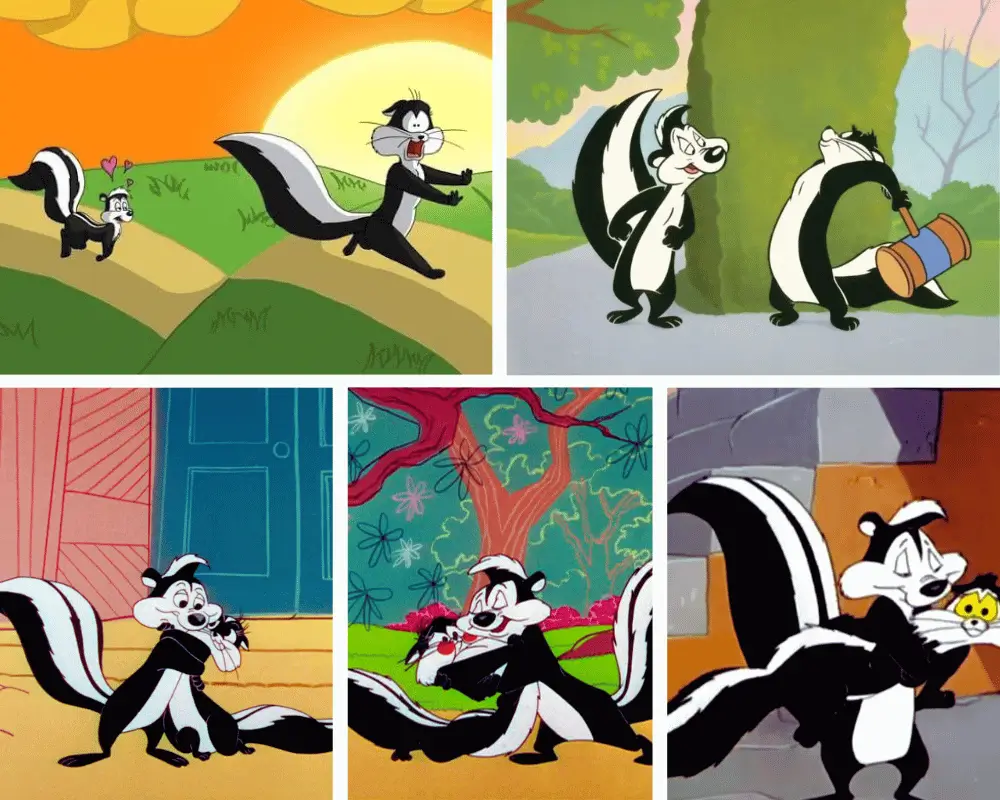
Trope strategy: Define the stereotype so thoroughly that everyone else must respond to it
Pepé Le Pew is not the first fictional skunk, but he is the character who established the basic animated formula.
The Looney Tunes skunk combines:
- A thick French accent
- Complete romantic self-confidence
- A powerful odor he barely notices
- A black-and-white cat he repeatedly mistakes for a female skunk
His design is elegant rather than dirty.
Pepé has smooth fur, a proud chest, half-closed eyes and a slow walk that suggests he believes every scene belongs to him. He never rushes, even when Penelope Pussycat is sprinting for her life.
That movement is essential.
The comedy does not come only from the smell. It comes from the difference between how Pepé sees himself and what everyone else sees.
He thinks he is a sophisticated romantic lead. The rest of the screen treats him like an environmental emergency.
The pursuit premise has aged badly, and modern audiences are right to question it. Pepé remains historically important because nearly every later skunk character either copies, softens, reverses or rejects the template he established.
- Visual signature: Smooth black fur, one bright stripe and a permanently self-satisfied expression.
- Design move: Graceful movement is placed against the panic he creates.
- Why it works: Pepé’s confidence and the audience’s understanding of reality are always in direct conflict.
Penelope Pussycat Is Not a Skunk
One of the most searched-for “skunk cartoon characters” is not actually a skunk.
Penelope Pussycat is a black cat who repeatedly receives a white stripe through wet paint or another accident. Pepé sees the stripe and assumes she belongs to his species.
Why the mistake reads instantly
Animation reduces species recognition to a few visual signals. Add one white stripe to a black cat, and the entire identity changes in a single frame. The joke works because the skunk silhouette is already embedded in the audience’s visual memory.
That simple stripe gag later reappeared with Furrball and Calamity Coyote in Fifi La Fume’s stories.
Why Skunks Work So Well in Animation
A skunk is an unusually efficient piece of character design.
The animal comes with:
- A bold black-and-white color scheme
- A stripe visible from almost any angle
- A large tail that can dominate the silhouette
- A defensive ability audiences already understand
- A built-in conflict between appearance and social acceptance
That final point is what gives the best skunk characters more depth.
Flower is accepted because the story ignores the stereotype. Stella expects rejection and learns she does not need to disguise herself. Fifi wants affection but struggles to understand boundaries. Petunia responds by becoming obsessively clean. Pepper turns the joke into part of her own comedy act.
Even Pepé Le Pew reveals something useful about character design, although not always for the reasons originally intended.
A strong animal character does not simply resemble the species.
The species creates an expectation, and the personality decides what to do with it.
That is why the best skunk cartoon characters are not necessarily the ones with the biggest stink clouds.
They are the ones who make the stripe mean something different.
Hey everyone! This post originally went live back in 2023, but it was long overdue for a major glow-up! I’ve recently updated it with deeper character design breakdowns and animation archetypes to showcase why these iconic skunk designs work so well.
I’m going to be working my way through my older, dated posts and giving them fresh updates throughout the rest of the year, so stay tuned for more revamps!