The World’s First Cartoon: Fantasmagorie
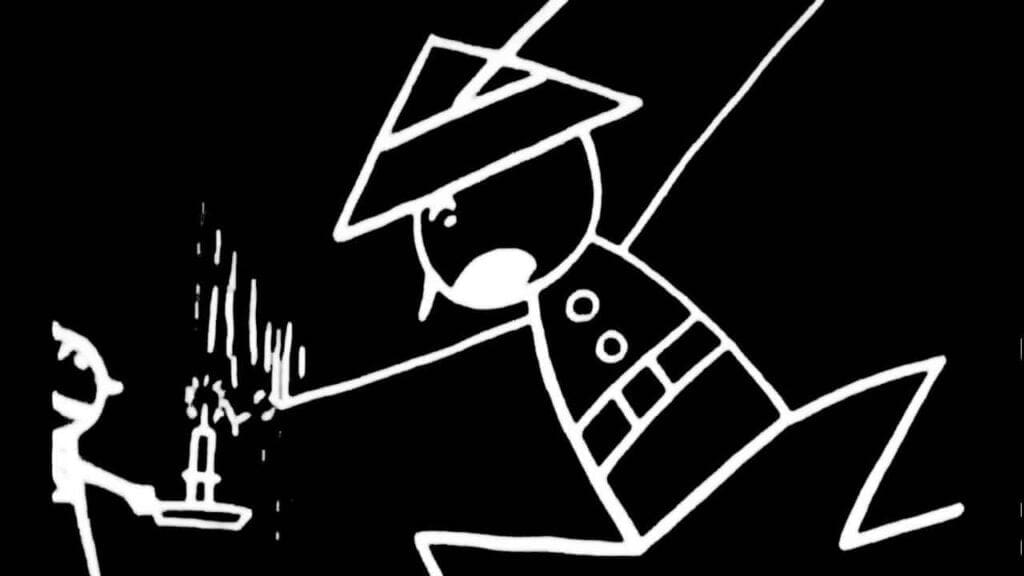
In the prehistoric era of cinema—way back in 1908—an eccentric, visionary Frenchman named Émile Cohl forever altered the entertainment landscape. Affectionately remembered as the “Father of the Animated Cartoon,” Cohl took a radical leap of faith.
In a world accustomed to rigid theater and primitive live-action photography, he introduced a concept that seemed like dark magic to early audiences: completely hand-drawn, frame-by-frame, moving drawings.
His creation, Fantasmagorie, stands as a monumental landmark in film history.
It is a whirlwind of fluid, black-and-white lines that dance, bend, twist, and shift shape across the screen.
While it tickled the funny bones of early 20th-century Parisian audiences, it did something much bigger: it laid down the creative DNA for everything from Mickey Mouse and Bugs Bunny to the modern-day antics of Homer Simpson.
The Great Historical Debate: The First Cartoon vs. The First Animation
To understand the genius of Fantasmagorie, we must first address an ongoing debate in the animation community. Many historians point to James Stuart Blackton’s Humorous Phases of Funny Faces (1906) as the world’s very first animated film. While this is technically accurate, there is a massive stylistic and structural difference between Blackton’s work and Cohl’s masterpiece.
Blackton’s early experiment was a “trick film” deeply rooted in vaudeville. It featured a live-action artist physically sketching a character on a chalkboard, followed by cut-outs, stop-frame camera pauses, and localized chalkboard alterations. The animator’s real hand remained an active, frame-blocking presence throughout the narrative.
Fantasmagorie, on the other hand, is recognized by film purists as the first fully animated cartoon because it abandoned these physical tricks. Cohl bypassed the chalkboard entirely, creating a self-contained world drawn entirely on individual sheets of paper.
There were no actors, no physical chalkboard cutouts, and no visible live-action sets. It was a fluid, uninterrupted stream of traditional, drawn-from-scratch imagery.
Cohl proved that drawings alone could carry a narrative, giving birth to the medium of traditional hand-drawn animation as we know it today.
A Fantasmagorical Ride
The journey to bring Fantasmagorie to life was a grueling test of human endurance. Over approximately five months—running from February 1908 to either May or June of that year—Émile Cohl locked himself away to craft 700 individual drawings. This massive pile of illustrations translated into a brief, lightning-fast running time of just 1 minute and 20 seconds of pure animation.
To pull off this miracle, Cohl utilized a customized, under-lit glass plate (a primitive precursor to the modern lightbox). He placed each sheet of paper over his previous drawing, allowing him to trace consecutive lines with subtle, incremental variations. This painstakingly meticulous technique guaranteed smooth motion and solid continuity, ensuring the characters didn’t erratically jump around the frame.
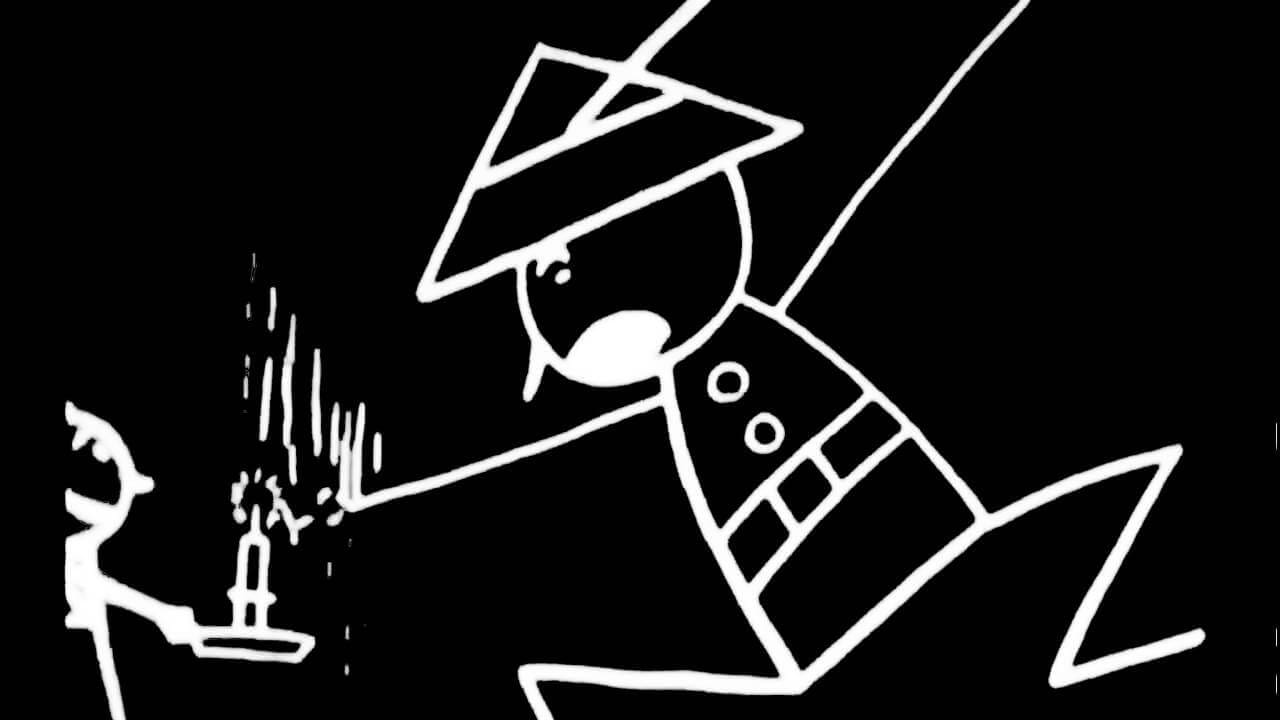
While the final film mirrors the chalkboard caricatures popular in early 1900s vaudeville, this was actually a brilliant optical illusion. Cohl drew his characters with black ink on white paper, but photographed them onto negative film stock.
This double exposure reversed the values, creating a “chalk line” aesthetic—glowing white lines on an inky black background. It was a brilliant visual choice that masked any paper imperfections and made the characters leap off the screen.
Working closely with a camera assistant, Cohl projected his masterwork at a speed of 16 frames per second. To save time without sacrificing fluid movement, he shot the project “on twos”—photographing each individual drawing twice before moving to the next.
This frame rate, combined with his high-contrast line style, gave the movie an ethereal, dreamlike energy that fascinated viewers.
“At the beginning and end, Cohl’s own hands appeared in positive, necessitating in these two shots the use of white ink on black paper to match the negative animation sequence.”
— Donald Crafton, Emile Cohl, Caricature, and Film
Under the Microscope: A Scene-by-Scene Analysis
Without a structured plot, Fantasmagorie functions as a fascinating, stream-of-consciousness dreamscape. If you watch the film closely, you will see a series of brilliant vignettes that defy the laws of gravity, logic, and physical reality:
- The Creator’s Gesture: The cartoon begins in a meta-cinematic fashion. We see the hand of the live-action animator sketch a simple, stick-figure clown. Once the hand exits the frame, the drawing bursts to life, hanging from an invisible ceiling before stepping into the world.
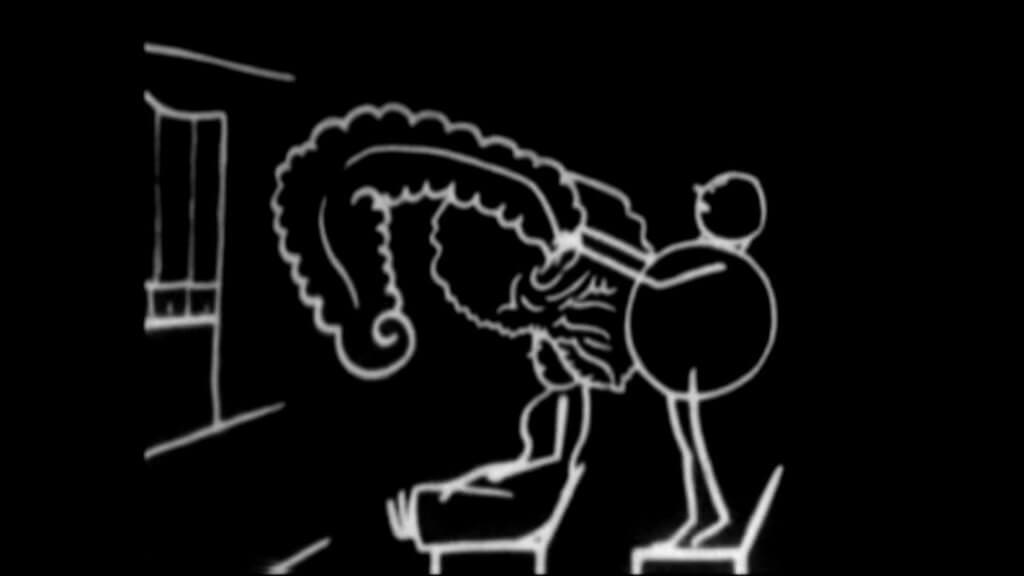
- The Theater Feathers: In a highly relatable piece of observational humor, our stick-figure protagonist sits in a movie theater. A wealthy woman wearing a massive, absurdly feathered hat sits directly in front of him, entirely blocking his view. Frustrated, he plucks the feathers one by one until the hat is ruined, but it magically regenerates in an instant.
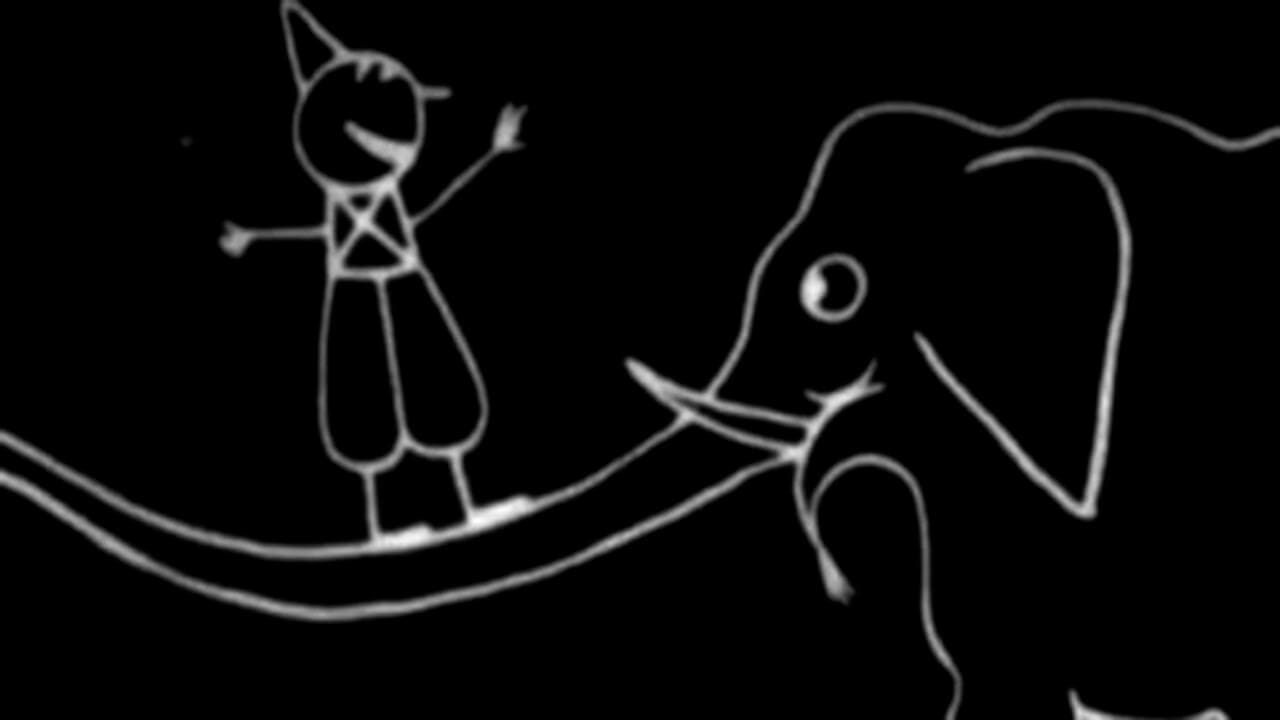
- The Morphing Menagerie: In the film’s most famous sequence, our clown falls, morphing smoothly into a bubble, which transforms into a elegant wine bottle, then blooms into a flower, and finally expands into a massive, walking elephant.
- The Cannon and the Castle: Characters regularly explode, disintegrate, and reassemble. Heads are popped off and swapped, a strongman flexes his muscles, and a classical castle morphs into a simple box.
The Man Behind the Magic: Émile Cohl
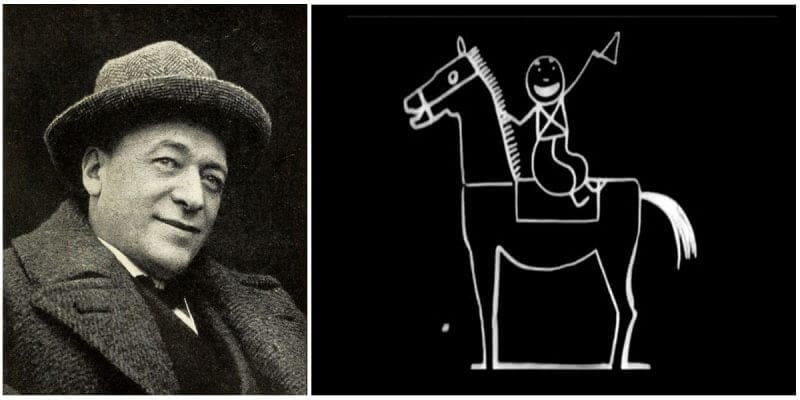
To understand why Fantasmagorie is so wildly chaotic, you have to look at the colorful history of its creator. Born in Paris on January 4, 1857, as Émile Eugène Jean Louis Courtet, Cohl was a bohemian artist, painter, and caricaturist who lived on the cutting edge of the French avant-garde.
Before his transition into film, Cohl studied under the famous caricaturist André Gill. He quickly developed a unique graphic style defined by oversized, expressive heads on tiny, puppet-like bodies. He spent decades drawing political cartoons and satirical sketches for major French newspapers, training his eyes to translate complex human emotions into simple, highly expressive lines.
Laughter in the Dark: The “Incoherent” Influence
Crucially, Émile Cohl was a founding member of Les Arts Incohérents (The Incoherent Art Movement)—a satirical, anti-cliché art collective active in Paris in the late 19th century. Preceding the surrealist and Dada movements by several decades, the Incoherents championed the absurd, the nonsensical, and the childish. Their slogan was simple: “Gaiety is properly French, so let’s be French.” They regularly hosted exhibitions of “drawings by people who do not know how to draw.”
This deep foundation in absurdity is the real engine behind Fantasmagorie. It explains why the film values continuous transformation over rigid storytelling. For Cohl, animation was not meant to merely duplicate real life; it was a tool to shatter the boundaries of physical possibility, allowing a wine bottle to easily turn into an elephant with zero logical explanation.
Producing the Fantasmagorical Classic
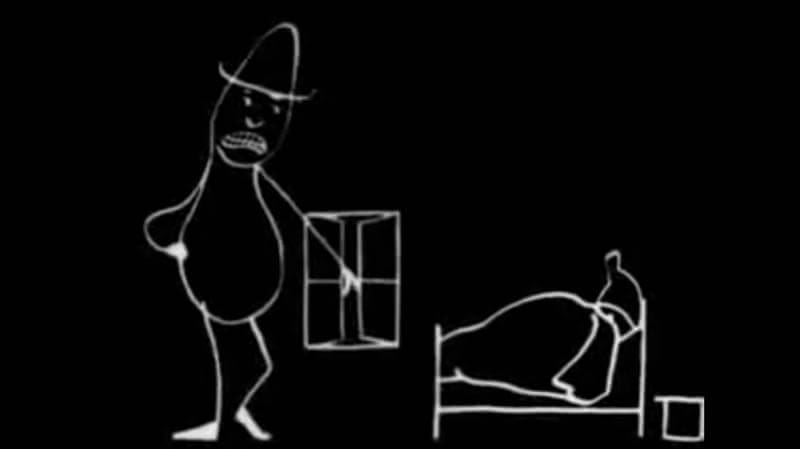
To appreciate how far technology has progressed, we must realize that Cohl produced his masterpiece entirely by hand in a tiny, primitive studio at Gaumont. Without digital tools, the production process required immense focus:
- 1. Concept & Storyboarding: Cohl conceptualized the dapper gentleman and the mischievous clown, sketching basic ideas on loose scratch paper. There was no formal script, only a fluid series of key scenarios.
- 2. Traditional Tracing: Working on a custom-built lightbox, Cohl traced each frame over the previous one, carefully tracking the tiny deviations needed to create the illusion of weight and momentum.
- 3. Stop-Motion Capture: Cohl photographed each sheet of paper onto standard 35mm film stock. Because he shot “on twos,” he had to hand-crank the camera twice for every single page.
- 4. Magic Lantern Legacy: The title *Fantasmagorie* refers directly to the *fantasmograph*—a mid-19th-century magic lantern system used to project ghostly, morphing silhouettes onto theater walls. The film premiered at the Théâtre du Gymnase in Paris on August 17, 1908, leaving the audience entirely spellbound.
A Tragic End for a Brilliant Pioneer
Despite essentially inventing the modern animated cartoon and producing over 250 films during his lifetime—including classics like The Puppet’s Nightmare (1908) and The Hasher’s Delirium (1910)—Émile Cohl’s life ended in profound tragedy.
The outbreak of World War I shattered the European film market. To make matters worse, a devastating fire at the Gaumont laboratories destroyed the vast majority of Cohl’s master negatives, leaving only a tiny fraction of his lifetime filmography intact.
Impoverished and largely forgotten as the American studio system began to dominate world cinema, Cohl spent his final years in a municipal hospital in Villejuif, France.
In January 1938, Cohl passed away due to a tragic accident: while reading at his desk, his long beard caught fire from a candle, leading to severe injuries from which he never recovered.
He died only a few weeks after Walt Disney’s *Snow White and the Seven Dwarfs* premiered in theaters—a cruel irony, as the global industry celebrating Disney’s triumph was built entirely upon the foundation Cohl had laid thirty years prior.
The Long Legacy of Metamorphosis
The core technique popularized in Fantasmagorie is **metamorphosis**—the seamless, uncut transition of one object into another. Rather than relying on standard editing cuts or scene dissolves, Cohl relied purely on the precision of sequential drawing to morph physical reality.
This technique remains one of the most powerful tools in animation history. You can trace its impact through the rubber-hose animation styles of the 1920s and 30s, the mind-bending sequences in modern adult animated series on platforms like Rick and Morty, and even the beautiful, organic shapeshifting of Studio Ghibli films like *Spirited Away*. When a modern Pixar movie utilizes morphing effects to convey magic, they are directly utilizing the visual language invented by Émile Cohl in his Paris studio.
The Retrospective Debrief: How Does the 1908 Classic Hold Up?
Viewing Fantasmagorie over a century after its premiere is a mesmerizing experience. Strip away the hyper-polished digital rendering of the modern age, and what remains is pure, unadulterated creative energy.
The film’s greatest strength is its sheer visual rhythm. Free from the constraints of complex dialogue or logical plot progressions, Cohl embraced the absolute freedom of the medium. The lines feel alive—vibrating with a nervous, electric current that modern computer-generated imagery often struggles to replicate.
It is a work of pure pop-art surrealism that still feels surprisingly modern, raw, and boundary-pushing.
The Pioneer Verdict — The Spark of Creation: Fantasmagorie is a triumphant masterclass in artistic freedom. In 80 seconds of hand-drawn bliss, Émile Cohl proved that the only limit of animation is the boundary of the creator’s imagination. It is the big bang of the cartoon universe, and it still burns as brightly as ever.
Watch Fantasmagorie from 1908