Long before Mickey Mouse whistled aboard a steamboat, early animators were already performing small miracles.
Using little more than ink, paper and strips of film, they learned how to make audiences laugh without dialogue, sound effects or synchronized music.
Silent cartoons were not simply a warm-up for modern animation. They were a period of bold visual experimentation, where artists developed many of the storytelling techniques still used today.
Here are the classic silent cartoons that helped shape animation history.
The Pioneers and Their Inventions
To appreciate how fast the medium evolved, we have to look at the massive leaps in technology and technique.
| Animator / Studio | Key Innovation | Classic Work |
|---|---|---|
| Winsor McCay | Keyframe drawing & naturalistic character weight | Gertie the Dinosaur (1914) |
| The Fleischer Brothers | Rotoscoping (tracing live-action frames for fluid human movement) | Out of the Inkwell (1921) |
| Otto Messmer / Pat Sullivan | Character merchandising & visual personality licensing | Felix the Cat (1919) |
| Lotte Reiniger | Silhouette stop-motion & early multiplane camera effects | The Adventures of Prince Achmed (1926) |
Timeline of Silent Animation Milestones (1900–1928)
1900
The Enchanted Drawing
Directed by J. Stuart Blackton, this “trick film” blended live-action with a cartoonist drawing on a board. While not fully animated, it was the first time movie audiences saw drawings “come to life” on screen.
1908
Fantasmagorie
French animator Émile Cohl created what film historians widely consider the world’s first fully hand-drawn, traditional animated cartoon. It consisted of roughly 700 double-exposed drawings of a morphing stick-figure clown.
1914
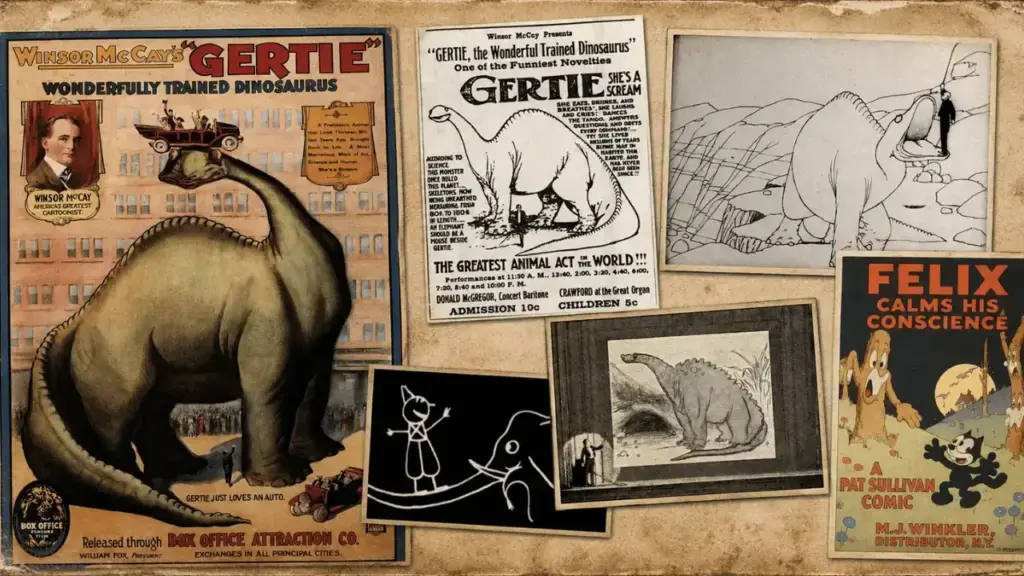
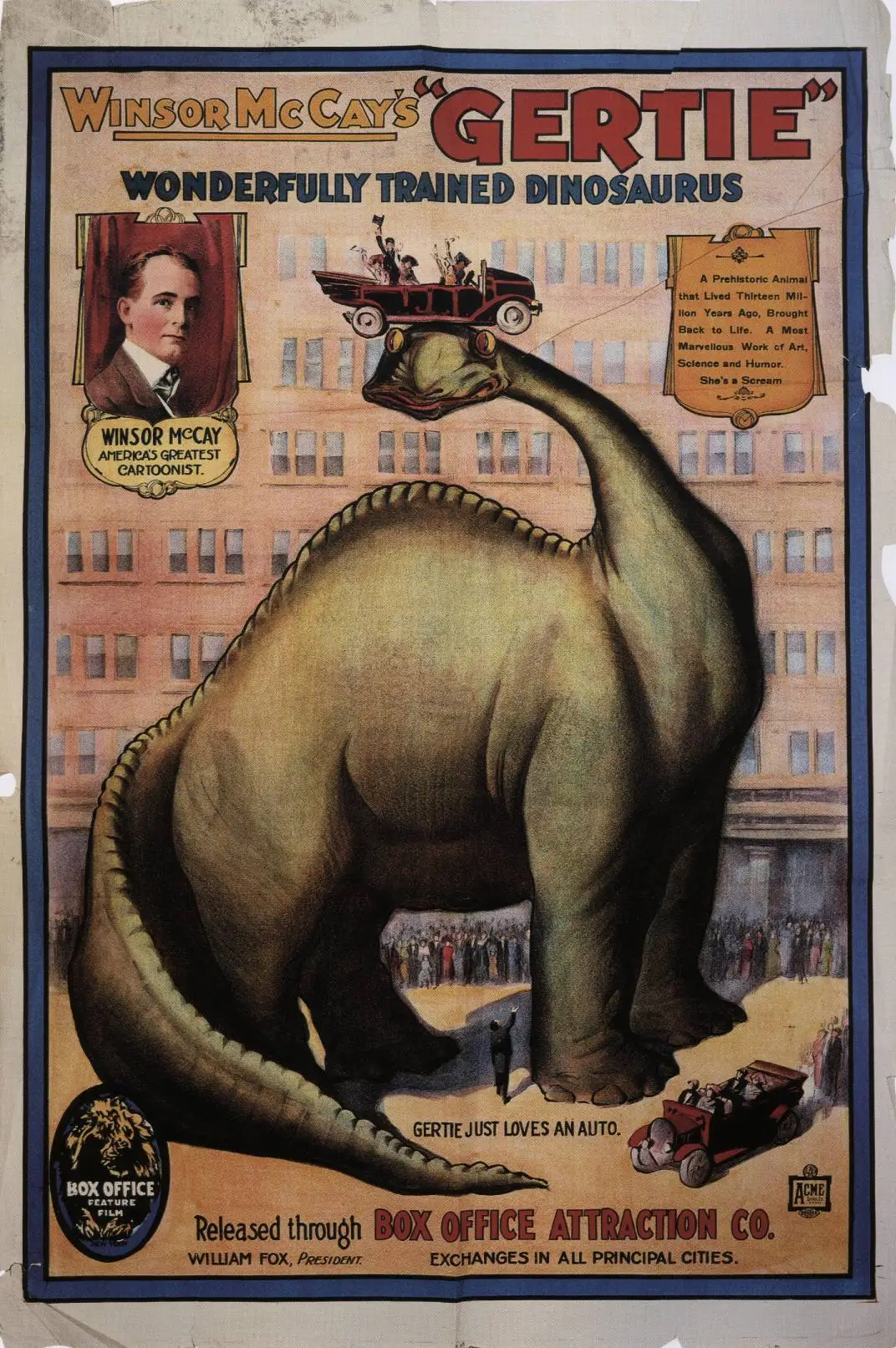
Gertie the Dinosaur
Winsor McCay revolutionized the industry by introducing character personality. Gertie didn’t just move; she had attitude, pride, and played directly with McCay, who performed live alongside the screen in vaudeville shows.
1919
Feline Follies
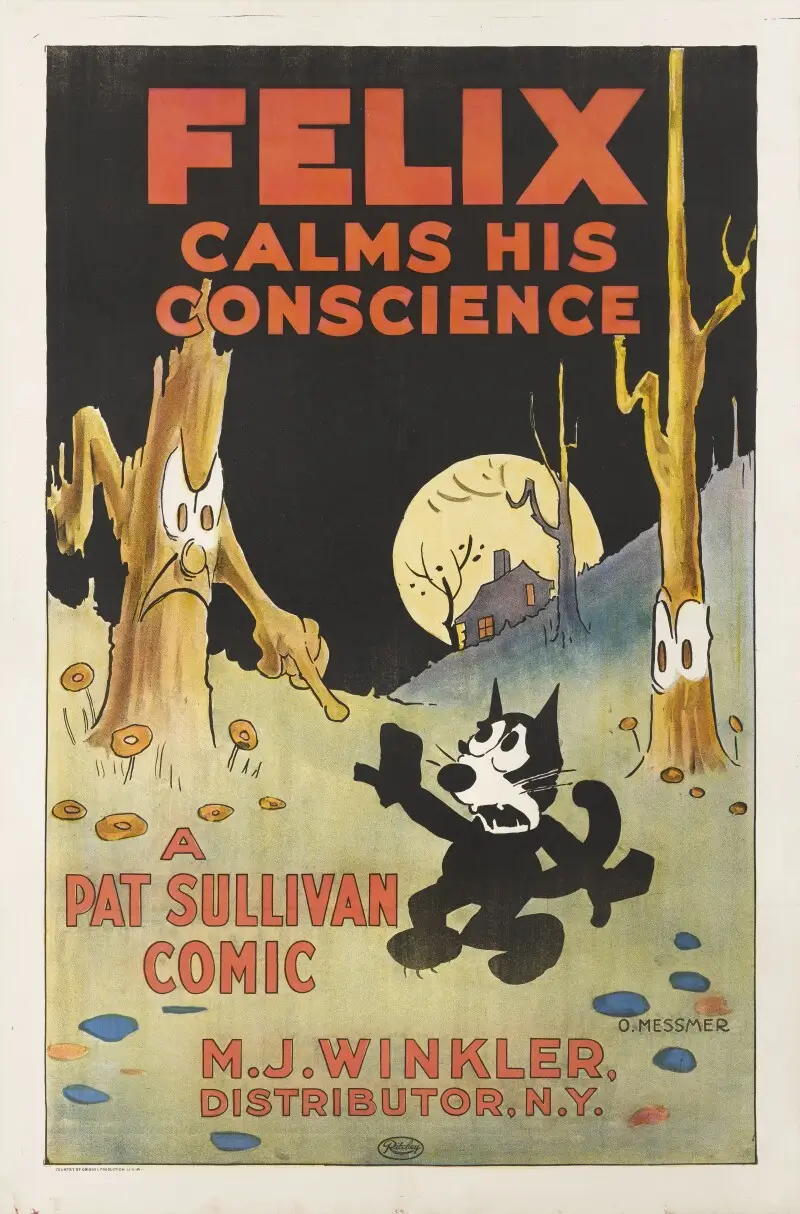
Otto Messmer and Pat Sullivan introduced Felix the Cat. Felix quickly became the world’s first animated superstar, proving that a cartoon character could carry a film solely on their visual personality and expressive pacing.
1923
Alice’s Wonderland
A young Walt Disney made his mark by flipping the “trick film” formula, placing a live-action girl inside an entirely animated, hand-drawn cartoon world. This series kept his early studio afloat.
1926
The Adventures of Prince Achmed
Lotte Reiniger released this gorgeous, feature-length German silhouette film. Using intricate paper cutouts, she created the oldest surviving animated feature film in history, pushing visual storytelling to fine-art status.
1928
Plane Crazy
Originally released as a silent test film, this short introduced Mickey Mouse and Minnie Mouse to test audiences before Steamboat Willie’s synchronized sound changed the landscape forever.
The Art of Silent Comedy: Visual Grammar
Silent animators faced one major limitation: no spoken dialogue. To make jokes clear, they relied on an expressive visual language that audiences could understand instantly.
- The Double Take: A character notices something strange, looks away, then snaps back in exaggerated disbelief.
- Physics-Defying Slapstick: Characters stretch, flatten like pancakes or hover in mid-air for a moment before gravity finally takes over.
- Visual Symbols: Lightbulbs represented sudden ideas, stars showed pain or dizziness, and floating musical notes helped audiences imagine sound.
These early boundaries forced animators to focus heavily on posing, expression, and pacing. Today, modern animation giants like Disney, Pixar, and Studio Ghibli still rely on these exact visual principles to build deep emotional connections without spoken words.
Why GIFs and Memes Feel Like Modern Silent Cartoons
There is a clear connection between 1920s characters like Felix the Cat and the GIFs shared online today.
Both rely on the same basic tools:
Instant visual shorthand: A single expression or movement can communicate frustration, excitement or confusion within seconds.
No sound required: GIFs work perfectly during a silent mobile scroll, just as early cartoons told complete jokes without spoken dialogue.
The Loop: Early animators reused repeating movements to save time and drawings. Modern GIFs use the same looping structure to reinforce a reaction or visual punchline.
The “Symphony” of Silence: How Theaters Heard These Cartoons
When we picture the silent era, it is easy to imagine audiences sitting in complete silence as a flickering film played on the screen.
In reality, silent cartoons were rarely watched without sound. Moviegoing was often a lively, communal experience, with music performed inside the theater to accompany the action.
The exact presentation depended on the venue:
- The Neighborhood Pianist: In small local theaters, a single piano player sat at the front of the stage, improvising ragtime tunes, frantic chases, and dramatic chords to match the physical pacing of the animation on screen.
- The Mighty Wurlitzer Organ: Larger city theaters utilized massive theater organs. These weren’t just musical instruments, they were early sound effect machines. With the pull of a lever or the step on a pedal, a skilled organist could trigger built-in physical sound effects like car horns, sirens, bird chirps, and crashing cymbals to perfectly synchronize with a cartoon character’s pratfalls.
- Photoplay Cue Sheets: To keep things consistent, studios began distributing “cue sheets” alongside the film reels. These guides instructed theater conductors exactly what classical compositions or popular melodies to play during specific scenes. For example, a fast-paced chase sequence between a cat and a mouse would come with instructions to play a high-tempo version of Rossini’s William Tell Overture.
Because much of the music was performed live, the same cartoon could feel slightly different from one theater to the next.
The musicians, the venue and even the energy of the audience helped turn each screening into its own performance.
The Dark and Surreal Side of Early Animation
Many modern viewers assume that early cartoons were wholesome, simple, and strictly designed for young children.
However, a deep dive into the silent era reveals a shocking amount of surrealism, dark humor, and avant-garde weirdness that would never fly on modern children’s networks.
Long before the strict censorship rules of the 1934 Hays Code took hold of American cinema, early animators operated in a sort of “Wild West.”
Because animation was a brand-new medium, artists used it to push the absolute boundaries of reality, logic, and comfort:
- Fleischer’s Nightmare Landscapes: Max and Dave Fleischer were notorious for packing their Out of the Inkwell shorts with unsettling body horror. Characters like Koko the Clown would have their limbs stretched like taffy, melt into puddles of ink, or mutate into bizarre monsters.
- Macabre Themes: Skeletons, ghosts, and the literal underworld were incredibly common motifs in silent animation. Characters were routinely dragged to spooky dungeons, played music on the ribcages of skeletons, or faced existential dread. Rather than scaring audiences away, this gothic aesthetic captivated viewers who were fascinated by the medium’s ability to easily depict the impossible.
- The Logic of Dreams: In silent cartoons, objects were constantly sentient. A building might grow eyes and swallow a character whole, or a shadow might detach itself from its owner to commit a crime. This dreamlike logic became the foundation of early cartoon comedy, celebrating the idea that in a hand-drawn world, the only limit is the ink in the bottle.
If you only watch modern, digitally polished animation, going back to the late 1910s and 20s can feel like stepping into an alternate, beautifully chaotic dimension where anything can—and usually does—happen.
15 Essential Silent Cartoons to Watch
Here is a curated, historically accurate list of classics that defined the era, along with direct links to stream them legally and for free:
-
- 1. The Enchanted Drawing (1900) – J. Stuart Blackton
Watch Free:
YouTube |Internet Archive
- 1. The Enchanted Drawing (1900) – J. Stuart Blackton
-
- 2. Humorous Phases of Funny Faces (1906) – J. Stuart Blackton
-
- 3. Fantasmagorie (1908) – Émile Cohl
-
- 4. Little Nemo (1911) – Winsor McCay
-
- 5. How a Mosquito Operates (1912) – Winsor McCay (The hand-drawn cartoon)
-
- 6. Gertie the Dinosaur (1914) – Winsor McCay
-
- 7. Bobby Bumps Starts for School (1917) – Earl Hurd
-
- 8. The Sinking of the Lusitania (1918) – Winsor McCay
-
- 9. Feline Follies (1919) – Otto Messmer
-
- 10. The Tantalizing Fly (1919) – Max Fleischer
-
- 11. Out of the Inkwell (1921) – Max Fleischer
-
- 12. Alice’s Wonderland (1923) – Walt Disney
-
- 13. Felix in Hollywood (1923) – Otto Messmer
-
- 14. The Adventures of Prince Achmed (1926) – Lotte Reiniger
- 15. Oswald the Lucky Rabbit (1927) – Walt Disney & Ub Iwerks