
Daffy Duck is animation’s ultimate narcissist. His entire comedic engine is built on selfishness, greed, and a relentless need to be the center of attention.
So how do you transplant that archetype into a team-based superhero show without losing the character’s DNA? That is the premise of Danger Duck.
He isn’t just a rebooted superhero. He is a narcissist in training, forever struggling to balance a massive ego with the demands of being a team player. It is the kind of internal conflict most superhero shows save for their villains.
This analysis looks past the “wildcard” label to ask whether Danger Duck is a real evolution of the classic Looney Tunes archetype, or a character stuck in a permanent identity crisis.
The Divergence Score: Danger Duck
Loonatics Unleashed took a character built on pure narcissism and forced him into a team dynamic. It is a messy transition, but one that offers a rare look at what you might call Heroic Ego. The result is not always graceful, but it is never boring.
- The Legacy Baseline: Daffy Duck’s hallmark selfishness, greed, and slapstick misfortune. He was a character who thrived on chaos and betrayal.
- The Heroic Shift: Danger transforms from “selfish con-man” into “insecure wildcard.” He keeps the ego, but now it works as a defense mechanism, masking a real fear of failure.
- The Synergy Metric: 7/10. A risky redesign. Stripping away his villainous edge can leave him feeling toothless, yet it succeeds in making him the team’s most unpredictable asset.
- The “Loonatic” Strength: Controlled chaos. Danger is the wildcard, and when the team’s careful plans fall apart, his sheer unpredictability is often what forces the win.
The Archetypal Shift: From “Jerk” to “Hero”
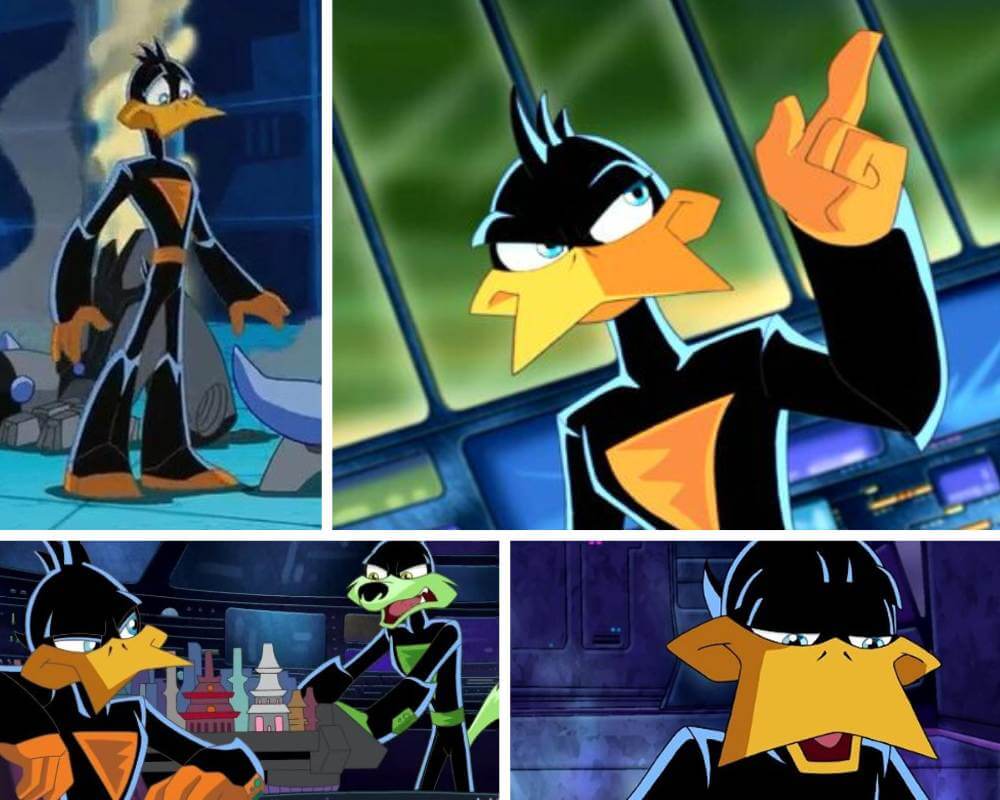
Here is the problem the writers inherited. Daffy Duck is not a hero. He is a jerk, and a brilliant one, whose whole appeal is watching him scheme, cheat, and earn his comeuppance. You cannot build a team-based superhero show around that.
So the reboot faced a real dilemma: keep the selfishness and make him unlikable, or soften him and lose the character entirely.
The writers split the difference, and the seams show.
Danger is selfish enough to feel like Daffy, yet heroic enough to belong on a team. He never fully commits to either.
That in-between quality is his biggest weakness, and also the thing that makes him the most interesting Loonatic to analyze.
- The core problem: Daffy’s comedy runs on greed and betrayal, which is poison for a team player.
- The compromise: Danger keeps the ego and the schemes, but now they backfire on him rather than on his teammates.
- The tonal clash: Tech fits the show’s slick super-science world instantly. Danger’s goofy, old-school archetype fights against a series straining to look cool.
- The lingering greed: the Daffy DNA is still visible. He once tried to become Slam’s wrestling manager purely for profit, then haggled to keep 90 percent of the winnings for himself.
Tactical Utility: The Wildcard Mechanic
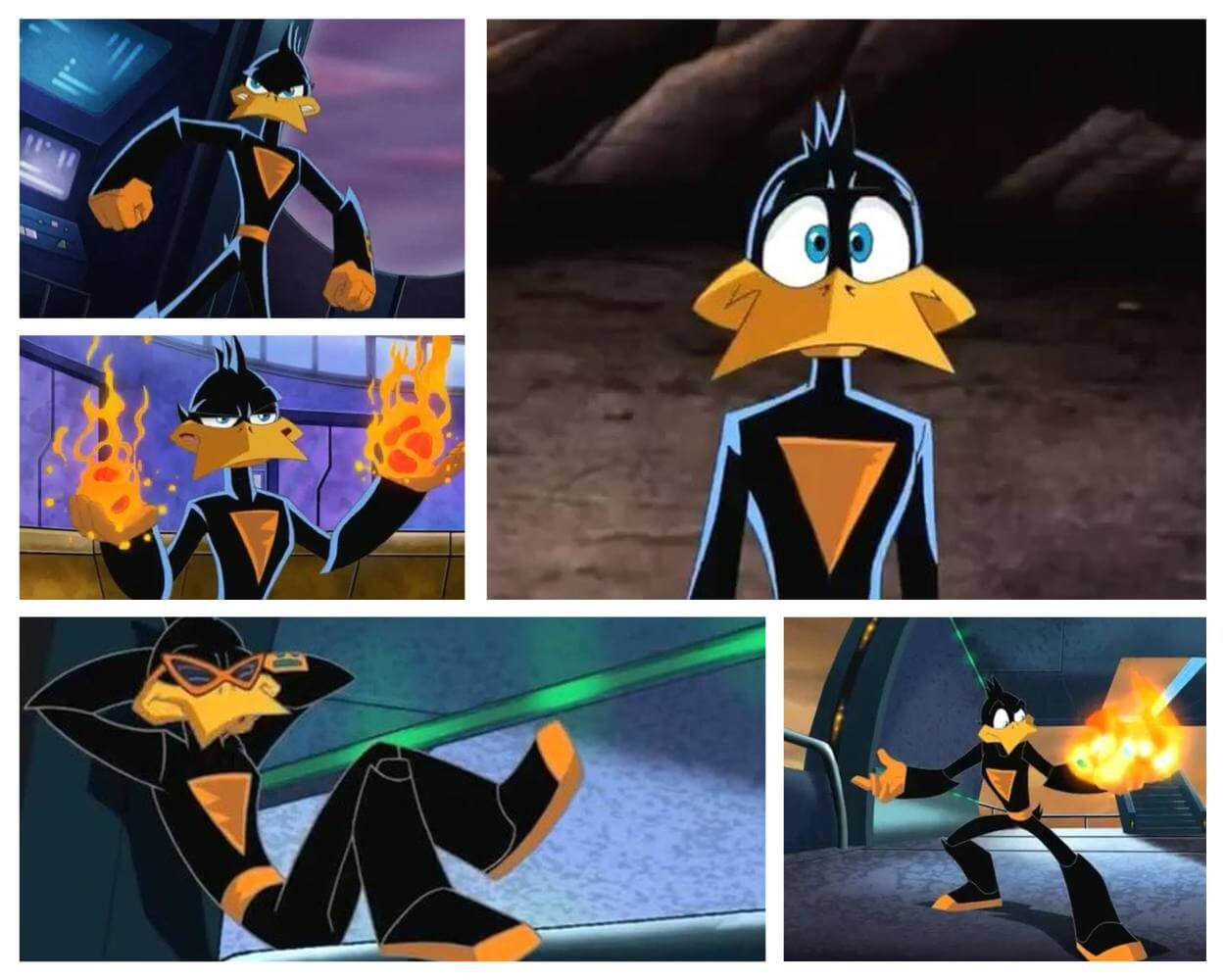
If Tech E. Coyote is the team’s precision instrument, Danger Duck is its wild swing. His powers are not built for control.
They are built for unpredictability, which turns out to be a weapon all its own. In a fight, that means nobody, including Danger himself, ever quite knows what is about to happen.
- Power Orb Randomizer: his signature move. He hurls flaming energy “eggs” whose effects are randomized. One might explode, the next might drop tar, orange juice, or a boulder on the target. Even Danger only half-controls them.
- Aqua Dense: near water, those eggs become blasts of aquatic energy, and he can bend the flow of water itself. He discovered the power in the middle of a mission and quickly learned to weaponize it.
- Quantum Quack: his teleport, which he calls “quacking.” It lets him blink through solid objects to dodge and ambush, though there is always a slight delay on the other side.
The Psychological Load: Narcissism as a Defense
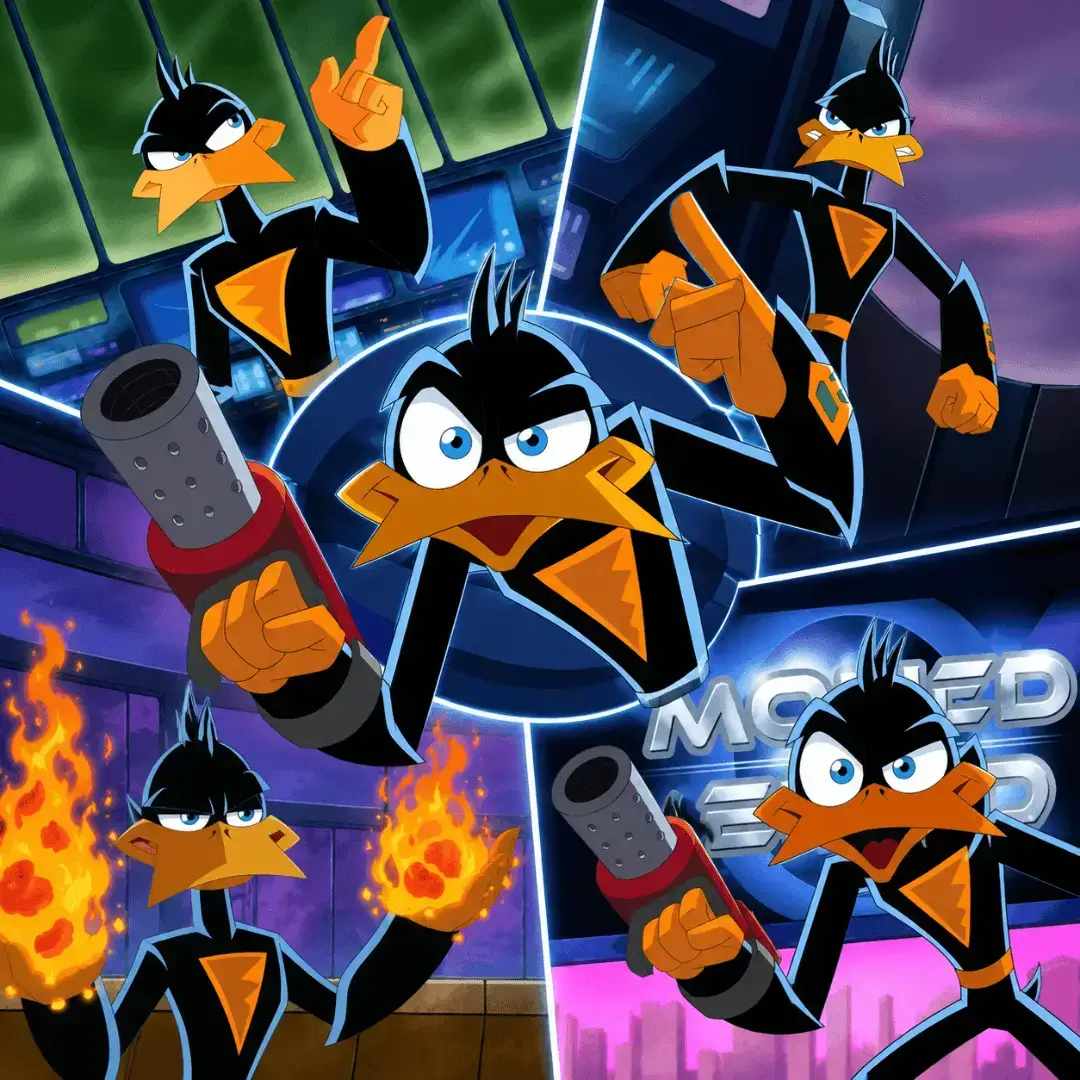
This is where Danger Duck gets quietly clever. Strip back the bragging and you find the most relatable character on the team. His arrogance is not confidence.
It is a costume.
Jason Marsden voices him with a manic, needy energy that sells the whole act. The louder he brags, the clearer it becomes that he is performing for an audience that may not be there. It is the loneliest kind of confidence, the sort that needs constant proof.
- The tell: the show itself describes his ego as mostly bluster. In truly dire moments, a real hero slips out from behind the bravado.
- The wound: Danger grew up in an orphanage and cheated a coin toss with a two-headed coin just to get adopted first. His swagger is built on an old fear of being left behind.
- The reinvention: he constantly tries to rebrand himself, requesting new names and even fighting to add a cape to his suit. That is not vanity. It is someone desperate to be seen as more than “just a duck.”
- The relatability: everyone has felt the imposter syndrome Danger runs on. He acts like the best because he is terrified that everyone else will realize he is just a duck in a cape.
The Nexus Interaction: The Danger/Tech Contrast
The show is at its best when it plays Danger and Tech off each other.
They are engineered opposites, and that contrast is the entire point. Danger even needles Tech about his inventions, right up until the moment he unselfishly rushes in to save him. It is a friendship built on friction.
Tech trusts systems, Danger trusts instinct, and the gap between them is where many of the show’s best moments live.
The Analytical Verdict: The Wildcard’s Worth
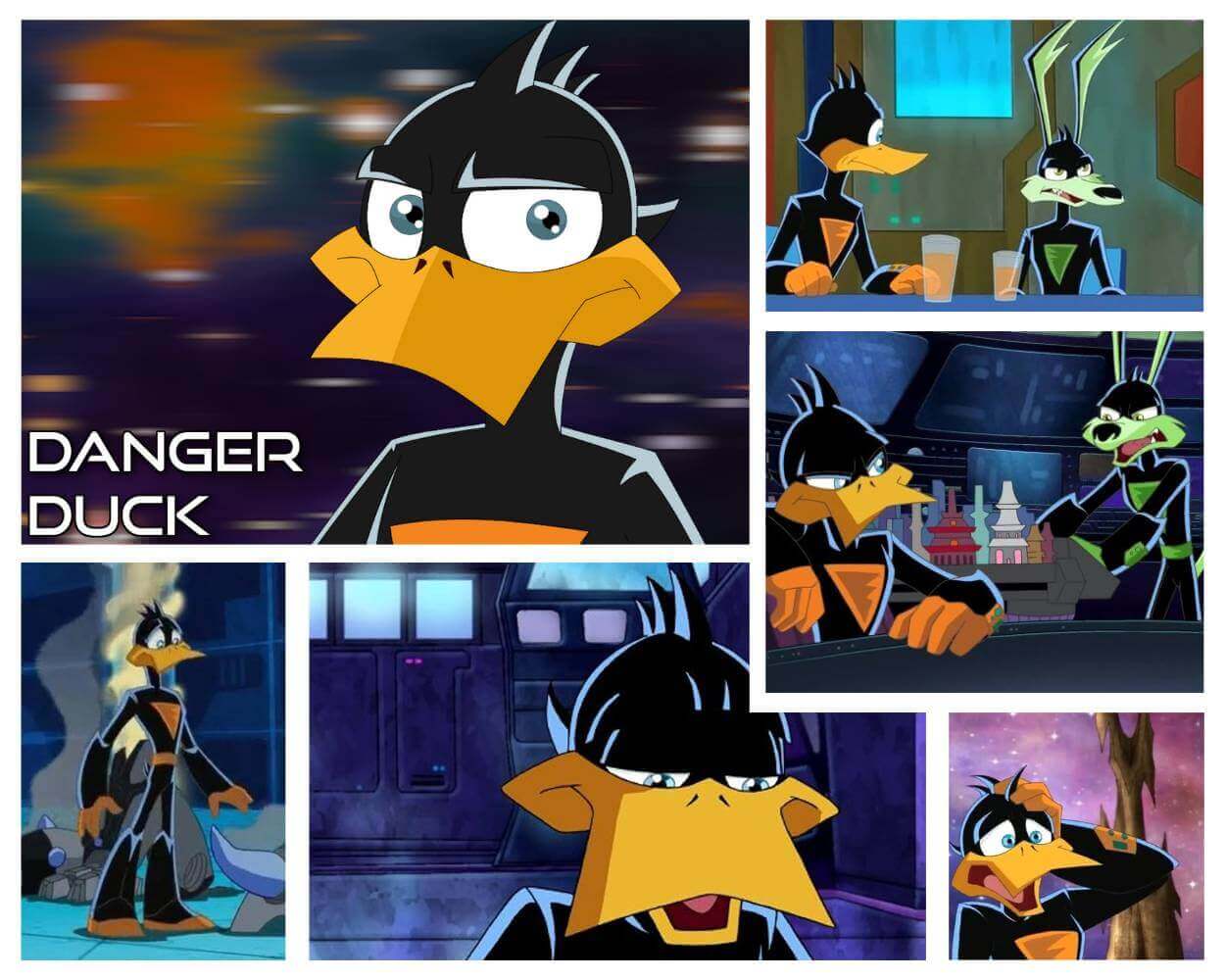
So did the experiment work? The fair answer is partly, and that is more of a compliment than it sounds. Danger Duck was never going to be a clean success, because his source material actively resists heroism. Judged as a faithful Daffy, he is too soft. Judged as a brand-new character, he is the most human member of the team.
Both readings are true at once, which is exactly why he divides people. He even tolerates Ace Bunny‘s leadership while quietly gunning for the top job himself.
The show clearly knows what it has.
It repeatedly hands him the winning move at the last second, as if to remind us the loudmouth was worth keeping around.
- As comic relief: he is the show’s reliable source of levity, the one willing to look ridiculous so the others can look cool.
- As a character: he is the emotional underdog, the imposter-syndrome everyman who makes the whole team feel human.
- As a redesign: he is a bold, flawed swing. He keeps Daffy’s DNA when the safe move would have been to erase it completely.
Danger Duck remains the great debate of Loonatics Unleashed.
Few characters in the whole franchise split a room faster.
Do you see him as the reboot’s charming wildcard, or its weakest link? Sound off in the comments below.

Did you know Danger Duck was originally intended to sound exactly like Daffy Duck, complete with his famous trademark lisp. However, actor Jason Marsden made the bold choice to drop the lisp for his performance, giving the character his own unique voice.
Jason Marsden is aso the voice for Goofy’s son Max in A Goofy Movie and Haku in Spirited Away.