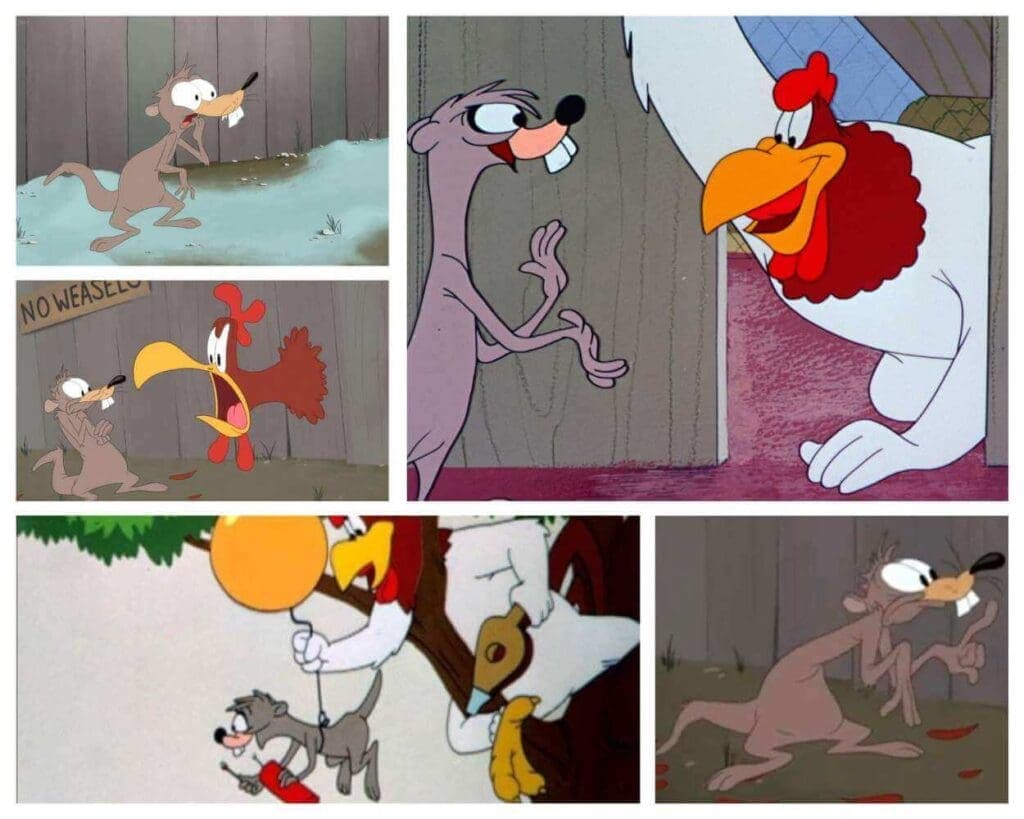
The Weasel is one of the most obscure recurring characters in the Looney Tunes barnyard. He turns up in exactly three classic shorts, he never gets a name, and he loses almost every time.
So he is worth a closer look, because the thing most write-ups say about him is backwards. The Weasel is not the schemer of these cartoons. He is the object both Foghorn Leghorn and the Barnyard Dawg keep picking up and pointing at each other.
Who the Weasel Is
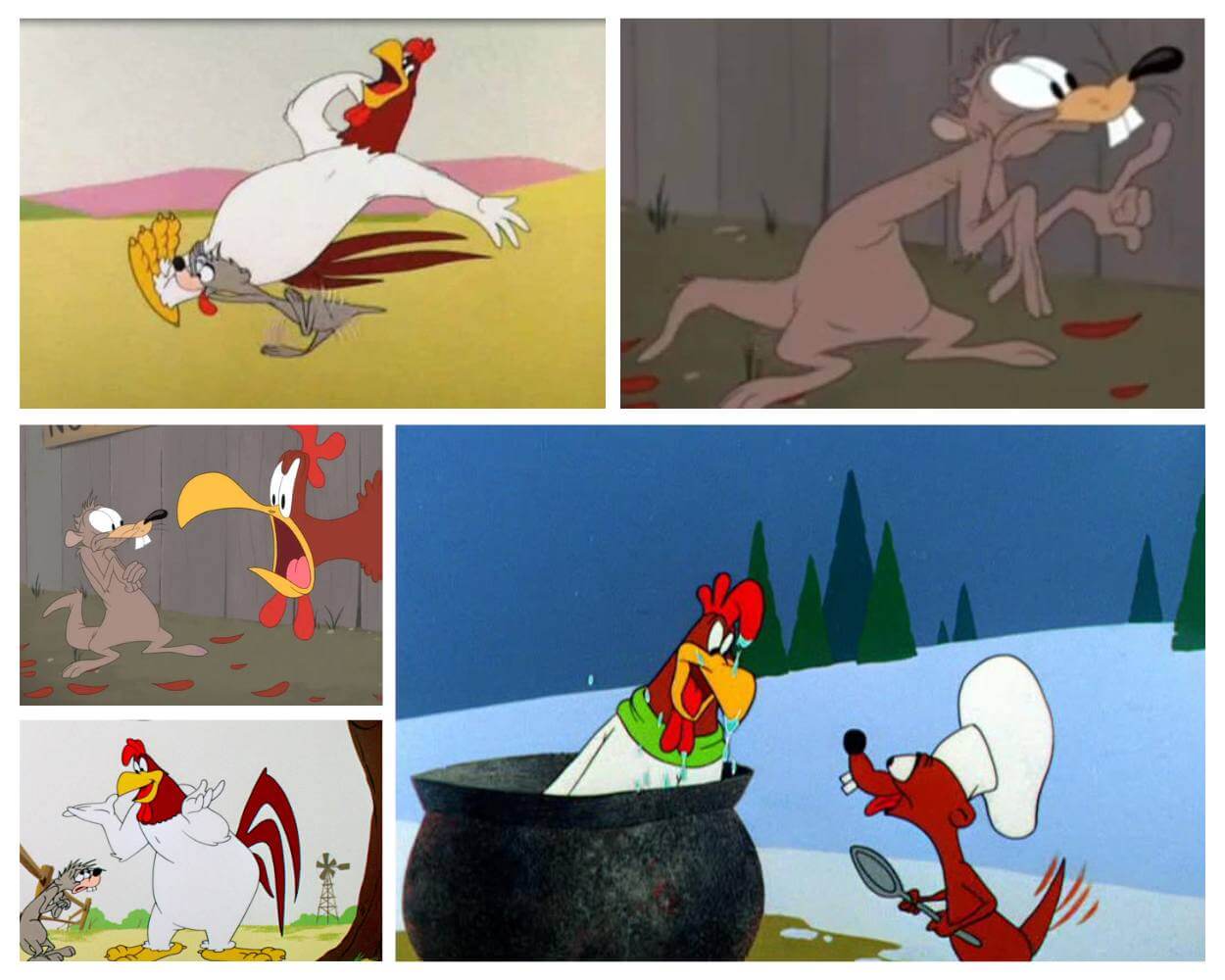
He is a lean, permanently starving predator who wanders into Foghorn Leghorn’s barnyard looking for a meal. That is the whole of his motivation across every appearance.
- His debut short opens on a wanted poster reading “WEASEL (CHICKEN THIEF)”.
- He appears in three Golden Age shorts, released between 1953 and 1958.
- Robert McKimson directed all three of them.
- Hunger, rather than mischief, drives everything he does.
Plop Goes the Weasel! (1953)
The debut is a Foghorn Leghorn short, and the Weasel walks into a feud that was already running.
- Warner Bros. released the short on 22 August 1953, with a story by Tedd Pierce.
- Carl Stalling scored it, and it runs about seven minutes in Technicolor.
- The Barnyard Dawg is on duty guarding the hen house.
- Foghorn deliberately lets chicks escape so the Dawg appears to be failing.
Weasel Stop (1956)
Three years later he returns, and the pattern repeats with the roles slightly shuffled.
- Warner Bros. released it on 11 February 1956.
- McKimson directed again, with Tedd Pierce back on story.
- Milt Franklyn scored this one instead of Stalling.
- It runs roughly six minutes.
Weasel While You Work (1958)
The final classic appearance is also the strangest, because it swaps the barnyard for deep snow.
- Warner Bros. released it on 6 September 1958.
- Unusually for a Foghorn short, the whole thing takes place in winter.
- A ravenously hungry Weasel turns up and starts gnawing on Foghorn’s leg.
- Foghorn and the Dawg spend the short redirecting him at each other.
He Is Not the Trickster, He Is the Weapon
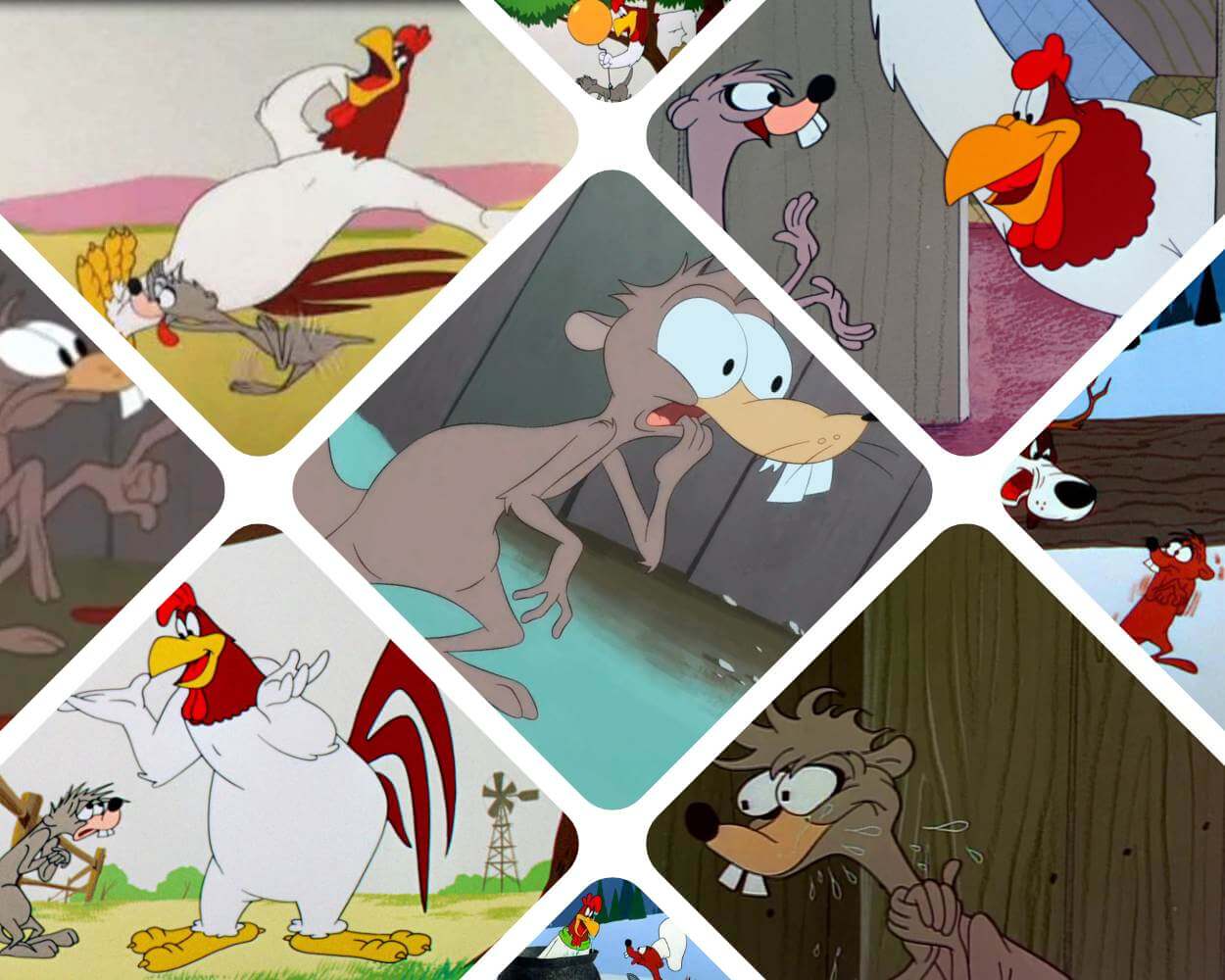
This is the part almost every article about him gets wrong, and it is the most interesting thing about the character.
- Foghorn and the Barnyard Dawg cannot stand each other, and that feud drives the shorts.
- Both of them use the Weasel as ammunition against the other.
- He is talked into working for either side with almost no effort.
- He winds up in the middle of every fight he did not start.
Does the Weasel Have a Name?
This is the question people most often search for, and the honest answer is short.
- The classic shorts never give him a name.
- Credits and studio material list him simply as the weasel.
- Some fan sites have invented names, though none of them are canon.
- He is occasionally described as the Hungry Weasel, which is a description rather than a name.
The Titles Are All Jokes
Every one of his shorts is named after a pun, which tells you how the studio thought about him.
- “Plop Goes the Weasel!” plays on the nursery rhyme “Pop Goes the Weasel”.
- The tune appears in that short’s opening and returns in his later cartoons.
- “Weasel While You Work” puns “Whistle While You Work” from Snow White.
- “Weasel Stop” works as a pun on the phrase weasel out.
Foghorn Leghorn and the Barnyard Dawg
The Weasel makes no sense without the two characters he keeps getting caught between.
- Foghorn debuted in “Walky Talky Hawky” on 31 August 1946.
- That same short introduced Henery Hawk and the Barnyard Dawg.
- Foghorn’s Southern drawl came from the radio character Senator Claghorn.
- The Dawg is a basset hound, and he appeared in twenty-three Golden Age shorts.
Who Voiced the Weasel
The voice history is brief, in keeping with the rest of his career.
- Mel Blanc voiced him across all three classic shorts.
- Blanc also voiced Foghorn Leghorn and the Barnyard Dawg in the same cartoons.
- Modern Warner Bros. productions have brought the character back.
- Eric Bauza handles much of the current Looney Tunes barnyard roster.
Frequently Asked Questions About the Looney Tunes Weasel
A few of the questions that come up most about this character.
What is the Weasel’s name in Looney Tunes? He does not have one. The classic shorts and studio credits refer to him only as the weasel.
When did the Looney Tunes Weasel first appear? In “Plop Goes the Weasel!”, released on 22 August 1953. Some sources incorrectly date his debut to 1943.
Who created the Looney Tunes Weasel? Robert McKimson, who also created Foghorn Leghorn and the Barnyard Dawg. He is sometimes wrongly attributed to Chuck Jones.
How many cartoons is the Weasel in? Three classic shorts: “Plop Goes the Weasel!” in 1953, “Weasel Stop” in 1956 and “Weasel While You Work” in 1958.
Is the Weasel in Space Jam? There is no reliable record of him appearing in the 1996 film, despite some filmographies listing it. Foghorn Leghorn does appear.
Does the Weasel fight Bugs Bunny? No. All three of his shorts are barnyard cartoons, so he never shares a scene with Bugs Bunny.
Who voiced the Weasel? Mel Blanc, who also voiced Foghorn Leghorn and the Barnyard Dawg in the same shorts.
Why is he called a chicken thief? His debut opens on a wanted poster with that exact label, and stealing chickens is his only real goal in every appearance.
Three cartoons across five years is a thin career, and yet the Weasel is oddly memorable. Being the thing two louder characters keep throwing at each other turns out to be a decent role.
So do you remember him from the Foghorn shorts, or is this the first you have heard of him?
Let me know in the comments.