In the world of Tokyo Ghoul, no name carries more terror or awe than Kishou Arima.
He was not simply an investigator. He was the Reaper, the impossible benchmark that every ghoul feared and every rookie idolized.
Behind the stoic mask and the spotless combat record sits one of the series’ most tragic figures: a man who lived only for his duty, with almost no room left for his own humanity.
Character Snapshot: Kishou Arima
- Series: Tokyo Ghoul
- Primary role: The Reaper / The Ceiling
- Core trait: Absolute efficiency
- Chaos rating: 0/10 (the embodiment of order)
- Best dynamic: Ken Kaneki (the final test)
- Status: Legendary
The Reaper: The CCG’s Impossible Standard
Kishou Arima sits at the very top of the CCG. He is the finest ghoul investigator the organization has ever produced, and for years he holds a record with no losses in it at all.
But that is the whole point of his character. He is not a threat. Instead, he is the ceiling. Every ghoul measures its odds against him, and every one of them comes up short.
- He clears the most dangerous targets without breaking a sweat.
- He turns the tide of entire operations on his own.
- He earns the names Reaper and White Reaper for a reason.
Why he matters: Most villains raise the stakes. Arima sets the limit. He is the wall every other fighter in the series is measured against.
Absolute Efficiency: Order in a World of Chaos

Tokyo Ghoul runs on chaos. Grief, rage, hunger, and revenge drive nearly every character in it. Arima is the exception.
So he faces a room full of monsters with the same flat calm he would bring to paperwork. No panic, no fury, no wasted motion. His chaos rating is a clean zero, and that stillness is scarier than any scream.
- He greets a legendary ghoul mid-fight instead of flinching.
- He corrects a subordinate for being off by a fraction of a second.
- He treats extermination as a craft, not a rush.
In a story where emotion gets people killed, Arima’s total control reads as the ultimate weapon. Order, it turns out, beats fury almost every time.
The Paradox of Empathy

A cold killing machine should feel nothing. Arima breaks that rule in quiet, telling ways.
Yet he respects his fallen enemies. He compliments the ghouls he fights. He even scolds a colleague for speaking ill of a dead investigator. For a man defined by slaughter, that is a strange amount of grace.
But the clearest crack in the armor is his bond with Ken Kaneki. There is real care buried under the ice, and it hints that Arima is far more than the weapon the CCG points at its problems.
The contradiction: Arima kills more ghouls than anyone alive, yet he shows them more respect than most of his peers ever do. That tension is the key to him.
A Master of Quinques

A quinque is a weapon forged from a dead ghoul’s kagune. In Arima’s hands, it becomes an extension of his body.
For example, his signature is IXA, a koukaku quinque built for both offense and defense. He wields several others with the same ease, and he treats every fight like a grandmaster reading a chessboard.
- IXA: his signature blade and shield in one.
- Narukami: a ranged ukaku quinque.
- Yukimura 1/3: the blade later passed to his student.
- Owl: an SSS-rated quinque of terrifying power.
Still, raw skill only tells half the story. Arima reads an opponent’s strengths, predicts the next move, and answers it before it lands. That mind is why the CCG calls him its best.
The Father Figure in Disguise

Cold, impassive, deadly. Then, quietly, something softer. Arima becomes a father figure to the amnesiac Kaneki, who lives for a time as the investigator Haise Sasaki.
Yet what starts as a stiff mentor-student setup grows into something close to family. Arima spars with him, lends him books, and gives him advice when he is lost. One character even describes Arima’s feelings toward him as parental love.
- He teaches Kaneki how to fight.
- He teaches him how to mentor others in turn.
- He gives him a steadiness he never had himself.
This is the warmest thread in Arima’s story, and it makes everything that comes later hurt far more.
A Role Model Built on a Secret

Inside the CCG, Arima is a living legend. Juniors idolize him, peers respect him, and his composure under pressure becomes the standard everyone chases.
But that admiration rests on a lie. Beneath the model-investigator image, Arima carries a secret that would shatter everything his fans believe about him.
- He is worshipped as humanity’s greatest shield against ghouls.
- He is, in truth, working toward the opposite goal.
- He lets the whole organization believe the legend anyway.
So the gap between the role model and the real man is enormous. Holding both faces at once, for years, takes a discipline that borders on cruelty to himself.
An Icon of Sacrifice: The Death That Made a King

Here is where the Reaper’s story turns tragic. Arima’s final fight with Kaneki is not a battle he intends to win. It is a handoff.
In fact, he holds back the entire time, later admitting he could have ended Kaneki hundreds of times over. Instead he provokes his student into fighting seriously, then takes his own life so Kaneki can claim the victory and the title that comes with it.
As he dies in Kaneki’s arms, he confesses the truth he has guarded for years and asks his student to carry the blame. It is the ultimate act of duty, and the ultimate act of love.
The turning point: Arima does not fall to a stronger fighter. He chooses to fall, so that Kaneki can rise as the One-Eyed King. His last act is engineering his own defeat.
The Wild Card: An Aura of Unpredictability

Just when the audience thinks Arima is fully solved, he pulls the rug out. His true loyalties rewrite everything that came before.
But that unpredictability is baked into the writing. He plays the villain to Kaneki’s hero, right up until the moment he reveals he was on the ghouls’ side the whole time.
- He appears as the CCG’s deadliest enforcer.
- He acts, in secret, as ghoulkind’s greatest hope.
- He keeps both truths hidden until his dying breath.
Still, few characters in the series flip their meaning so completely. Arima stays a wild card even after death, because his choices keep reshaping the plot.
The Unassuming Reaper: Appearance

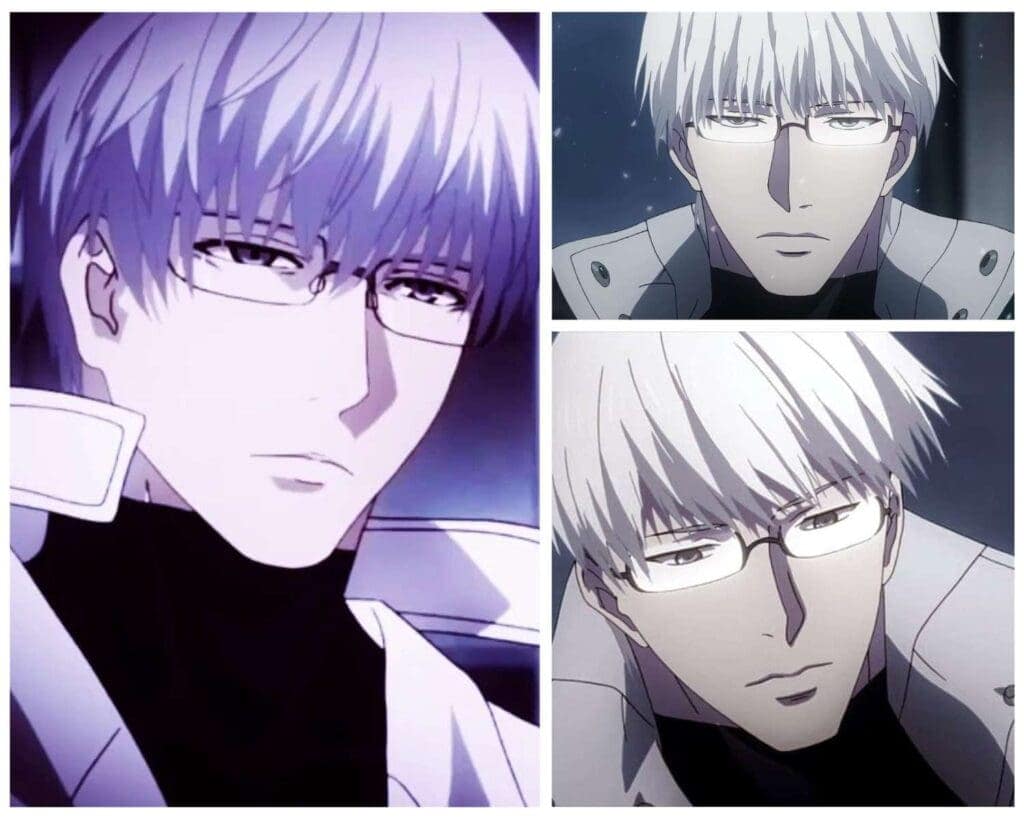
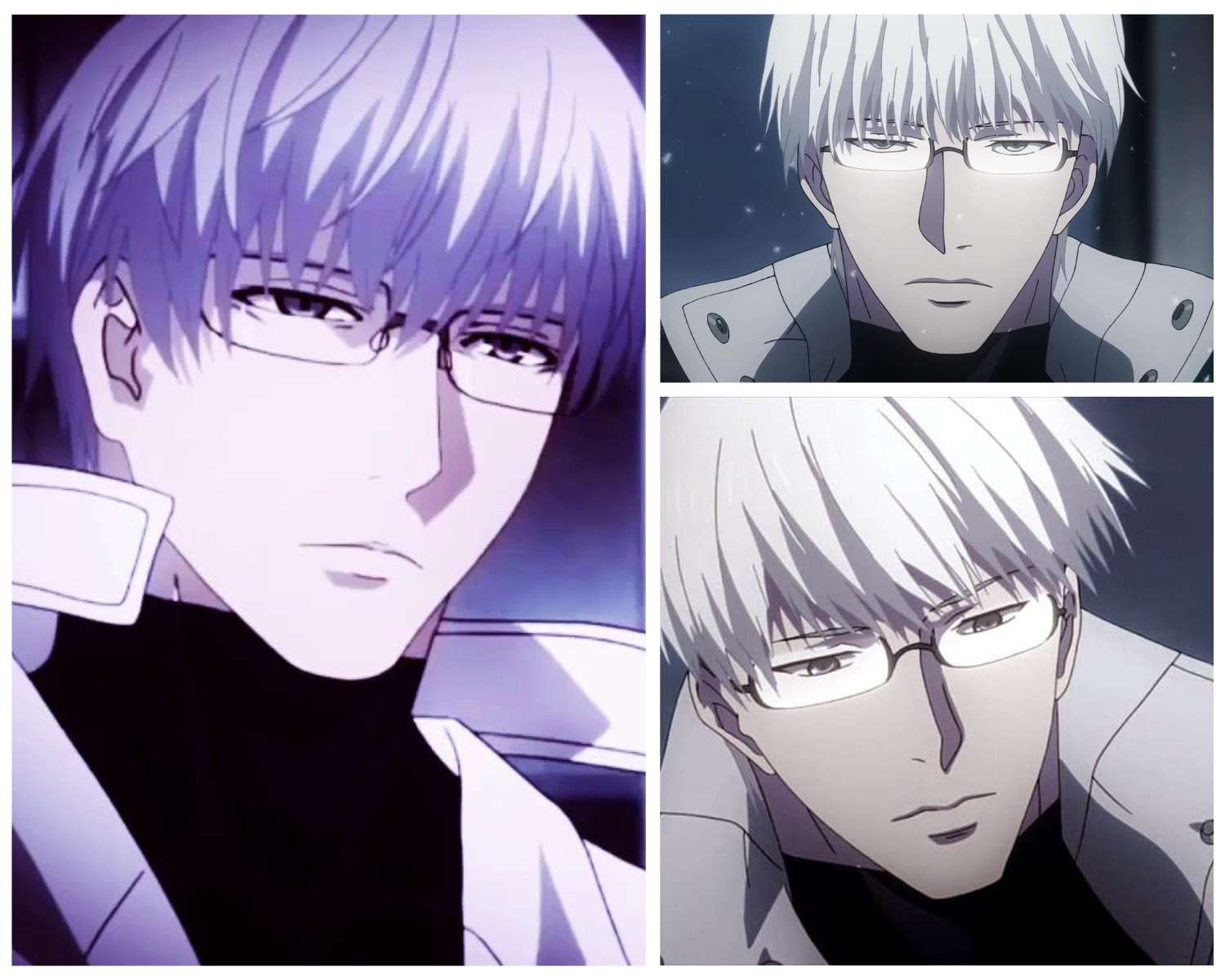
Arima looks nothing like a monster. He is tall and lean, with white hair, pale blue eyes, and a pair of glasses that make him read more like a scholar than a soldier.
But that mildness is the trick. Nothing about his face warns you how dangerous he is, and the contrast does a lot of quiet work.
- Unthreatening on the surface, lethal underneath.
- Emotionless in expression, yet capable of empathy.
- Bookish in style, yet the deadliest man in the room.
So his whole look mirrors the contradiction at his core. The most frightening figure in Tokyo Ghoul dresses like the last person you would fear.
The Stoic Guardian: Personality

Arima is a fortress of stoicism. His calm never cracks, even with ghouls closing in from every side. But that flatness is not the same as apathy.
But underneath it sits a deeply introspective man who wrestles with the weight of what he does. He is part duty-bound warrior, part silent philosopher, and the mix gives him a depth that most anime enforcers never get.
- He rarely shows emotion, yet clearly feels a great deal.
- He questions the morality of his own mission.
- He carries his doubts alone, without ever setting them down.
So that interior life is what separates Arima from a simple killing machine. He is a thinker trapped inside a weapon.
Kishou Arima’s True Tragedy: The Half-Human Ceiling

The real gut-punch arrives at the end. Arima was never fully human. He was a Half-Human, bred in a secret Washuu facility called the Sunlit Garden to be a perfect weapon.
Born without a kagune but with ghoul-level speed and strength, he could outclass ghouls that ordinary investigators could not touch. Yet that gift came at a brutal price.
- His body aged far too fast, which turned his hair white early.
- He was built and raised to kill, with no say in the matter.
- He was dying of that accelerated aging long before Kaneki arrived.
The tragedy in one line: The impossible ceiling was also a cage. Arima’s power was borrowed straight from his own shortened life, and he spent every bit of it on a duty he never chose.
Villain, Hero, or Pawn?

So which was he? For most of the series, Arima plays the antagonist, the shadow standing over every ghoul in the story. The finale flips that read completely.
He was raised as a tool of the Washuu system, then quietly turned that role against his masters. Working with Eto, he spent years shaping a successor who could break the cycle he was trapped in.
- A villain, to everyone who feared the Reaper.
- A hero, to the future he was secretly building.
- A pawn who learned to move himself across the board.
So Arima is all three at once. That refusal to sit in a single box is exactly what makes him unforgettable.
Arima’s Legacy: The Ceiling That Chose to Fall

In the end, Arima’s death is not an ending. It is a foundation. By handing the title of One-Eyed King to Kaneki, he plants the seed for a world where humans and ghouls might finally coexist.
Still, his fingerprints stay on the story long after he is gone. The CCG loses its symbol, the ghouls gain a champion, and the whole balance of Tokyo Ghoul shifts because one man decided to fall on purpose.
More from the Tokyo Ghoul cluster:
Arima Kishou was a protector, a judge, and in the end a pawn who turned himself into a player.
He paved the way for the future of the CCG and for the rise of the next One-Eyed King. For deeper background, the series runs on the dark, brilliant world that Sui Ishida built across Tokyo Ghoul and its sequel, with plenty more character lore on the Tokyo Ghoul wiki.
Voice Your Opinion
Settle the debate:
- Was Arima a villain, a hero, or just a man who lost himself in his mission?
- Where does he rank for you against the other greats in the series?
Drop your verdict in the comments.
The Reaper spent his whole life as the answer to everyone else’s questions, so it feels right to leave the last word to you.