Before gritty reboots and sprawling cinematic universes, Saturday morning television was a much simpler, weirder place.
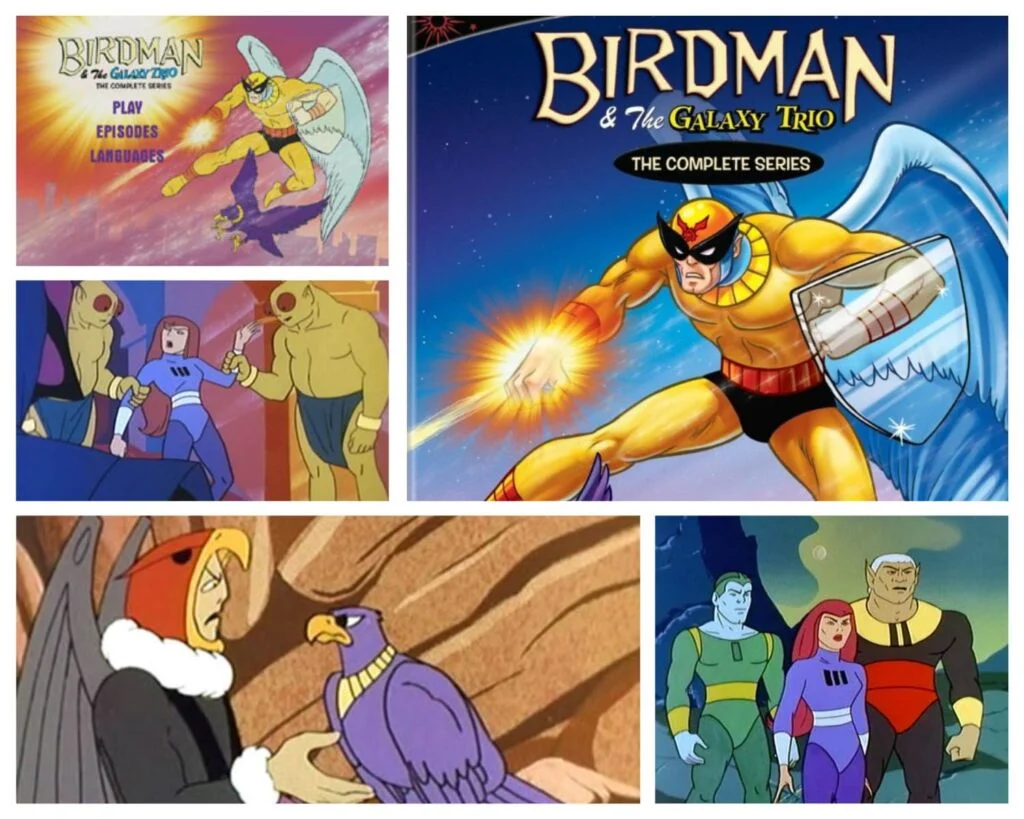
In 1967, Hanna-Barbera gave us Birdman and the Galaxy Trio, a high-energy fusion of solar-powered heroics and cosmic law enforcement.
Created by the legendary Alex Toth, the show never bothered with long-winded backstories.
It ran on pure imaginative energy instead.
So let me take you back to the sun-drenched skies of Ray Randall and the far-off planets of Vapor Man, Gravity Girl, and Meteor Man, and explain why this odd little series still matters.
The Legendary Birdman and the Galaxy Trio
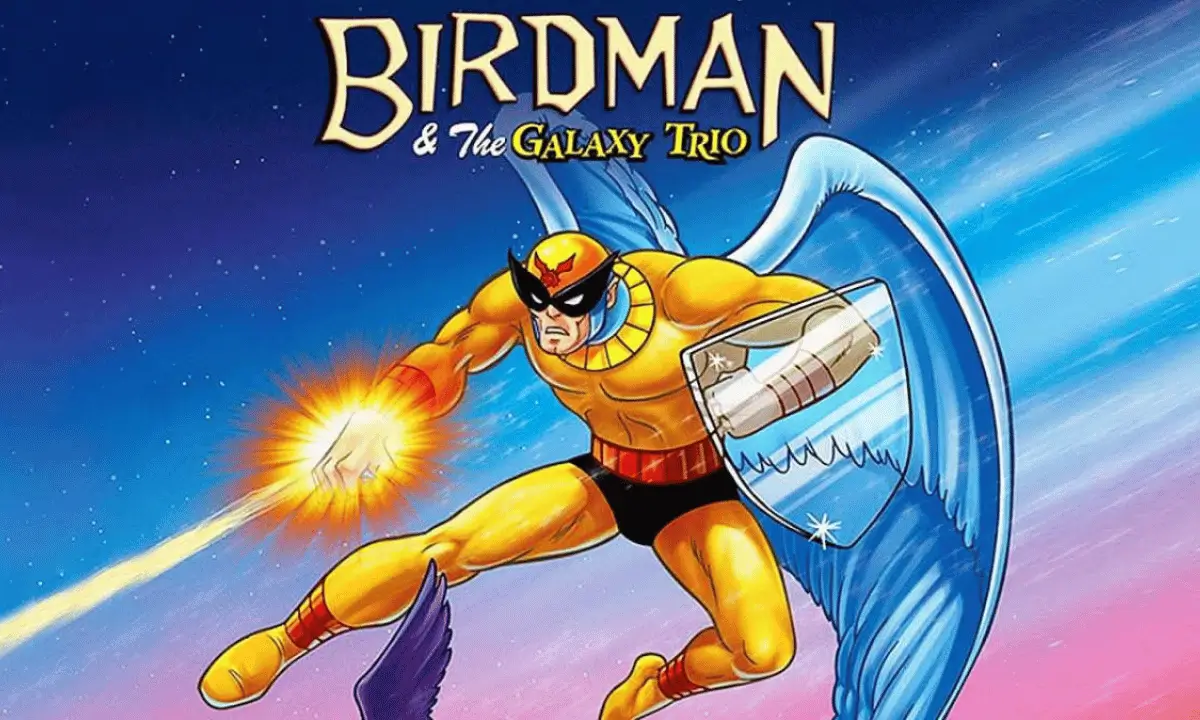
Birdman is not your everyday superhero. He is your solar-powered, sonically-named crimefighter, soaking up energy from the sun like a beefed-up houseplant.
He debuted on NBC on September 9, 1967, right in the middle of a Saturday morning superhero boom.
When he is not winging it against villains like the brilliantly named Dr. Millennium, he is bellowing his own name, “Biiirdman!”, at the top of his lungs. And that yellow and blue uniform?
The bird has style.
Set the scene: 1967 was the year Saturday morning went superhero-crazy, and Hanna-Barbera cranked out six new hero shows at once. Birdman and the Galaxy Trio was NBC’s entry, going up against CBS’s Space Ghost and ABC’s Fantastic Four, all designed by the same artist, Alex Toth.
The Galaxy Trio: Cosmic Justice with a Dash of Quirk

You have met Birdman, but what about the other half of the show? The Galaxy Trio are three alien lawkeepers who put the “space” in space justice.
Here is the team, and what each one brings to a fight:
- Vapor Man (from the planet Vaporus): can turn his body into any kind of gas. Strategy: he is the infiltrator, slipping through cracks and dodging solid attacks.
- Meteor Man (from the planet Meteorus): can enlarge his body and limbs for huge strength. Strategy: he is the heavy hitter, the answer whenever brute force is the only option. He is voiced by Ted Cassidy, better known as Lurch from The Addams Family.
- Gravity Girl (a princess of the planet Gravitas): can bend gravity to her will. Strategy: she is the tactical brain, solving problems that muscle cannot by pinning foes and lifting entire ships.
Dynamic Duos and Terrific Trios: The Episode Format

Ever wished one TV show was secretly two shows? Hanna-Barbera had you covered.
Each half hour was built like a sandwich. You got a Birdman adventure, then a Galaxy Trio adventure in the middle, then a second Birdman story to close things out. Three self-contained seven-minute segments, back to back.
Fun quirk: Despite sharing a title, Birdman and the Galaxy Trio never once crossed over. Two grounded Birdman thrillers wrapped around one wild space romp gave kids variety without whiplash.
Legacy and Influence: From the ’60s to Today

Despite a single-season run, the impact of Birdman and the Galaxy Trio still echoes today.
The most famous ripple is the parody series Harvey Birdman, Attorney at Law, which reimagined our hero as a defense lawyer for fellow Hanna-Barbera characters.
Who knew Birdman’s legal credentials were as sharp as his solar blasts?
Once you have heard that power scream, you never forget it.
From Limited Animation to Icon: The Alex Toth Effect
I will be straight about the animation. By modern standards it can look stiff, with the same flight and transformation shots reused over and over.
But that is not really a flaw. This was pioneering “limited animation,” the cost-saving style that made TV cartoons possible in the first place, and it laid the groundwork for decades of action animation.
The real magic was the design. Alex Toth had a gift for bold, simple shapes that read instantly, even when the characters barely moved. His genius was the silhouette, not the motion, and it is why these heroes still look striking.
The sound of a hero: The music came from Ted Nichols, who scored almost every Hanna-Barbera hit from 1963 to 1972. His brassy, repetitive, endlessly heroic cues gave the whole studio catalog its instantly recognizable retro-adventure sound.
The Galaxy Trio’s Cameo Carnival

These characters have a real habit of resurfacing. Gravity Girl, for one, showed up in Harvey Birdman, Attorney at Law right alongside Birdman himself.
It seems Hanna-Barbera can never quite resist dropping these vintage do-gooders back into the mix, giving new audiences a taste of that old-school cosmic justice.
The Space Stars Connection

Here is one worth correcting, because a lot of fan sites get it wrong. In 1981, Hanna-Barbera launched Space Stars, a cosmic-hero revival on NBC.
Birdman and the Galaxy Trio themselves were not part of it. Space Stars brought back Space Ghost and the Herculoids instead. But their fingerprints were all over the show.
The real link: Space Stars introduced a brand-new team called Teen Force, which was essentially a younger reimagining of the Galaxy Trio. Elektra echoed Gravity Girl and Moleculad echoed Meteor Man. So the Trio’s spirit carried on, even without the original heroes on screen.
Feathers Fly in Future Quest

Then there is Future Quest, the crossover comic that fans did not know they needed until they had it.
Published by DC Comics in 2016, Future Quest united the mightiest of Hanna-Barbera’s action heroes, and both Birdman and the Galaxy Trio played major roles. Their classic 60s personas got a modern makeover that pulled in a whole new generation of readers.
Meet Birdman’s Roster

In the Birdman half of the show, the hero is an ordinary secret agent named Ray Randall, granted powers by the sun god Ra. Here is his corner of the cast:
- Birdman: shoots solar blasts, projects a force field, and flies on giant wings.
- Avenger: his loyal eagle sidekick and constant companion.
- Falcon 7: the intelligence agent who dispatches Birdman on his missions.
- Birdboy: a young protege Birdman rescued after a plane crash, who gained similar powers.
The built-in weakness: Birdman draws all his power from the sun, so his enemies learn to trap him somewhere dark, where his strength drains faster than a phone battery. It gave nearly every episode a simple, effective ticking clock.
The Galaxy Trio Up Close

The Galaxy Trio operate out of their spaceship, the Condor One, as agents of the Galactic Patrol.
Vapor Man can turn into any form of gas. Meteor Man, arguably the most versatile, can resize parts of his body, making a fist the size of a boulder when he needs it. And Gravity Girl truly defies the norms, bending gravity to her will and, more often than not, being the one who wins the day.
Meet the Villains: Deliciously Despicable

Our heroes would be nothing without their rogues.
Birdman’s earthly, spy-fi threats include the hilariously named Dr. Millennium, the criminal organization F.E.A.R. and its masked leader Number One, plus schemers like Reducto and the assassin X the Eliminator.
The Galaxy Trio, meanwhile, played on a cosmic scale, tangling with the likes of Computron, Titan the Titanium Man, and the monstrous Growliath. That difference in danger, grounded versus galactic, is the whole appeal of the pairing.
The Comics and the Long Legacy

Birdman starred in Gold Key’s Hanna-Barbera Super TV Heroes comic from 1968 to 1969, making seven appearances, with the Galaxy Trio joining him in the second issue.
From there the journey kept going.
He turned up in DC’s Toonami comic in 1997, ran through Cartoon Network and Boomerang reruns, got the parody treatment in Harvey Birdman in 2000, headlined Future Quest in 2016, and by 2021 Gravity Girl was cameoing as a referee in Jellystone!
Why it still soars: Birdman and the Galaxy Trio is not high art, and it never pretends to be. It is a bold, colorful, wonderfully weird time capsule of the moment Saturday morning fell in love with superheroes. For fans of vintage animation, it is absolutely worth a watch.
Full Episode Guide
Every episode is made up of three seven-minute segments. The first and third spotlight Birdman, while the Galaxy Trio takes the middle slot. Here is the complete run.
Episode 1
- “The Menace of Dr. Millennium”
- “Revolt of the Robots”
- “X the Eliminator”
Episode 2
- “The Ruthless Ringmaster”
- “The Battle of the Aquatrons”
- “Morto the Marauder”
Episode 3
- “Birdman vs Cumulus, the Storm King”
- “The Galaxy Trio vs. the Moltens of Meteorus”
- “Nitron, the Human Bomb”
Episode 4
- “Birdman vs. the Mummer”
- “The Galaxy Trio vs. Growliath”
- “The Quake Threat”
Episode 5
- “The Brain Thief”
- “The Galaxy Trio and the Sleeping Planet”
- “Avenger for Ransom”
Episode 6
- “Birdman meets Birdgirl”
- “The Galaxy Trio and the Cavemen of Primevia”
- “Birdman vs. the Constrictor”
Episode 7
- “Birdman meets Reducto”
- “Titan the Titanium Man”
- “Serpents of the Deep”
Episode 8
- “Hannibal the Hunter”
- “Computron Lives!”
- “The Purple Moss”
Episode 9
- “The Incredible Magnatroid”
- “Space Fugitives”
- “Vulturo, Prince of Darkness”
Episode 10
- “Birdman vs. Dr. Freezoids”
- “The Eye of Time”
- “The Wings of FEAR”
Episode 11
- “Number One”
- “The Duplitrons”
- “Train Trek”
Episode 12
- “The Deadly Duplicator”
- “The Demon Raiders”
- “The Deadly Trio”
Episode 13
- “Professor Nightshade”
- “The Rock Men”
- “The Chameleon”
Episode 14
- “Birdman meets Birdboy”
- “Return to Aqueous”
- “The Empress of Evil”
Episode 15
- “Birdman meets Moray of the Deep”
- “Space Slaves”
- “Birdman and the Monster of the Mountains”
Episode 16
- “The Revenge of Dr. Millennium”
- “Invasion of the Sporoids”
- “The Return of Vulturo”
Episode 17
- “The Ant Ape”
- “Gralik of Gravitas”
- “The Wild Weird West”
Episode 18
- “Morto Rides Again”
- “Plastus the Pirate Planet”
- “Skon of Space”
Episode 19
- “Mentor, the Mind Taker”
- “Drakmore the Despot”
- “The Pirate Plot”
Episode 20
- “Murro the Marauder”
- “Peril of the Prison Planet”
- “Birdman vs. the Speed Demon”
So which side were you on: the sun-powered skies with Birdman, or the far reaches of space with the Galaxy Trio? For me, it is the calm confidence of that big “Biiirdman!” every single time.