
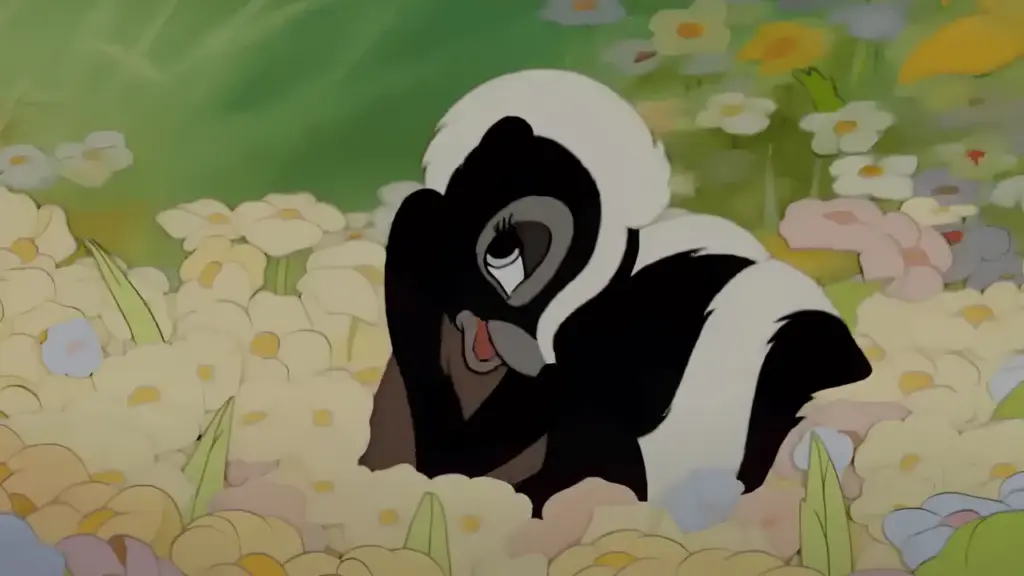
Flower from Bambi is one of Disney’s most frequently misunderstood characters.
He has a traditionally feminine name, long eyelashes, a soft voice and a bashful habit of blushing before disappearing behind his tail. Put those traits together, and it is easy to understand why so many viewers assume Flower is a girl.
The film itself is clear that he is male.
What makes the confusion interesting is not the answer. It is how quickly animation teaches us to read a character through a name, voice, silhouette and a few carefully chosen expressions.
Flower is only a supporting character in Bambi, but his design communicates an entire personality before he has finished his first scene.
Flower from Bambi at a glance
- Animal: Skunk
- Sex: Male
- First appearance: Bambi in 1942
- Created for: Disney’s animated adaptation
- Young voice: Stanley Alexander
- Adolescent voice: Tim Davis
- Adult voice: Sterling Holloway
- Bambi II voice: Nicky Jones
- Closest friends: Bambi and Thumper
- Defining trait: His gentle personality
Who Is Flower From Bambi?
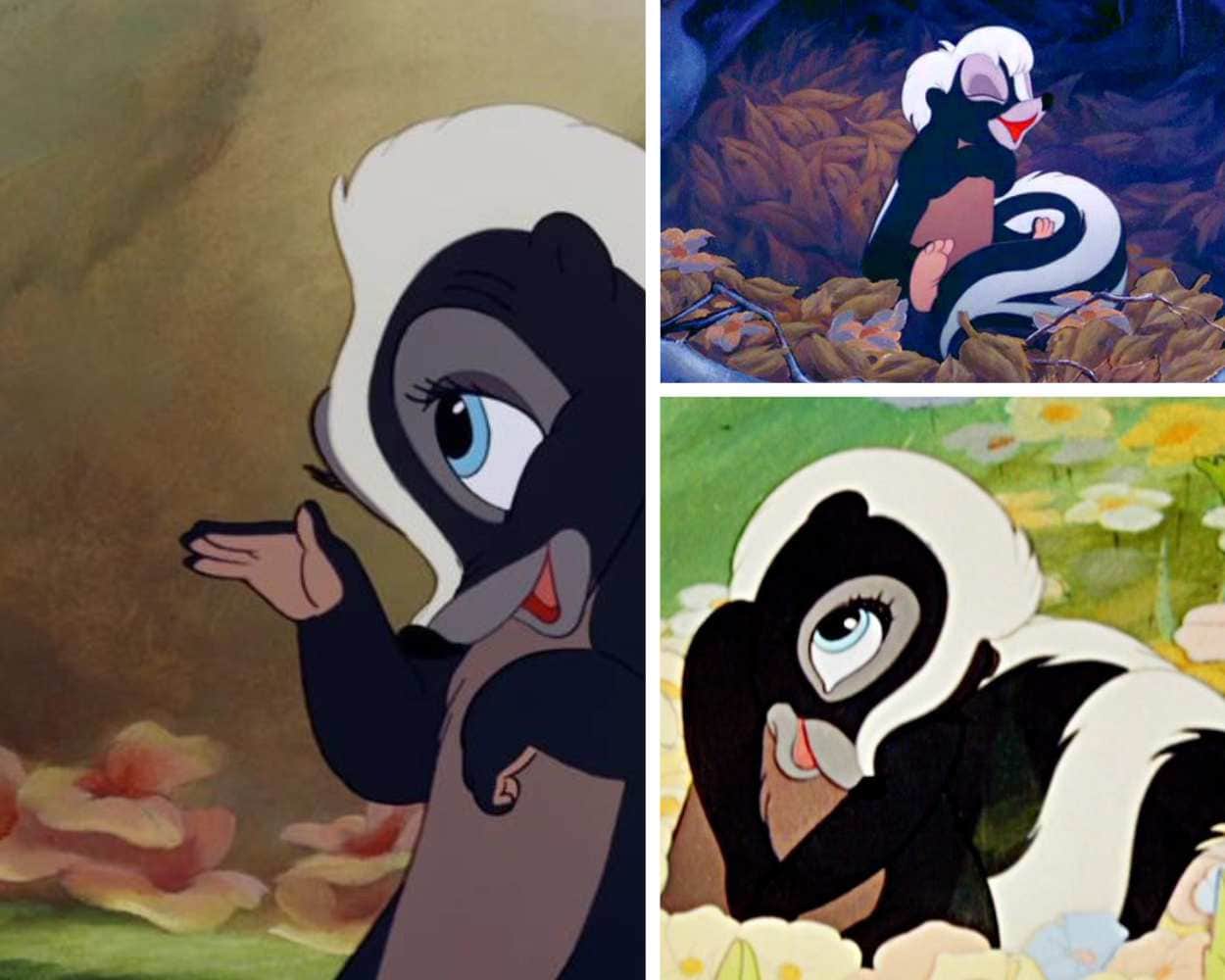
Flower is the shy young skunk character who becomes one of Bambi’s first friends.
Disney released Bambi in 1942. The film follows a young deer as he discovers friendship, winter, love, loss and the dangers that exist beyond the safety of his mother.
Flower provides some of its quietest and warmest moments.
He does not have Thumper’s confidence or Bambi’s importance to the story. He rarely raises his voice, causes trouble or tries to control a scene.
He is simply happy to be included.
Disney’s official Flower profile describes him as Bambi’s skunk friend and identifies Stanley Alexander and Sterling Holloway as his young and adult voices.
Flower’s personality is built around softness:
- He speaks quietly.
- He blushes easily.
- He hides behind his oversized tail.
- He avoids confrontation.
- He responds to kindness with immediate trust.
That creates a clever contradiction.
A real skunk’s black-and-white pattern acts as a warning. Flower has the same high-contrast design, but he may be the least threatening character in the forest.
The design joke beneath the character
Flower looks like an animal other creatures should avoid, yet his entire personality invites affection. Disney takes nature’s warning label and places it on the gentlest member of Bambi’s group.
How Flower Got His Name
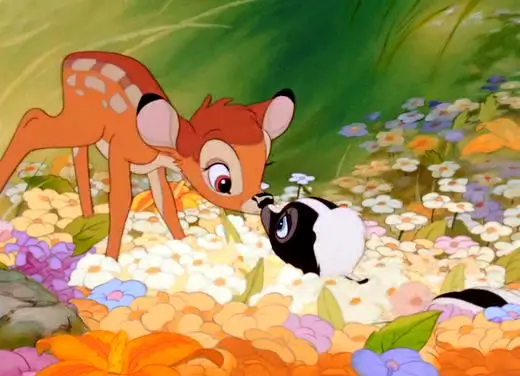
Flower receives his name during one of the most memorable scenes in Bambi.
Thumper is helping the young deer learn new words. After identifying a bird and struggling with the word “butterfly,” Bambi wanders into a bed of blossoms.
He pushes his face through the flowers and finds a baby skunk staring back at him.
Bambi proudly calls the animal a flower.
Thumper laughs and attempts to correct the mistake, but the skunk blushes and replies:
“He can call me Flower if he wants to. I don’t mind.”
The scene is brief, but it establishes the character immediately.
- Flower is too shy to interrupt Bambi himself.
- He understands that Bambi is trying to be friendly.
- He is pleased by the compliment inside the mistake.
- He does not object to receiving a delicate name.
The Library of Congress revisited the scene while telling the story of Stanley Alexander, the six-year-old actor who supplied Flower’s original voice.
What makes the exchange work is Flower’s response.
Thumper sees an error that needs correcting. Flower sees a new friend trying to say something kind.
Is Flower From Bambi a Boy or a Girl?
Flower is a boy.
Disney’s official character material uses male pronouns, and the original film follows him from childhood into adulthood.
Later in the story, Flower falls in love with a female skunk. By the ending, they have a young son whom Flower names Bambi after his childhood friend.
There is no uncertainty within the film.
The confusion comes from the way Flower is presented.
Why Flower is often mistaken for a girl
- His name: “Flower” is more often associated with female characters in English-language children’s stories.
- His eyelashes: Long eyelashes have traditionally been used as visual shorthand for femininity in cartoons.
- His voice: Young Flower speaks in a soft, high register.
- His expressions: He blushes, lowers his eyes and hides coyly behind his tail.
- His temperament: Older cartoons often assigned shyness and emotional sensitivity to female characters.
Those design cues do not mean Disney intended Flower to be secretly female.
They show how animation relies on a visual vocabulary audiences learn over time. A few eyelashes, a gentle voice and a traditionally feminine name can shape an assumption before the story provides any other information.
Flower is male, but several parts of his design are feminine-coded.
Both facts can be true.
Flower and Feminine Character Design Tropes
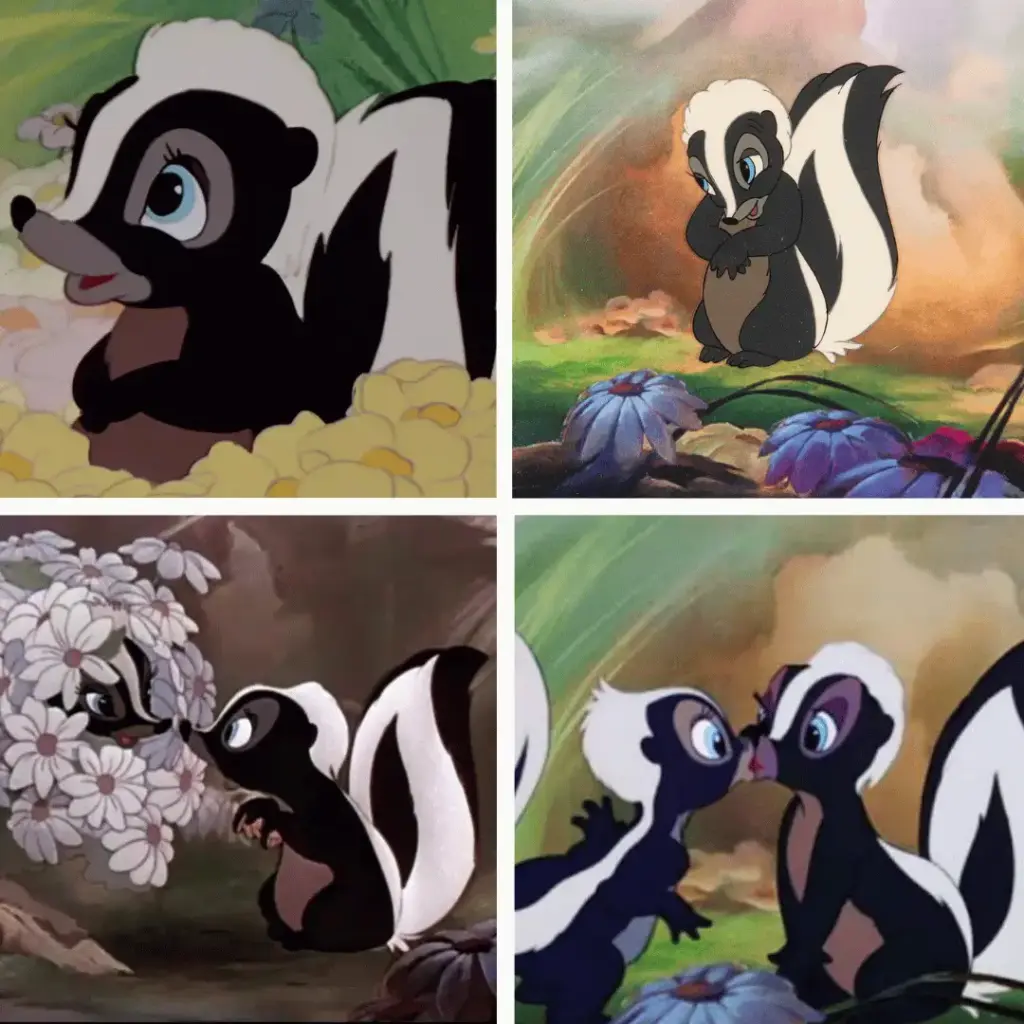
Flower arrived during an era when young male cartoon sidekicks were often noisy, mischievous or physically comic.
Thumper fits that tradition much more closely. He is energetic, outspoken and eager to prove that he understands the forest better than Bambi.
Flower is allowed to be different.
He is:
- Quiet without seeming suspicious
- Emotional without being treated as weak
- Gentle without needing to become tougher
- Visibly shy around affection
- Comfortable with a delicate name
The film finds humor in his bashfulness, especially when he becomes “twitterpated,” but it never suggests that his softness is a defect.
Flower does not demand a stronger name. His friends do not pressure him to act more traditionally masculine. The story never gives him a lesson about toughening up.
He remains gentle from beginning to end.
Why this still feels distinctive
Flower is a male character defined by tenderness, modesty and emotional openness. Those qualities are not obstacles he must overcome. They are the reasons Bambi trusts him and audiences remember him.
Flower Was Created for Disney’s Bambi
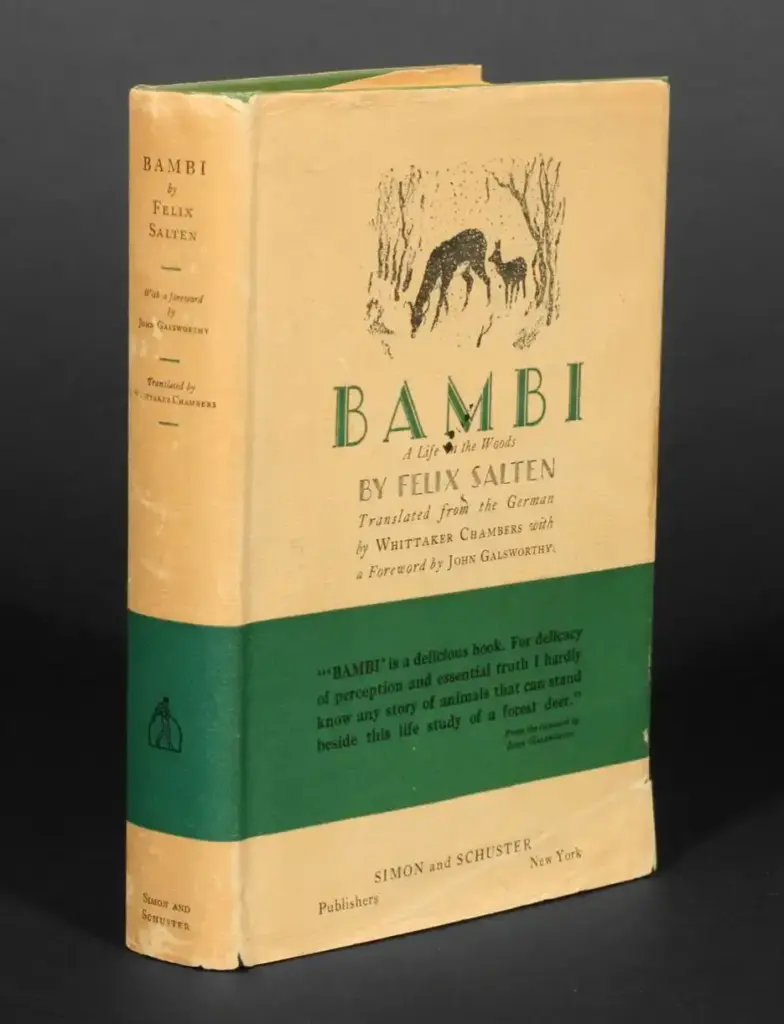
Flower did not appear in Felix Salten’s original novel, Bambi: A Life in the Woods.
The Walt Disney Family Museum’s comparison of the novel and film identifies Flower as a character created by Walt Disney and his team for the animated adaptation.
Salten’s novel is darker and more philosophical than the finished Disney feature. It focuses heavily on survival, fear and the relationship between animals and human hunters.
Disney reshaped the material for film.
Some literary characters were removed or combined, while new personalities were created to give the young Bambi friendship, humor and emotional warmth.
Flower serves a clear purpose within that adaptation.
Thumper teaches Bambi how to move and talk. Flower teaches him something quieter: a mistake does not need to become an embarrassment when it was made with kindness.
How Marc Davis Helped Bring Flower to Life
Flower also occupies an important place in Disney animation history.
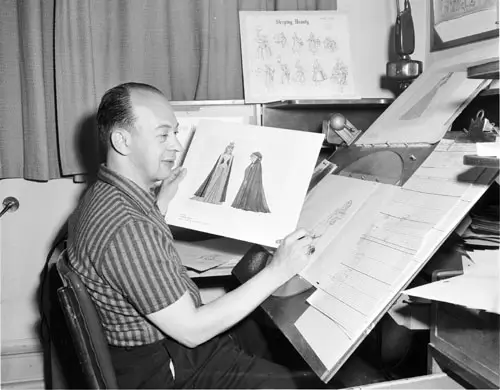
Marc Davis worked on the development and animation of the young forest characters in Bambi.
He later became one of Disney’s celebrated Nine Old Men and helped create characters including:
- Cruella de Vil
- Maleficent
- Tinker Bell
- Aurora
- Cinderella
Before those famous assignments, Davis studied the animals of Bambi and worked to understand how their real anatomy could support believable performances.
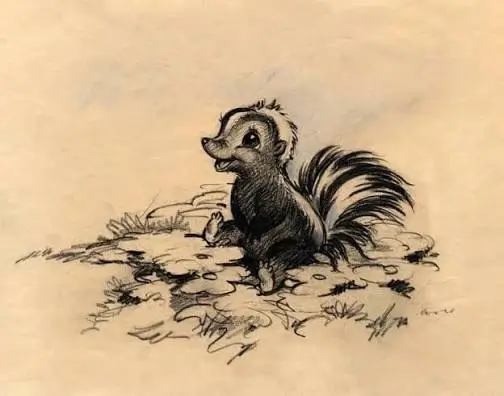
Animator Andreas Deja has identified Flower as Davis’s first character animation assignment.
The artists did not begin with a generic cartoon body and add a stripe.
They studied:
- How a skunk carries its weight
- How its joints bend
- How low its body sits to the ground
- How the tail changes its silhouette
- How the animal moves when cautious or relaxed
The finished character simplifies that anatomy, but it never abandons it.
Flower takes small steps, stays close to the ground and uses his tail as both a physical feature and an emotional prop.
The smartest part of Flower’s design
His tail is larger than the rest of his body. It identifies him instantly as a skunk, frames his face and provides somewhere to hide whenever attention becomes uncomfortable.
Who Voiced Flower in Bambi?
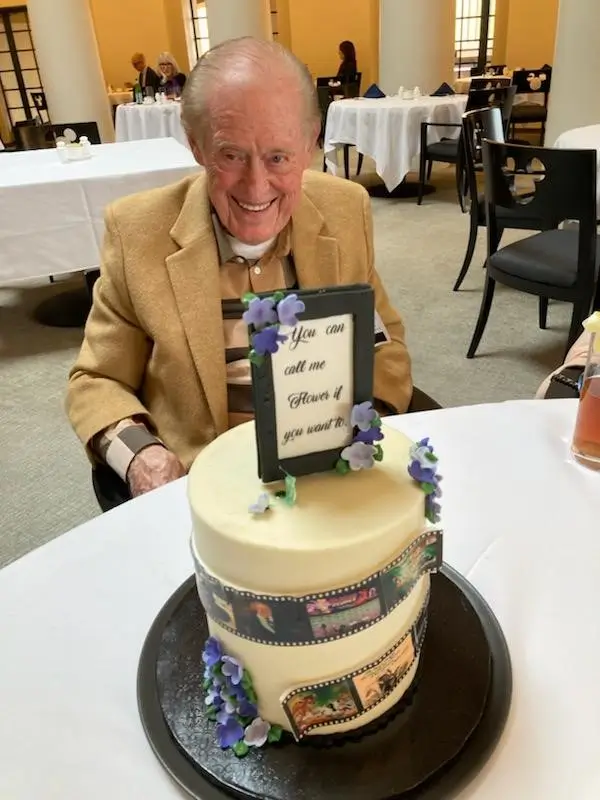
Three performers voiced Flower at different ages in the original movie:
- Stanley Alexander: Young Flower
- Tim Davis: Adolescent Flower
- Sterling Holloway: Adult Flower
Disney’s official film archive credits all three actors.
Stanley Alexander was six years old when he recorded the role.
According to the Library of Congress, Alexander’s Sunday-school teacher noticed his unusual voice and encouraged him to audition. The young actor was initially more interested in the possibility of missing school than beginning a Hollywood career.
He did not remain in the entertainment industry. Alexander later became a physician, while his childhood performance continued introducing Flower to new generations.
Sterling Holloway supplied the adult voice.
His soft, instantly recognizable delivery later became associated with several major Disney characters, including Winnie the Pooh, Kaa, the Cheshire Cat and Roquefort. Disney’s Sterling Holloway profile also identifies him as the adult Flower.
Nicky Jones voiced the younger version of the character in the 2006 film Bambi II.
Flower, Thumper and Bambi
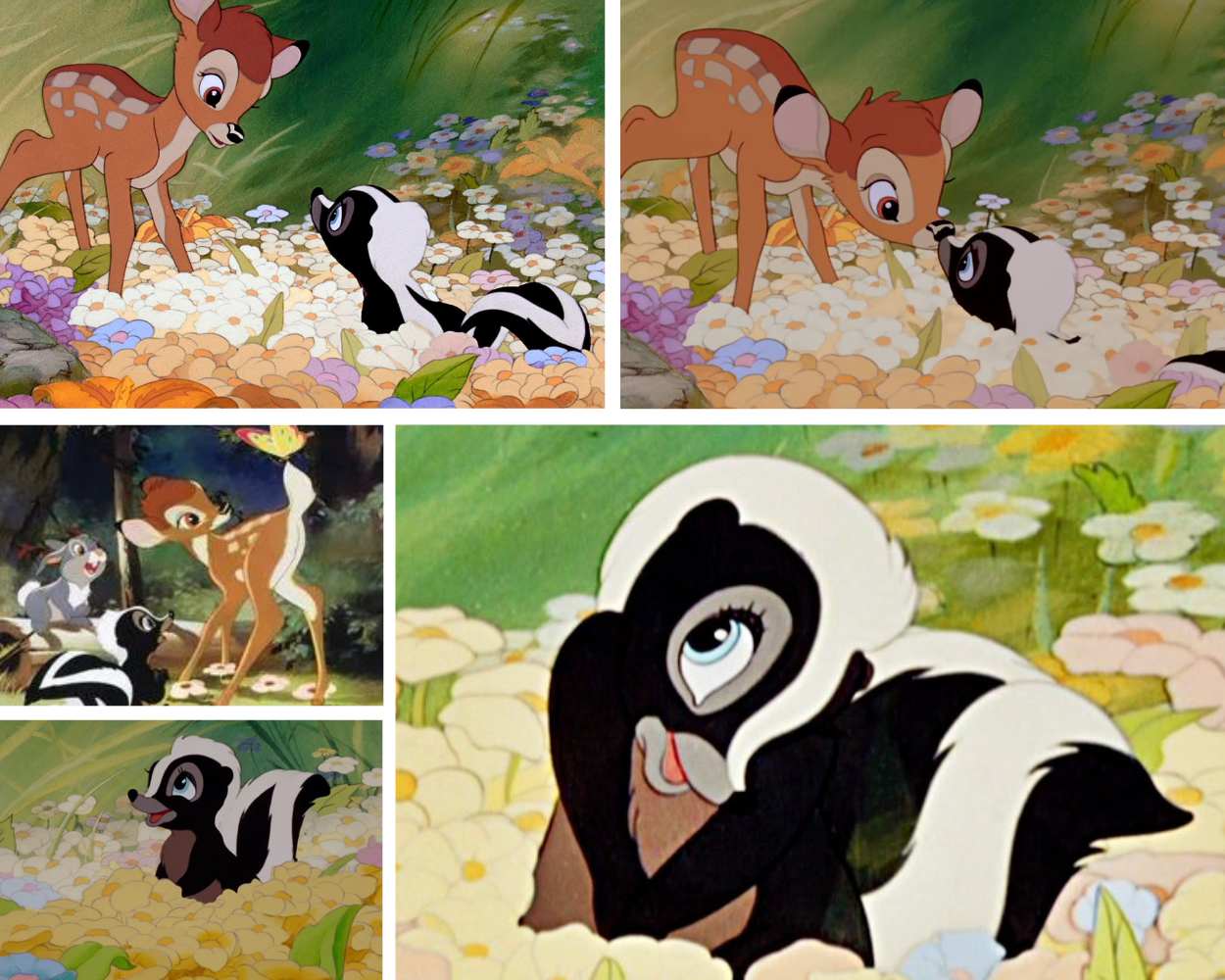
The friendship between Bambi, Thumper and Flower gives the early part of the film its warmth.
The trio works because each character brings a different kind of energy.
- Thumper: Confident, talkative and eager to teach
- Flower: Quiet, sensitive and accepting
- Bambi: Curious, inexperienced and caught between them
Thumper moves scenes forward. He explains the forest, introduces new words and encourages Bambi to try things.
Flower slows the rhythm down.
He gives Bambi a friend who is not always certain of himself. Both characters are cautious, easily embarrassed and more comfortable observing before acting.
That balance prevents the childhood scenes from becoming dominated by Thumper’s personality.
Flower may speak less, but his presence makes the friendship feel fuller.
Does Flower Hibernate?
During winter, Bambi and Thumper discover Flower sleeping inside a den.
He has gained weight, curled up for the season and has no interest in joining them outside. When they try to wake him, he quickly returns to sleep.
The film describes Flower as hibernating.
Real striped skunks are not usually considered true, uninterrupted hibernators. The National Park Service explains that skunks can enter deep periods of torpor lasting for weeks, but may wake and leave their dens during warmer winter weather.
Disney simplifies the behavior for a young audience.
The basic observation is still grounded in nature: skunks become much less active in cold weather and may remain sheltered for extended periods.
The scene also gives Flower another endearing visual transformation. His tiny body becomes rounder, his tail becomes a blanket and his usual shyness is replaced by complete sleepiness.
Flower Gets Twitterpated
When spring arrives, Friend Owl warns Bambi, Thumper and Flower about becoming “twitterpated.”
The three friends react as though falling in love is an illness they can avoid through determination.
Flower is the first to surrender.
A female skunk approaches him, looks into his eyes and gives him a kiss. Flower blushes bright red, stiffens and falls backward in a daze.
The moment uses all the qualities established during his childhood scene:
- His shyness
- His blushing
- His emotional openness
- His inability to hide what he feels
Thumper and Bambi attempt to resist romance for slightly longer, but Friend Owl’s warning eventually proves correct for all three.
Flower’s reaction is the most visually exaggerated because he was always the friend most easily overwhelmed by affection.
Who Is Flower’s Mate?
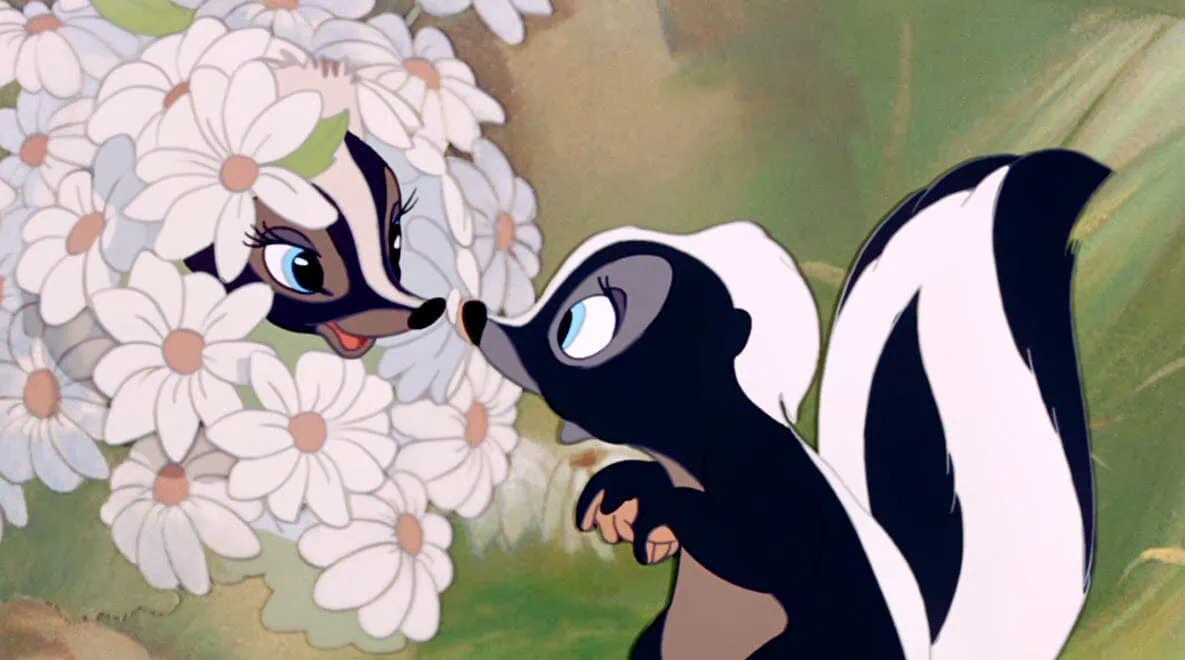
The female skunk who falls in love with Flower is not named in the dialogue of the 1942 film.
She is sometimes called Petunia in later references and fan databases, while other names have appeared in books and merchandise. Within the original movie, “Flower’s mate” or “the female skunk” is the most accurate description.
Their courtship receives very little screen time, but it completes Flower’s journey.
He begins the film as a shy child who quietly accepts a name from a new friend. He ends it as an adult with a mate and a young son.
Flower names the baby Bambi.
The choice creates a satisfying circle:
- Bambi accidentally gives Flower his name.
- Flower accepts it as an act of friendship.
- Years later, Flower gives Bambi’s name to his own child.
The film never pauses to explain the meaning.
It does not need to.
Flower remembers the first friend who looked into a bed of blossoms, saw him and decided he was something beautiful.
Flower in Bambi II
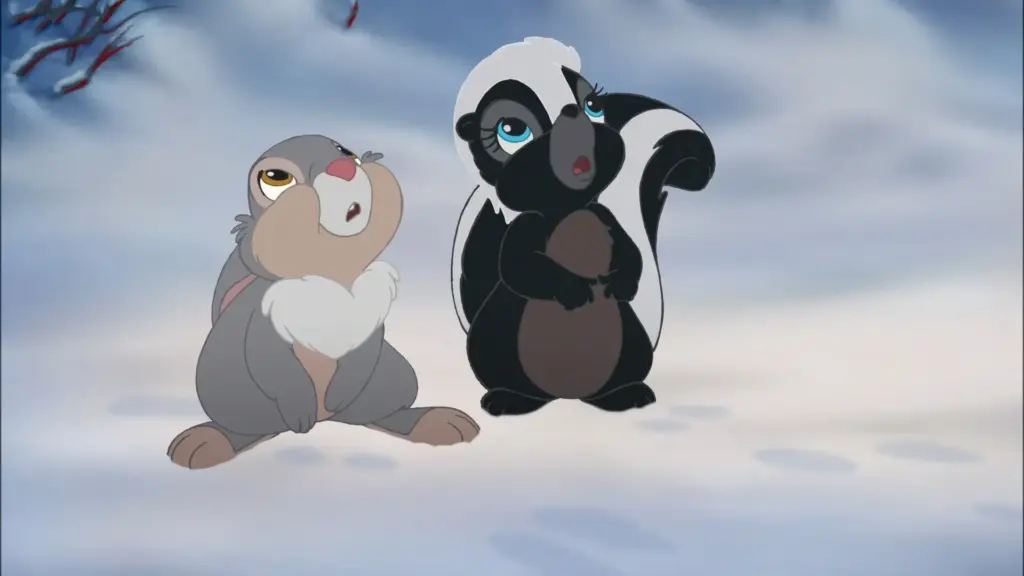
Disney returned to Flower in the 2006 film Bambi II.
The story takes place during a missing period in the original film, after Bambi loses his mother but before he grows into the adult seen during the final act.
Flower remains shy and gentle, but the newer film gives him more dialogue and a more active role in Bambi’s childhood adventures.
It also allows him to use his natural skunk defense when danger appears.
That distinction matters.
Many cartoon skunks are embarrassed by their smell or exist only to make other characters run away. Flower’s spray is treated as something practical he can use when threatened.
It does not replace his personality.
It is simply part of being a skunk.
Why Flower’s Design Still Works
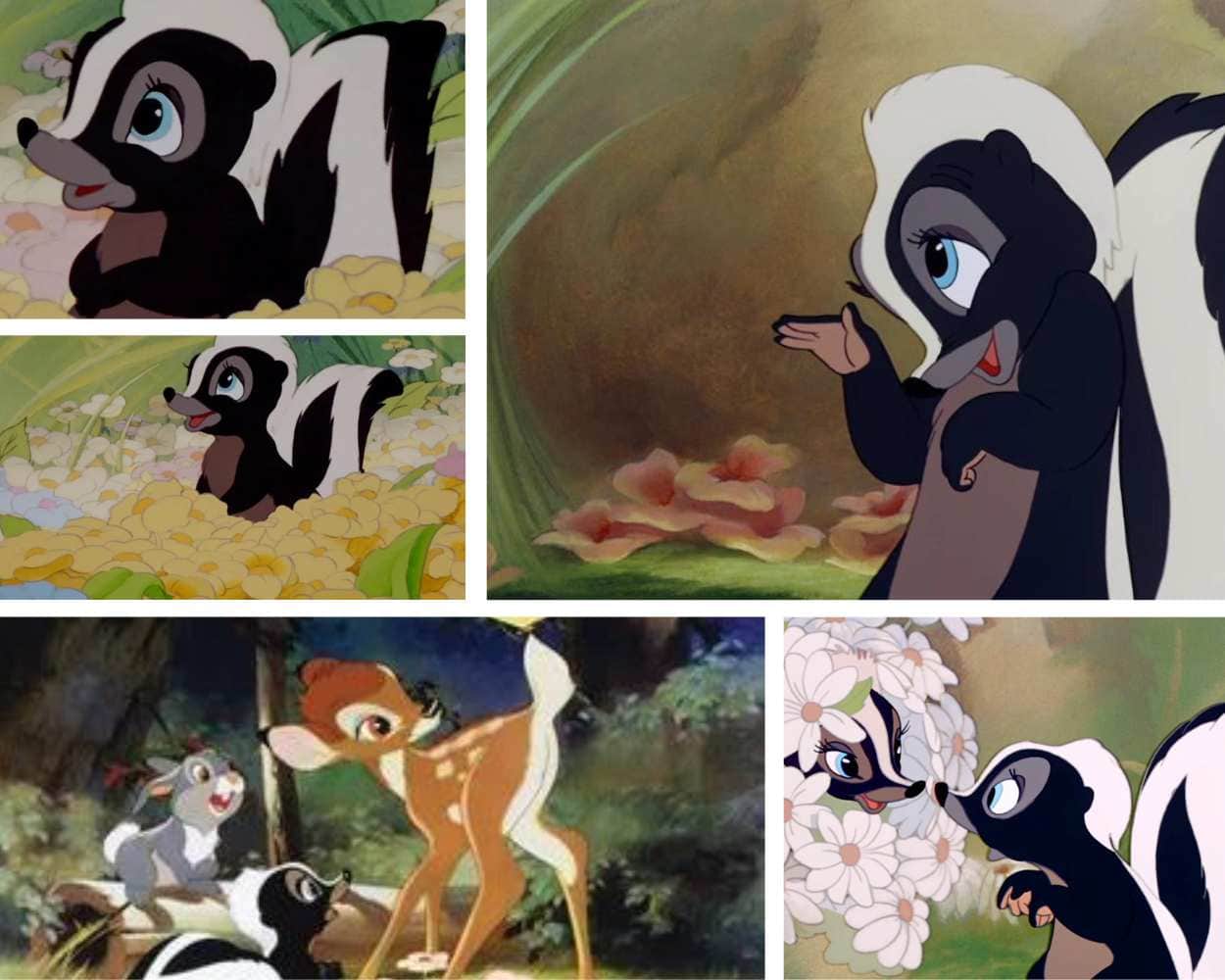
Flower is memorable because every part of his design points toward the same personality.
- Rounded face: Makes him look young and harmless.
- Large eyes: Keep every emotion easy to read.
- Long eyelashes: Add softness and contribute to the frequent gender confusion.
- Small body: Makes him appear vulnerable beside Bambi and Thumper.
- Oversized tail: Identifies his species while functioning as an emotional hiding place.
- Quiet voice: Completes the contrast between a warning-colored animal and a gentle personality.
The design does not hide the fact that Flower is a skunk.
It changes what the familiar skunk features mean.
The stripe no longer signals trouble. The tail becomes a security blanket. The black-and-white fur makes his pink blush easier to see. His name replaces the expectation of a foul smell with the image of something pleasant.
That is careful visual storytelling rather than a random collection of cute features.

Quick update! I just refreshed the main post with a few more historical details. While digging deeper into Bambi, I came across a perspective that I may have touched on above, but wanted to explicitly highlight here:
In modern film analysis and gender studies literature, Flower is frequently cited as one of the earliest examples of gender-subversive animation in mainstream cinema.
Film scholars point out how Disney deliberately played with audience expectations. By giving a male character a feminine name, soft eyelashes, coy body language, and a breathy voice, Disney led audiences to assume Flower was female only to flip those expectations during the adult “twitterpated” sequence when he falls in love with a female skunk.
Thought that was such a cool piece of animation history to share!