Five middle-school prodigies once dominated every court in Japan. Behind the highlight reels, though, sat a darker story.
Their own talent slowly destroyed them. This is the standing Autopsy of Kuroko’s Basketball: Generation of Miracles, the team that won everything and lost the one thing that mattered.
So here is the thesis that runs through every page.
Talent is a prison.
These players got so good so young that winning stopped feeling like anything. The real drama is not how they won.
Instead, it is how they broke, and how a few of them learned to love the game again.
The Kuroko no Basuke Autopsy: Our Methodology

This site treats every character like a case study, not a stat sheet. A wiki hands you a height and a jersey number. We hand you what a player really means.
- We read each prodigy through a Nexus framework, so every member sits against the player who completes or opposes him.
- We focus on archetype and psychology, rather than raw numbers.
- Every profile below points to a deeper Dossier, so you can go as far as you like.
- Think of this hub as the front door to a permanent archive, so the core reading stays fixed even as we add more.
The “Teiko Syndrome”: A Primer
Every wound in this series traces back to one place: Teiko Junior High. So we gave the pattern a name. We call it the Teiko Syndrome.
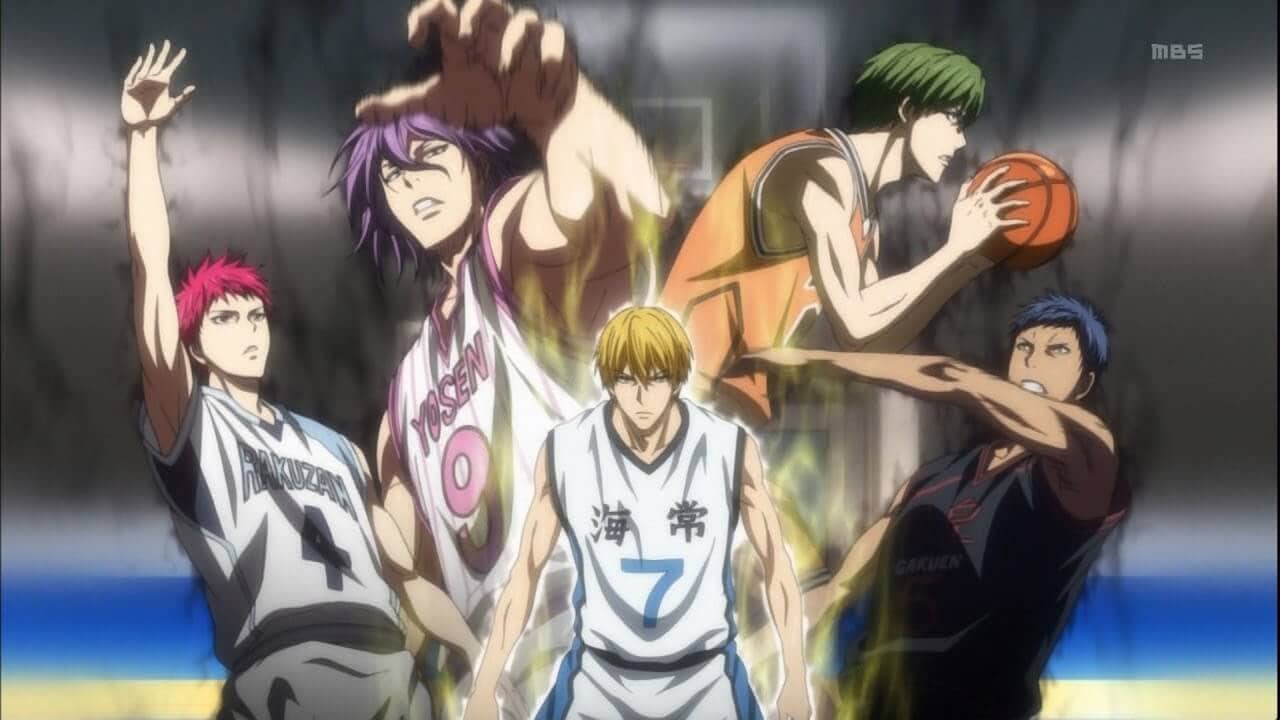
The five prodigies won the Junior High Nationals three years running, and they never once lost. So victory stopped teaching them anything. One by one, the game went quiet.
- Aomine grew so strong that no opponent could push him, so he stopped caring.
- Murasakibara followed, because effort started to feel pointless.
- Then Akashi challenged Murasakibara to a one-on-one, and his colder self won and dissolved the team’s cooperation for good.
Kuroko felt it worst of all. The endless, effortless wins crushed him, and he came to hate the sport he loved. So he quit, and the band of prodigies scattered to five rival high schools. The pressure never stopped at the scoreboard, either. Each prodigy also carried the weight of everyone’s expectations, so the mental toll ran as deep as the physical one.
The Talent Trap: When Strength Becomes a Weakness

Every gift in this series carries a hidden cost. So the show keeps proving one point. A strength pushed too far turns into a weakness.
- Aomine’s unstoppable scoring cost him every worthy rival, so the game bored him.
- Kise’s Perfect Copy drains his body, and it once left him with a serious leg injury.
- Midorima’s range has a hard ceiling, because nobody can shoot forever.
- Kuroko’s invisibility can hide him even when his team needs him seen.
- Even Murasakibara wears down his legs from constant blocking, so no gift here comes for free.
Before they split up, the five made a pledge. Each one vowed to face the others at full strength, to settle who stood above the rest. That oath reads like a declaration of war. Still, it is also the first real sign of growth, because it forces every prodigy to test his limits again.
The Emperor: Akashi Seijuro

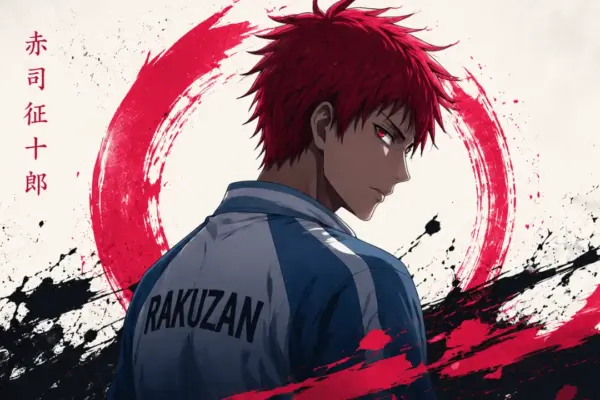
Akashi is the captain and the point guard, and every prodigy answers to him. He runs the floor with the Emperor Eye, a read so sharp it borders on seeing the future.
- Archetype: absolute control. He believes winning is the only thing that justifies him.
- His split personality works as a defense against the sheer terror of losing.
- So he is the pinnacle of the Teiko system, and also its most tragic product.
The Ace: Aomine Daiki

Aomine is the ace among aces, a power forward for Touou who can score from almost any spot. He was also Kuroko’s first light, back when the two of them still loved the game.
- Archetype: the talent trap made flesh. He grew so strong that basketball went silent for him.
- His motto says it plainly. The only one who can beat him is himself.
- Underneath the swagger, he aches for a rival who can make the sport fun again.
- At Touou, he barely bothers with practice, so he naps through drills and still dominates. That habit is the wound, not the flex.
The Copy: Kise Ryota

Kise is the copycat, a small forward for Kaijo who can mirror almost any move he sees once. The others rank him as the weakest of the five, yet that label sells him short.
- Archetype: adaptation. His Perfect Copy lets him borrow the skills of his former teammates.
- Aomine’s play first pulled him into the sport, so he still chases that standard.
- His easy mastery is also his curse, because nothing stays a challenge for long.
- Off the court, he even works as a model, so his fame outpaces his old teammates. On it, though, he still measures himself against them.
The Sniper: Midorima Shintaro

Midorima is the sniper, a shooting guard for Shutoku who can drain three-pointers from anywhere, including half-court. He treats each shot like a precise calculation.
- Archetype: precision and fate. He rarely misses when his form stays clean.
- He lives by the Oha-Asa horoscope, so he carries a new lucky item every day.
- Unlike most miracles, he works relentlessly, so his talent rests on real effort.
The Titan: Murasakibara Atsushi

Murasakibara is the titan, a 208 cm center for Yosen who literally looks down on the game. He anchors an almost invincible defense, and his blocks swallow the rim whole.
- Archetype: talent without love. He is the strongest by nature, yet he enjoys it the least.
- His height and reach turn the paint into a no-go zone for scorers.
- He treats effort as beneath him, which is its own quiet form of Teiko Syndrome.
The Light and Shadow Philosophy

Strip the series down to one idea, and you land on light and shadow. A scorer burns bright. A support player works in the dark. So the brighter the light, the more the shadow can do.
- Kagami is the light, the raw fire that pulls every eye toward him.
- Kuroko is the shadow, the quiet mind that makes the fire land at all.
- Neither one wins alone, so their pairing is the antidote to the lonely-king problem.
Fujimaki even grounded the cast in real basketball. For example, he modeled Akashi’s passing on NBA point guards Jason Williams and Steve Nash, so the miracles echo real playmaking as much as fantasy.
Join the Match: The Final Verdict
The Autopsy is never truly finished. So we keep breaking down the Generation of Miracles one Dossier at a time, and we want your theories in the mix.
- Was the Zone a real evolution, or just a flashy gimmick?
- Which prodigy had the hardest road back to loving the game?
- Who belongs at the top of the roster, and who is overrated?
So drop your verdict in the comments, then dig into the individual Dossiers for the full breakdowns.
The court is open, and the Autopsy continues.