
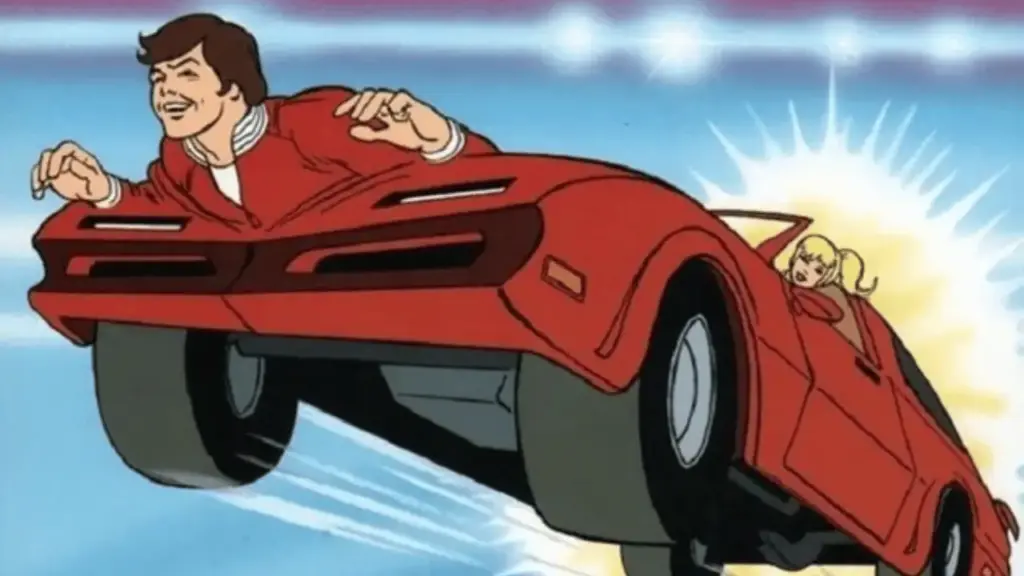
Every few years, the same Turbo Teen transformation clip escapes onto the internet.
A teenage boy stretches, bends, and somehow folds himself into a red sports car. New viewers stare at it for a moment and ask the obvious question: was this really a Saturday morning cartoon?
It was.
Turbo Teen premiered on ABC in September 1984 and produced only 13 episodes. That would already make it a memorable one-season oddity. The deeper story adds a Jack Kirby connection, a production team descended from Scooby-Doo, and a second life in cable reruns.
The transformation may be what people remember, but the history around it is every bit as strange.
Turbo Teen at a Glance
The show file
Turbo Teen, 1984
- Premiered on ABC on September 8, 1984
- One production season containing 13 episodes
- Created at Ruby-Spears and developed by Michael Maurer
- Executive produced by Joe Ruby and Ken Spears
- Production design credited to comics legend Jack Kirby
- Later rerun on USA Cartoon Express and briefly on Cartoon Network
Those facts make Turbo Teen more than a forgotten curiosity. It sits at the intersection of the 1980s car craze, Saturday morning economics, and Jack Kirby’s largely unseen career in television animation.
The Premise: A Teenager Fused With His Car
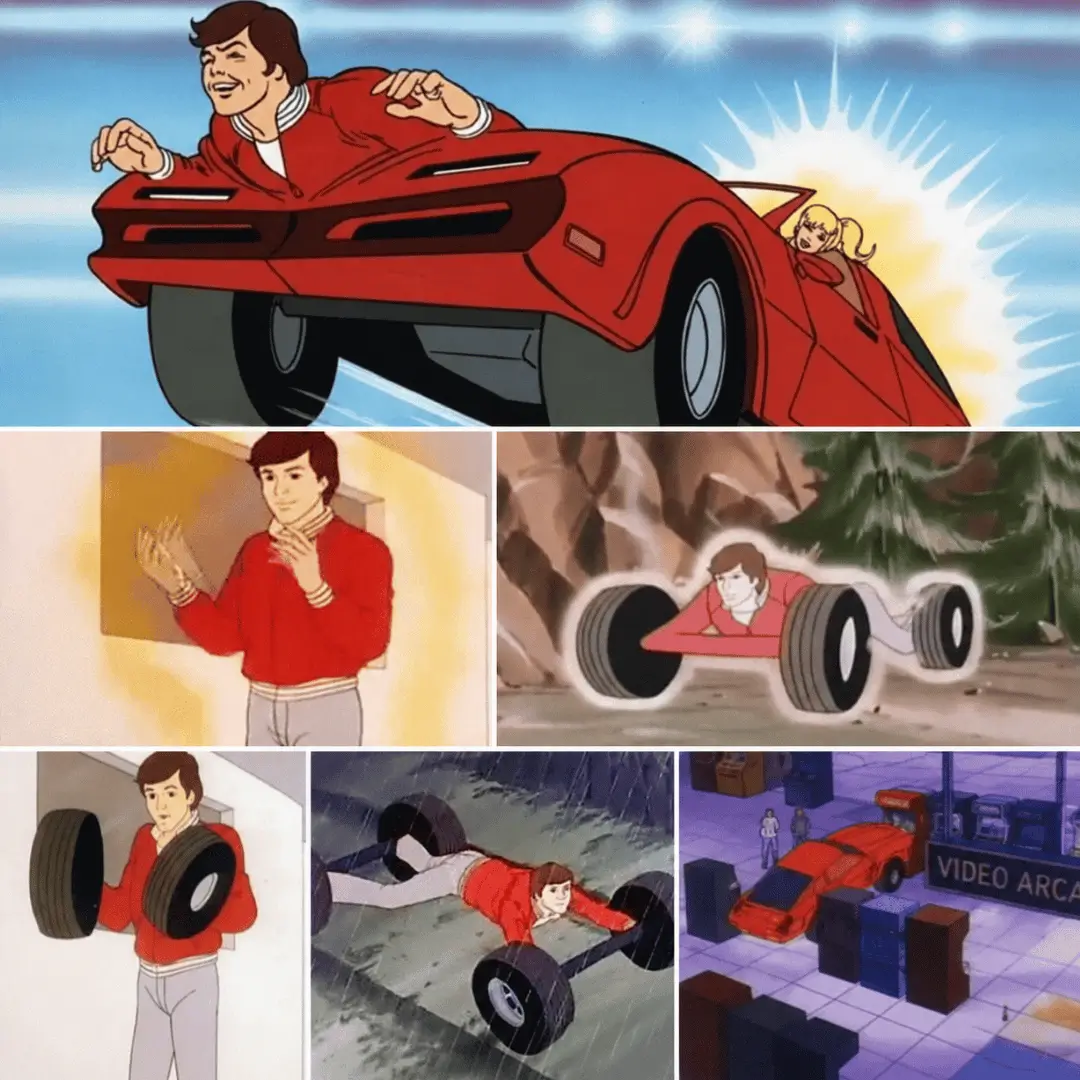
Brett Matthews begins as an ordinary teenager driving through a thunderstorm.
After swerving off the road, he crashes into a secret government laboratory and passes directly through a molecular-transfer experiment created by Dr. Chase. The beam does not simply damage Brett or his red sports car. It fuses them.
From that moment forward, heat transforms Brett into the vehicle. Extreme cold changes him back.
The opening narration calls him “the incredible Turbo Teen,” but the power is as much a medical condition as a superhero gift. Brett cannot always control when the change begins, and the series repeatedly uses that weakness to create trouble.
The transformation rules
Hot Becomes Car. Cold Becomes Human.
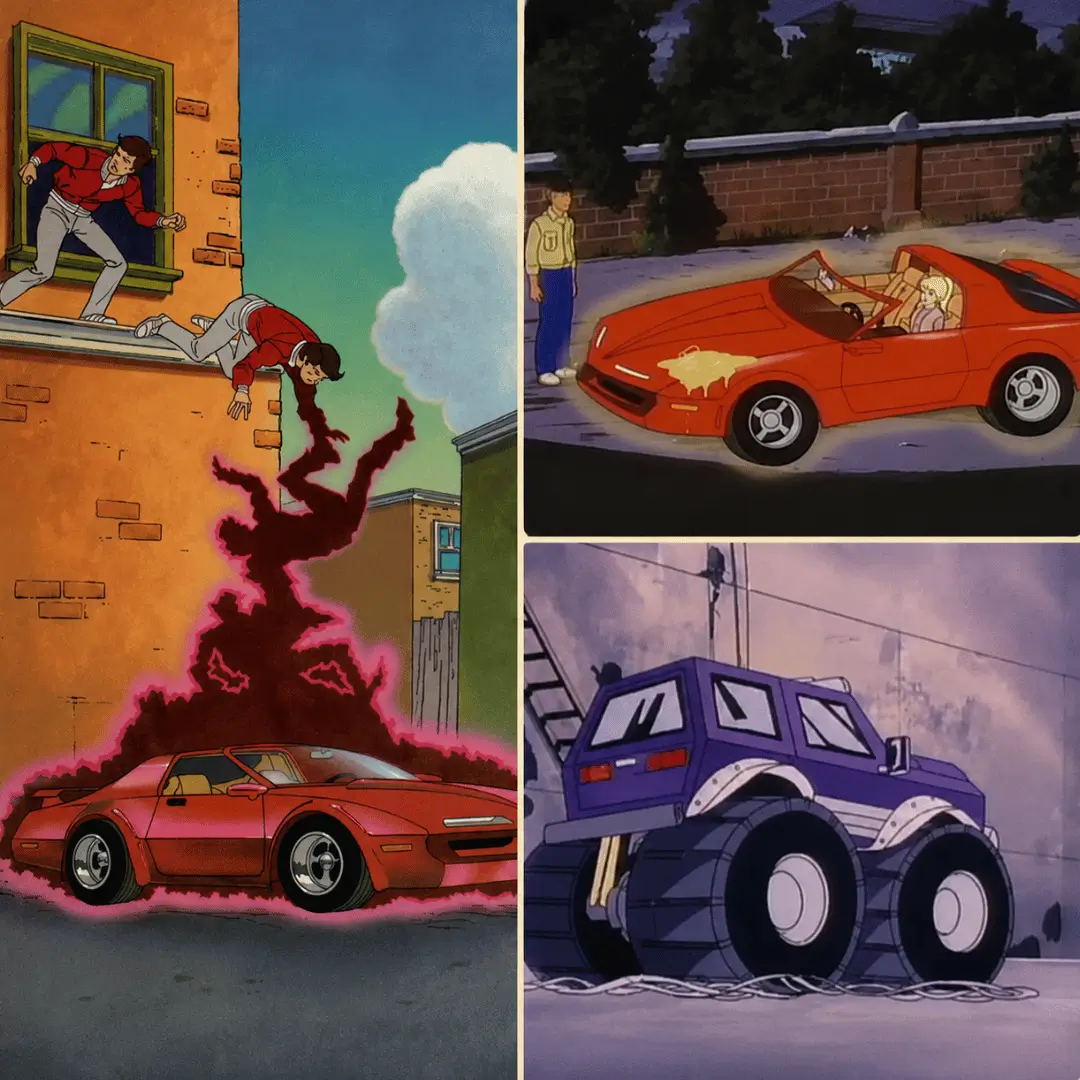
- Heat triggers Brett’s transformation into the red sports car
- Cold water, ice, or low temperatures restore his human body
- He remains conscious and able to speak while in car form
- The dashboard voice display moves when Brett talks
- He can drive himself without anyone behind the wheel
Because exercise, stress, and embarrassment can raise his temperature, Brett can begin transforming at exactly the wrong moment. The show treats that as comedy, even though the animation often makes it look alarmingly physical.
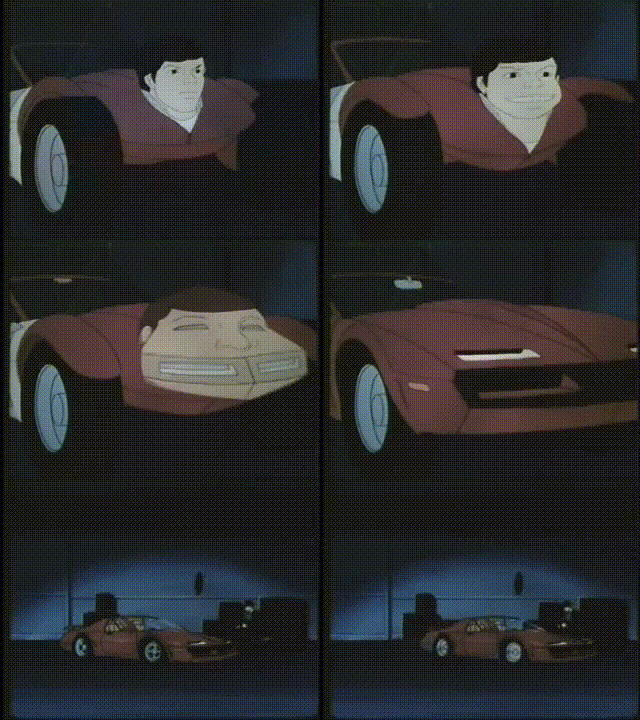
His hands flatten into wheels. His face stretches across the hood. Metal panels grow from a human body while the engine forms somewhere inside him.
No wonder the clips keep returning online. The premise was meant to be exciting, but the transformation lands somewhere between superhero fantasy and accidental body horror.
The Turbo Team
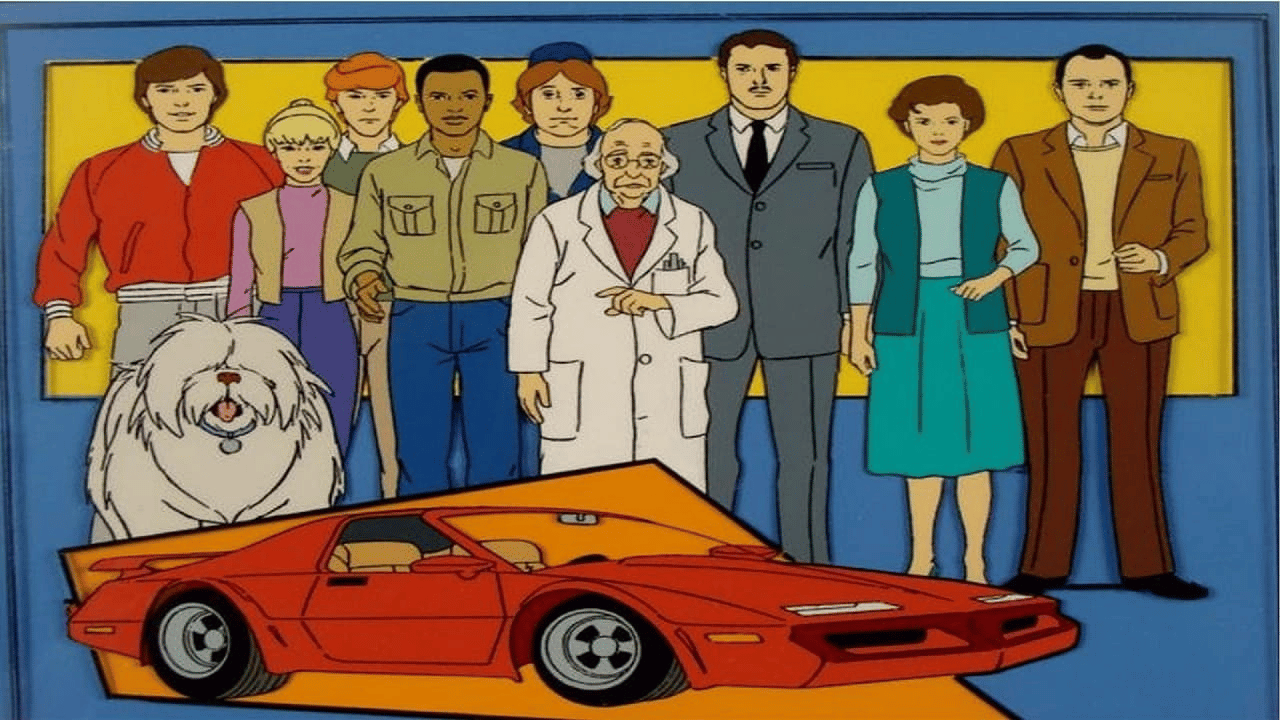
Brett does not handle the condition alone.
His girlfriend, Pattie, is a freelance reporter who helps investigate mysteries. His best friend, Alex, is a mechanic who understands the vehicle side of Brett better than anyone. Rusty, Brett’s dog, usually joins them.
Agent Caldwell and Dr. Chase continue searching for a cure, but they also send the group on government assignments. That gives the series a flexible structure. One episode can be a crime story, another can involve UFOs, a strange amusement park, or a shrinking experiment.
The recurring villain is Dark Rider, an unseen figure who drives an enormous black monster truck and wants the secret behind Brett’s transformation.
Dark Rider works because he is the visual opposite of Turbo Teen. Brett becomes a sleek red sports car associated with speed and freedom. Dark Rider hides inside a heavy black machine built to intimidate and destroy.
Classmates Eddie and Flip supply smaller problems, usually by bullying Brett or trying to prove themselves better than him.
Why 1984 Was the Perfect Year for This Idea
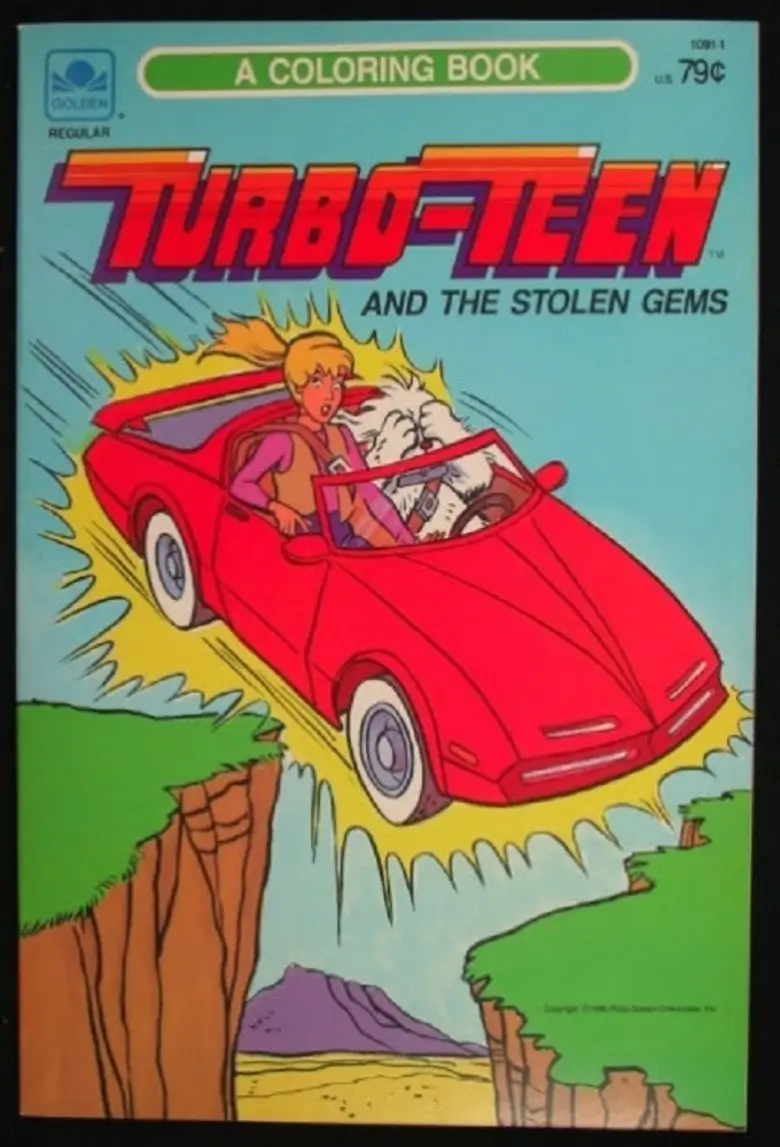
Turbo Teen makes far more sense when placed back inside 1984.
Knight Rider had turned a black Pontiac Trans Am into one of television’s biggest stars.
The Transformers and Challenge of the GoBots brought transforming vehicles into toy aisles and television schedules. Even the arcade game Pole Position received an animated series that autumn.
Cars were no longer expected to remain ordinary cars.
ABC wanted an action series that could compete in that environment, and Ruby-Spears pushed the concept one step beyond the obvious. Instead of pairing a teenager with a fantastic car, it made the teenager become the fantastic car.
Why the pitch made sense in 1984
- Knight Rider had made the Trans Am a television icon
- Transformers and GoBots made vehicle transformations marketable
- Saturday mornings were crowded with toy-friendly action concepts
- Animation allowed car stunts that live action could not afford
Brett’s final car form resembles the era’s third-generation Pontiac Trans Am and Chevrolet Camaro without copying either model exactly. The low hood, pop-up-car profile, and bright red body immediately place it in the early 1980s.
The Knight Rider influence is difficult to miss. Brett even has a dashboard voice display that reacts while he speaks in car form.
The difference is that KITT remained a machine with its own personality.
Brett’s machine was his body.
The Ruby-Spears Connection
Turbo Teen was produced by Ruby-Spears Productions, the studio founded by Joe Ruby and Ken Spears.
Ruby and Spears had helped create Scooby-Doo, Where Are You! while working at Hanna-Barbera. They later formed their own company, producing shows such as Fangface, Mister T, and Thundarr the Barbarian.
By the time Turbo Teen entered production, Ruby-Spears and Hanna-Barbera were both controlled by Taft Broadcasting. The studios were separate operations, but they shared the same corporate parent and worked in the same Saturday morning marketplace.
The series credits Michael Maurer as developer and story editor, with John Kimball directing. Animation work was supplied by overseas studios including Toei Animation and Hanho Heung-Up, a common production model for American television cartoons of the period.
That pipeline could deliver ambitious action on a television schedule, although it also contributed to the uneven drawing and continuity errors visible in some episodes.
Jack Kirby Drew the Idea Before It Became Turbo Teen
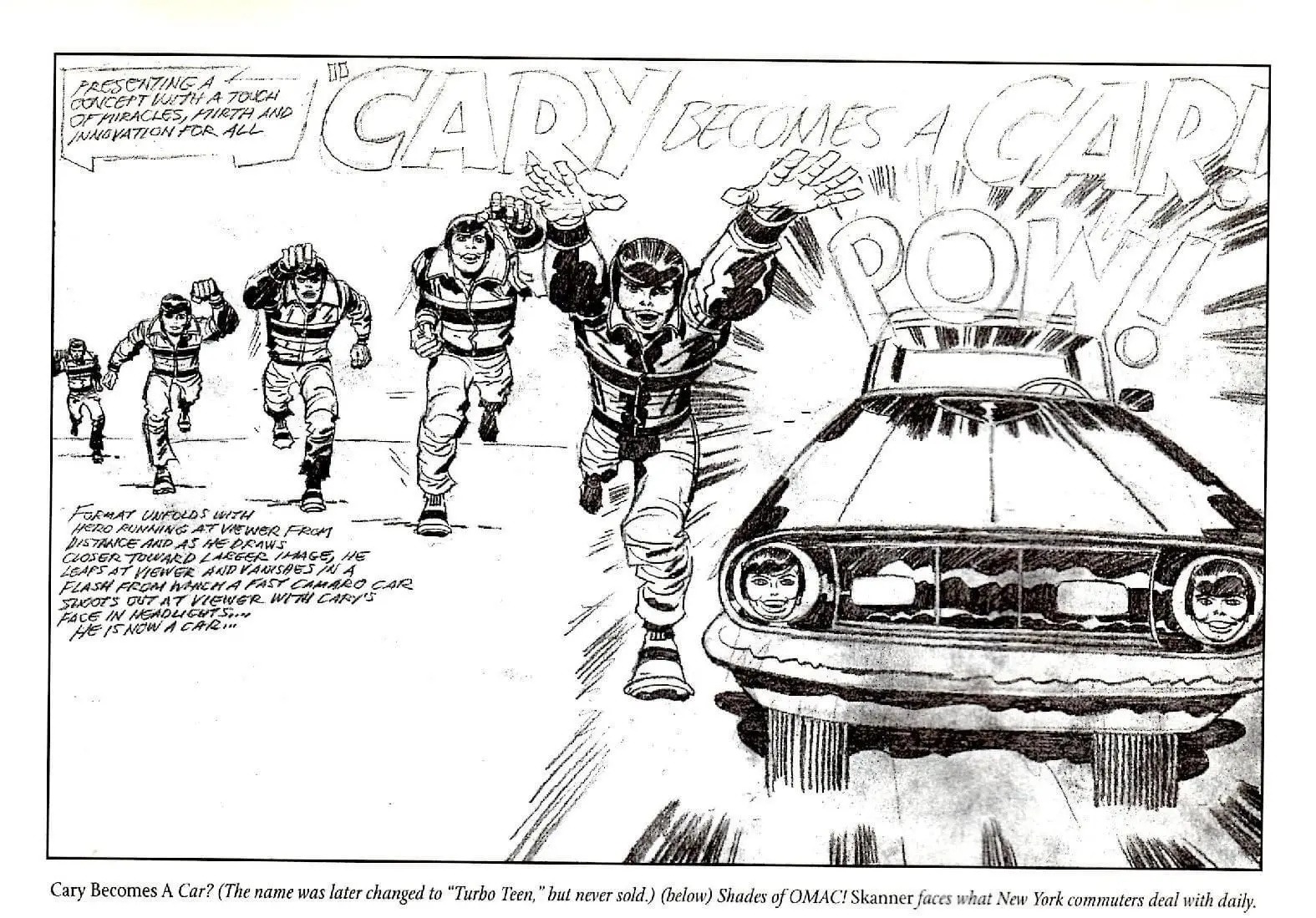
This is the detail that turns a bizarre cartoon into a genuine footnote in comics history.
During the early 1980s, Jack Kirby worked for Ruby-Spears producing concepts, characters, machines, villains, and presentation art for possible animated projects.
Kirby had already co-created Captain America, the Fantastic Four, the X-Men, Thor, the New Gods, and many other comic-book landmarks.
At Ruby-Spears, he generated a large body of animation development work, much of which never reached television.
According to surviving concept material documented by Saturday Mornings Forever, one project was called Cary Becomes a Car.
The basic idea is immediately recognizable: a teenager transforms into an automobile.
Kirby’s version appears more action-oriented than the finished show. The transformation looks deliberate, the car design differs from Brett’s final form, and the proposed villains sound like characters from one of Kirby’s cosmic comics.
- Mogal the Magi-Mechanic: A sorcerer carrying a magical toolbox
- Super Sonica: A witch with super speed
- Hot Rodney Rumpkin: An oversized racing driver accompanied by his butler
- Speed Demon: A mysterious driver who appears to anticipate Dark Rider
Additional designers helped reshape the material as it moved toward production, including Duncan Marjoribanks, Doug Wildey, and Thom Enriquez.
One of Kirby’s surviving Cary Becomes a Car drawings later appeared in Tom Scioli’s graphic biography Jack Kirby: The Epic Life of the King of Comics.
The transformation clip may look like an internet fever dream, but the original idea passed through the hands of one of the most influential artists in American comics.
The Voice Cast Had a Surprising Afterlife
The cast was small, but several performers became familiar voices elsewhere.
- Michael Mish voiced Brett Matthews and his Turbo Teen form.
- T.K. Carter played Alex, Brett’s mechanic and closest friend.
- Pamela Hayden voiced Pattie years before becoming Milhouse Van Houten and several other characters on The Simpsons.
- Pat Fraley played Dr. Chase and Eddie, later adding hundreds of animation and game credits.
- Clive Revill voiced Agent Caldwell.
- Frank Welker supplied the voices of Dark Rider, Rusty, Flip, and additional characters.
Welker’s Dark Rider performance gives the unseen villain much of his menace. Keeping him hidden also saved the show from having to settle on a face until the final episode.
Why Turbo Teen Lasted Only 13 Episodes
The 13 original episodes premiered weekly between September 8 and December 1, 1984.
That number was normal for a Saturday morning network order. Thirteen episodes could run once a week for a quarter, then be repeated throughout the broadcast year. It is the slower version of the same scheduling arithmetic discussed in why weekday cartoons often targeted 65 episodes.
ABC did not order a second production season.
No detailed cancellation statement appears to survive, so it would be misleading to blame one confirmed cause. There is no reliable public record showing that the transformation frightened viewers, that a toy deal collapsed, or that the network objected to the premise.
What can be documented is simpler:
What the record supports
- ABC ordered one batch of 13 episodes
- The first-run episodes ended in December 1984
- ABC continued showing reruns into August 1985
- No second production order followed
- No surviving network statement explains the decision in detail
The safest conclusion is that Turbo Teen was a one-quarter experiment that did not perform strongly enough to justify another order.
That is not as dramatic as the fan theories, but it fits the way Saturday morning television usually worked. Networks launched many 13-episode cartoons, repeated them for a season, and quietly moved on if the audience or merchandising potential did not meet expectations.
The Show Did Not Disappear Immediately
The original production ended after 13 episodes, but the cartoon remained on television much longer than its first-run dates suggest.
- ABC continued broadcasting the series in reruns during the 1984-85 season. It later joined USA Network’s USA Cartoon Express, where it aired from the late 1980s into the early 1990s.
Cartoon Network also briefly brought it back in October 1994 as part of Look What We Found!, a block devoted to overlooked cartoons from the Turner library.
- That rerun history explains why viewers who were too young to watch ABC in 1984 still remember Brett turning into a car.
It also kept the series alive long enough for home recordings to circulate. Those aging tapes became the source of many clips shared online decades later.
Is Turbo Teen Available to Watch?
As of July 2026, I could not verify an official complete-series DVD, digital purchase, or licensed streaming release in North America.
- TV Guide maintains a page for the show and episode listings, but it does not currently identify an available streaming provider.
That leaves Turbo Teen in an awkward position. It is remembered well enough to generate memes and retrospective articles, yet most people encounter it through old television recordings rather than a restored legal release.
The show is now controlled as part of the Warner Bros. television library, so an official release is possible.
None has been announced.
Turbo Teen Episode Guide
The complete run
13 episodes in 13 weeks
The entire first-run series fits between September 8 and December 1, 1984.
- “Turbo Thieves” (September 8, 1984)
Criminals learn about Brett’s ability and kidnap him, hoping Turbo Teen can make them rich. - “The Dark Rider” (September 15, 1984)
Dark Rider pursues Brett while Turbo Teen appears in a public exhibition. - “Mystery of Fantasy Park” (September 22, 1984)
The Turbo Team investigates suspicious activity at a local amusement park. - “No Show UFO” (September 29, 1984)
Agent Caldwell sends Brett and his friends to examine a series of UFO reports. - “Micro-Teen” (October 6, 1984)
A shrinking experiment reduces Brett, Pattie, Alex, and Rusty for a dangerous infiltration mission. - “The Sinister Souped-Up Seven” (October 13, 1984)
Brett develops amnesia while his friends confront criminals threatening a mission in the Southwest. - “Video Venger” (October 20, 1984)
An arcade game is revealed as a training system connected to a planned attack on Washington. - “Dark Rider and the Wolves of Doom” (October 27, 1984)
Dark Rider steals a scientist’s formula capable of returning dogs to a primitive state. - “The Curse of the Twisted Claw” (November 3, 1984)
The team travels to India and races to prevent ancient objects from being used as a weapon. - “Daredevil Run” (November 10, 1984)
A cross-country race becomes cover for escorting an important witness to court. - “The Amazon Adventure” (November 17, 1984)
A visit to Brazil pulls Brett, his friends, and his father into a conflict in the Amazon. - “Fright Friday” (November 24, 1984)
A frightening campfire legend appears to become real during a trip into the woods. - “The Mystery of Dark Rider” (December 1, 1984)
A Turbo Teen duplicate robs a bank, forcing Brett to clear his name and confront the mystery surrounding Dark Rider.
Quick Answers About Turbo Teen
What is Turbo Teen about? The series follows Brett Matthews, a teenager accidentally fused with his sports car by a molecular beam. Heat turns him into the car, while cold returns him to human form.
How many Turbo Teen episodes were produced? Ruby-Spears produced 13 episodes. They premiered on ABC between September 8 and December 1, 1984, with reruns continuing afterward.
Why was Turbo Teen cancelled? No detailed official cancellation explanation is known. ABC ordered one standard 13-episode batch and did not commission another, most likely because the series did not perform strongly enough to continue.
Did Jack Kirby create Turbo Teen? Kirby produced early concept and production artwork for Ruby-Spears, including the project Cary Becomes a Car, which developed into Turbo Teen. The finished show was developed by Michael Maurer and produced by Ruby-Spears.
Who voiced Turbo Teen? Michael Mish played Brett Matthews. The cast also included T.K. Carter, Pamela Hayden, Pat Fraley, Clive Revill, and Frank Welker.
Is Turbo Teen streaming? I could not confirm a licensed North American streaming service or official complete-series home release as of July 2026.
Why the Cartoon Still Gets Remembered
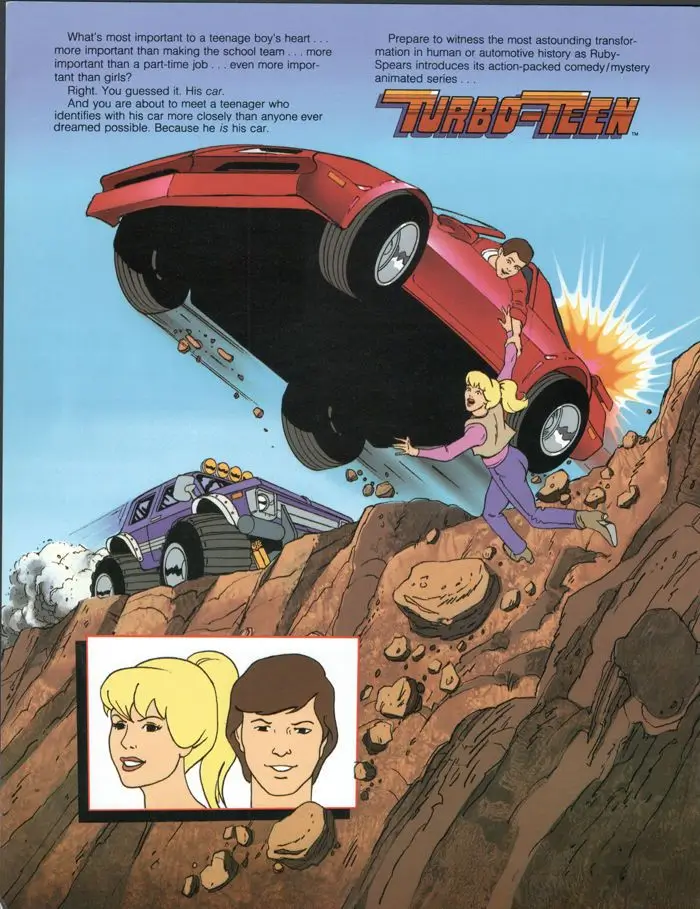
Plenty of 1980s cartoons had strange premises. Turbo Teen committed to its strange premise with unusual confidence.
The show took the decade’s obsession with advanced cars and made it personal. Brett did not own the ultimate sports car. He had to live inside it.
That gave the series an image no other cartoon could quite duplicate. Even people who remember nothing about Dark Rider, Agent Caldwell, or the episode plots remember the transformation.
The Jack Kirby connection gives the show a deeper historical value. The reruns gave it a longer life than its 13-episode count suggests. The lack of an official modern release has made it feel even more mysterious.
Turbo Teen was not a lost masterpiece, but it was certainly not an ordinary failure.
It was a Jack Kirby concept filtered through Knight Rider, Saturday morning economics, and one of the most unsettling superhero transformations ever shown to children.
Forty years later, people are still asking whether it was real.
That may be the strongest legacy a one-season oddity can earn.
Which half-remembered 1980s cartoon should this series investigate next?
Share your pick in the comments.
The strongest cases will decide where the strange-cartoon files go next.


Does anyone remember Robot Chicken? Turbo Teen was immortalised lol. There is a brutal parody on Adult Swim’s Robot Chicken. In the sketch, Brett starts transforming into a car after getting in a hot hot tub, but it goes horribly wrong and he crashes into a wall, perfectly playing into the “accidental body horror” element the article mentions.