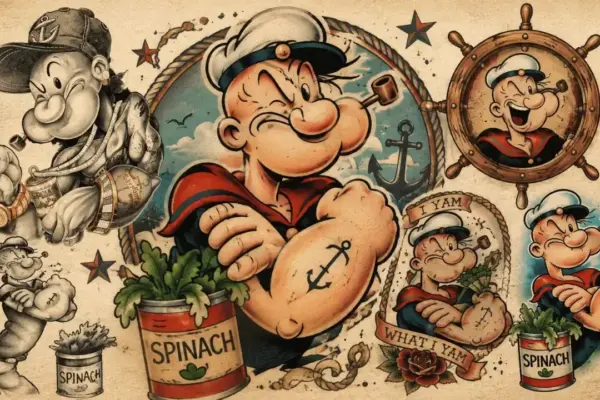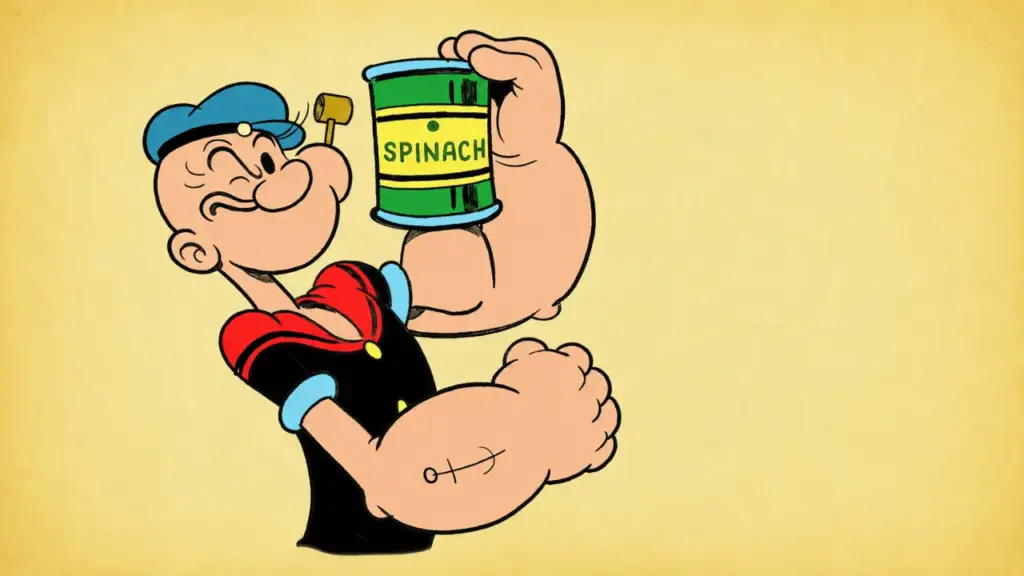
You know the scene without being told.
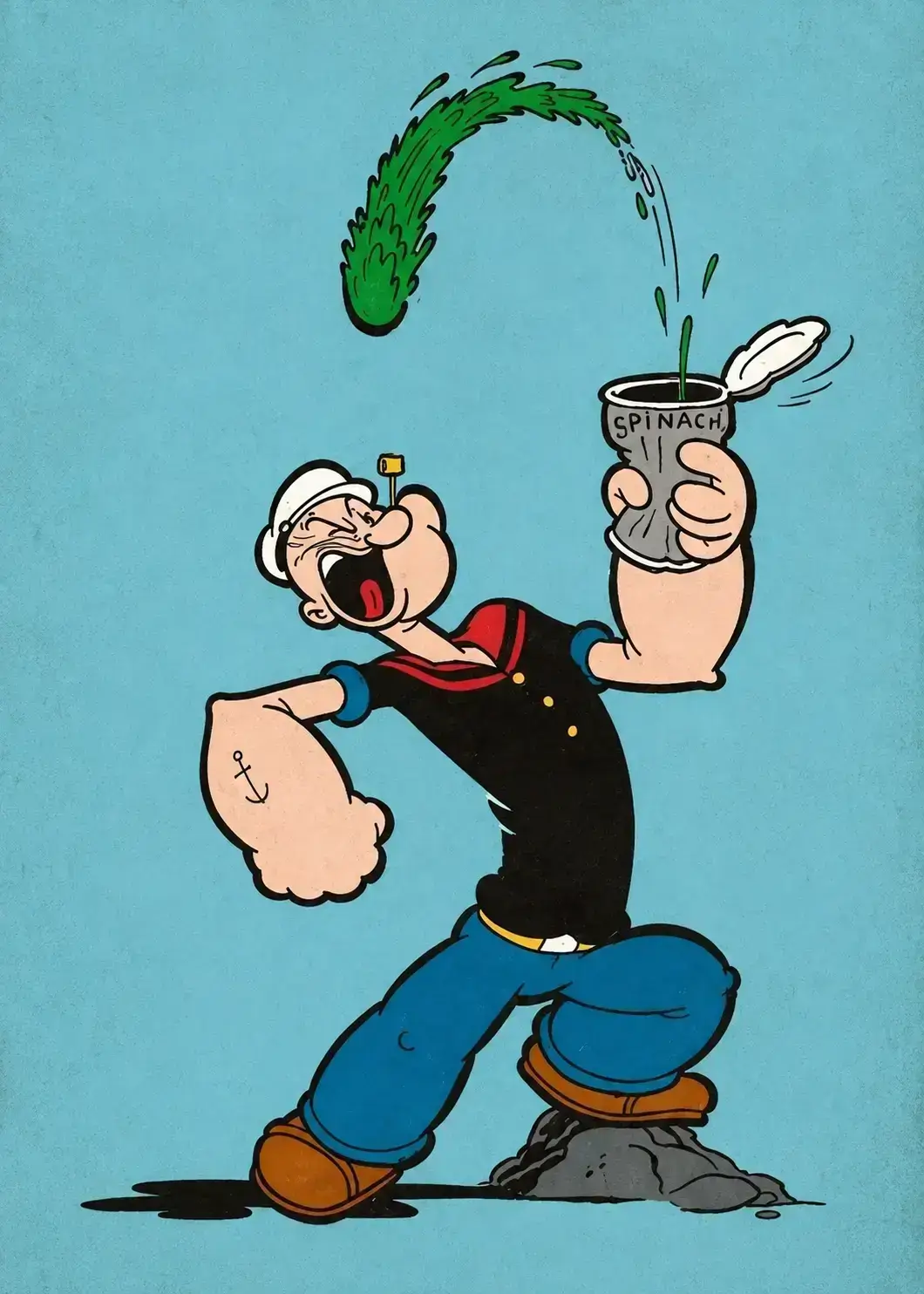
Bluto has Popeye pinned. The situation looks hopeless. Then a can bursts open, the spinach goes down in one gulp, Popeye’s forearms swell, and the nearest bully is launched out of the frame.
So why does Popeye eat spinach?
The familiar answer is that a scientist misplaced a decimal point while measuring spinach in the 1800s, accidentally giving it ten times more iron than it really contained. E.C. Segar supposedly believed the mistake and turned spinach into Popeye’s source of strength.
It is a wonderful piece of trivia.
It is also unsupported.
No surviving statement from Segar has been found saying that iron inspired the idea. When Popeye explains the benefits of spinach in the comic, he credits vitamin A instead.
The decimal-point story appeared decades later and seems to be a myth about another myth.
The short version
- 1931: The earliest currently identified strip links Popeye’s strength to eating spinach.
- 1932: Popeye explicitly says spinach makes people strong because it contains vitamin A.
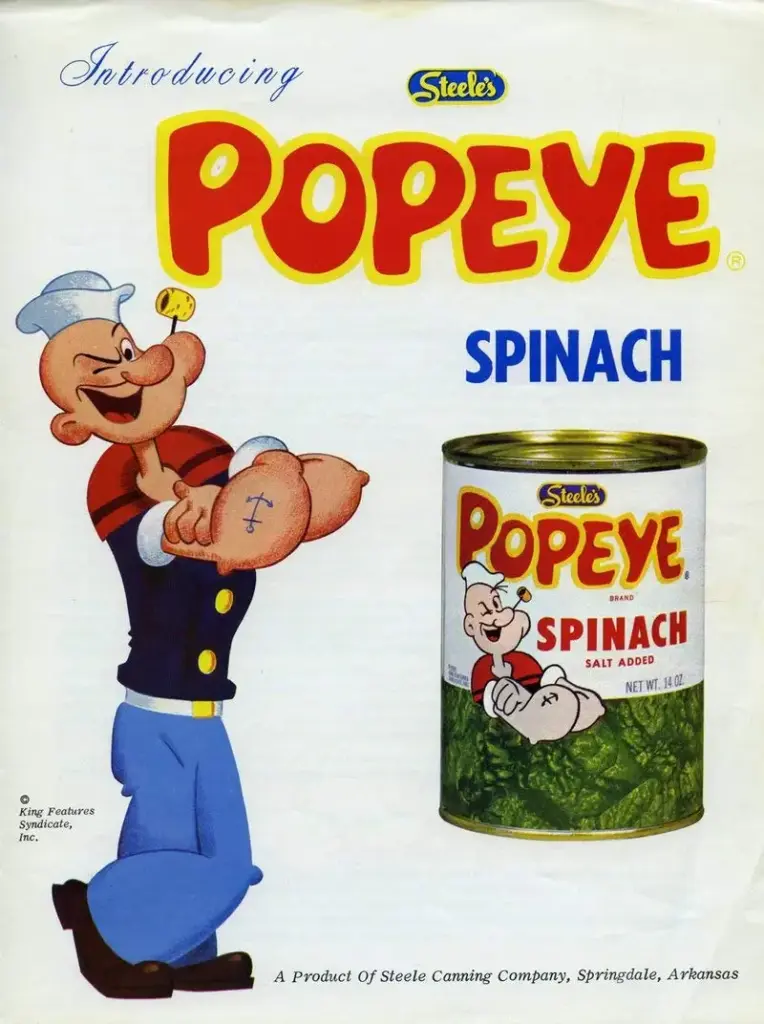
- 1933: The Fleischer cartoons turn the spinach can into his familiar instant power-up.
- The iron story: No primary evidence supports the famous misplaced-decimal explanation.
- The real science: Spinach is nutritious, but it does not produce instant strength or muscle growth.
When Did Popeye Start Eating Spinach?
Popeye debuted in E.C. Segar’s Thimble Theatre on January 17, 1929, but spinach was not originally part of his character.
The earliest currently documented comic linking spinach to his unusual strength appeared on June 26, 1931.
After Popeye escapes from jail and defeats a group of men, General Bunzo asks how he did it.
Popeye answers:
“That’s easy, I eats me spinach!”
The Duke Center for the Study of the Public Domain identified the strip while researching which elements of Popeye’s early history were protected by copyright.
That 1931 appearance establishes the connection between spinach and strength.
A later strip explains why Popeye believes it works.
What Did Popeye Say About Spinach?
On July 3, 1932, Segar published the clearest explanation in the original comic strip.
Popeye is shown eating freshly picked spinach and says:
“Spinach is full of Vitamin A an’ tha’s what makes hoomans strong an’ helty.”
Popeye, Thimble Theatre, July 3, 1932
He says nothing about iron.
Researchers examining Segar’s work have not found another explanation connecting Popeye’s strength to the vegetable’s iron content.
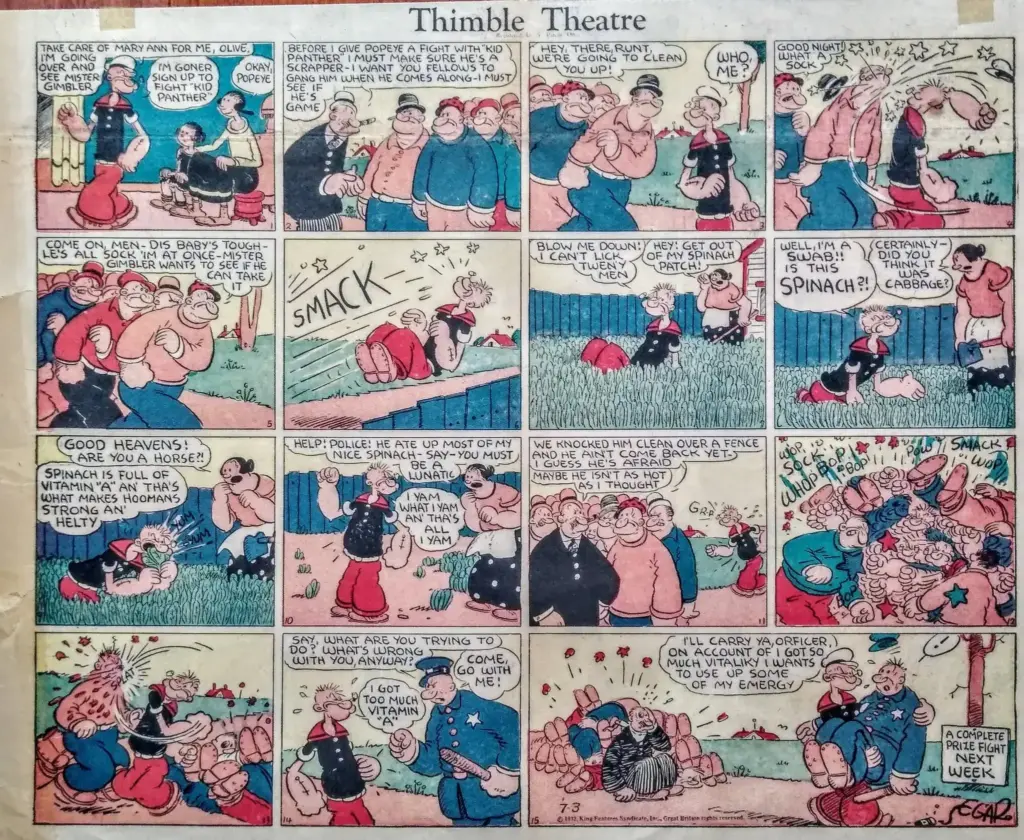
The wording is not chemically exact.
Spinach does not contain much preformed vitamin A. It contains beta-carotene and other provitamin A carotenoids that the body can convert into vitamin A.
Segar nevertheless had the basic nutritional connection right: spinach can contribute to a person’s vitamin A intake.
The important distinction
The 1931 strip establishes spinach as Popeye’s source of strength. The 1932 strip gives his explanation for eating it. Neither one mentions iron.
How the Cartoons Made Spinach Popeye’s Superpower
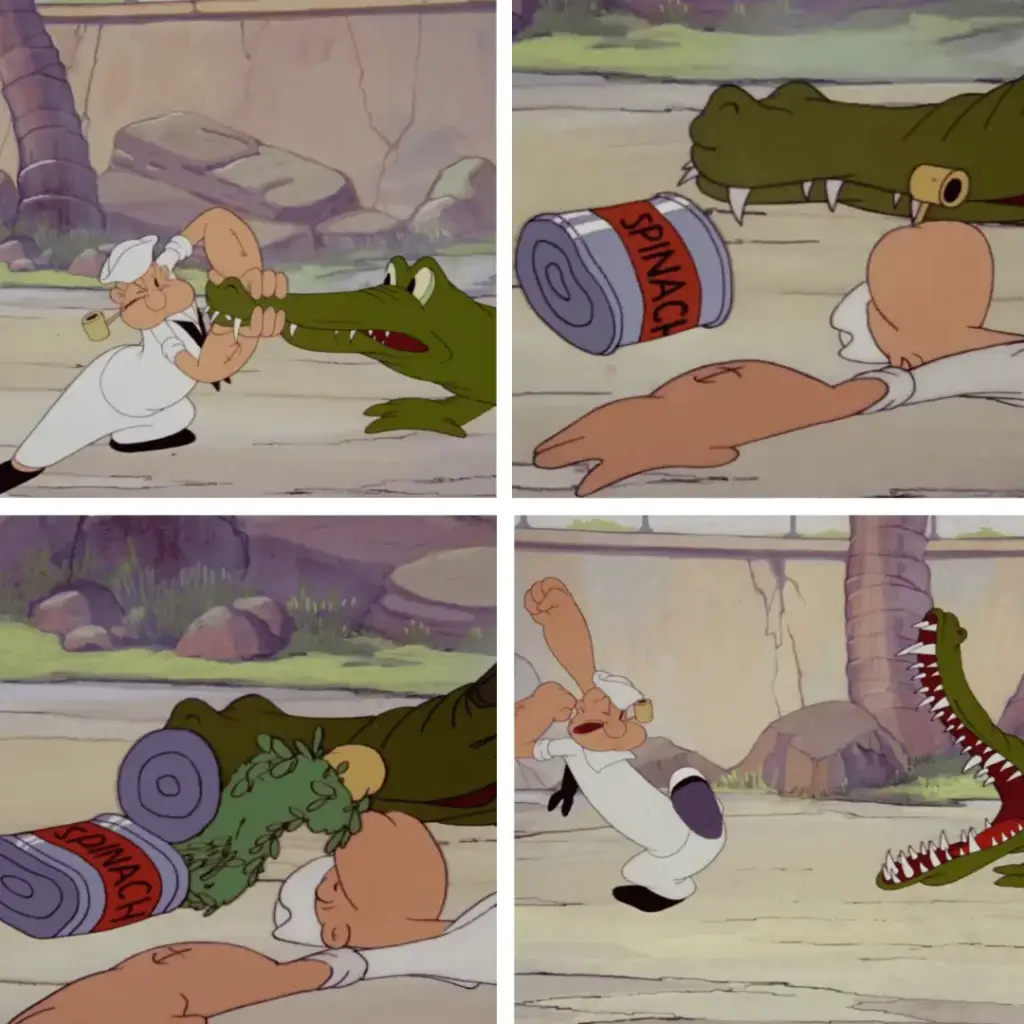
The comic strip introduced the idea, but the animated shorts made it famous.
Popeye reached movie screens on July 14, 1933, in a Fleischer Studios cartoon produced as part of the Betty Boop series.
The animation turned spinach into a perfect visual gag:
- Popeye begins a fight at a disadvantage.
- A can of spinach appears at the last possible moment.
- The can is crushed, squeezed or fired directly into his mouth.
- His body changes immediately.
- The fight ends within seconds.
The spinach was no longer merely something Popeye ate regularly.
It became a transformation sequence.
Sammy Lerner’s theme song also tied the food directly to Popeye’s strength, repeating the idea every time the character appeared.
That repetition is probably why later audiences assumed there must have been a scientific explanation behind the choice.
The Famous Spinach Decimal-Point Story
The popular version begins with a German chemist in the 1800s.
According to the story:
- A scientist measured the amount of iron in spinach.
- He accidentally moved a decimal point one place.
- Spinach was recorded as having ten times more iron than it actually contained.
- The incorrect number was copied into textbooks.
- Segar eventually used the claim when creating Popeye’s spinach habit.
The scientist is usually identified as E. von Wolff, and the mistake is normally dated to 1870.
Some versions say the false number remained uncorrected until 1937.
It is a neat story with an obvious lesson: one tiny publishing error can mislead the world for decades.
The trouble is that no one has produced the original misplaced decimal.
Did the Spinach Decimal Error Really Happen?
The evidence suggests that early measurements of spinach’s iron content were inaccurate.
That part is real.
What has not been found is evidence that someone accidentally moved a decimal point.
Nineteenth-century food analysis was vulnerable to several problems:
- Iron from laboratory equipment could contaminate samples.
- Dust and heating dishes could affect the results.
- Values for dried spinach could be confused with values for fresh leaves.
- Later writers sometimes repeated older figures without checking the original methods.
Fresh spinach contains a large amount of water. Remove that water and the remaining nutrients become much more concentrated by weight.
That means a dried sample and a fresh sample can produce very different figures without anyone mistyping a number.
Mike Sutton’s examination of the story also points out that von Wolff’s cited publication appeared in 1871, although popular retellings usually place the supposed mistake in 1870.
What appears to have happened
Some early spinach measurements were too high, and later research corrected them. The unsupported part is the claim that a single misplaced decimal caused the problem—or that the mistake inspired Popeye.
McGill University’s Office for Science and Society had previously repeated the decimal story but later published a correction after reviewing Sutton’s research.
Where Did the Decimal-Point Myth Begin?
The trail does not lead back to an 1870 laboratory record.
The earliest version Sutton located appeared in a 1972 inaugural lecture by British nutrition professor Arnold Bender.
Bender attributed the story to another nutritionist but did not provide evidence of the original error. He later repeated the claim in print.
The story gained a more authoritative-looking home in December 1981, when haematologist T.J. Hamblin published an essay titled “Fake” in the British Medical Journal.
Hamblin used the spinach story as an example of mistakes spreading through science.
When Sutton later contacted him, Hamblin reportedly said he could not remember his source. The article had been prepared as a lightly written Christmas issue contribution without the usual references.
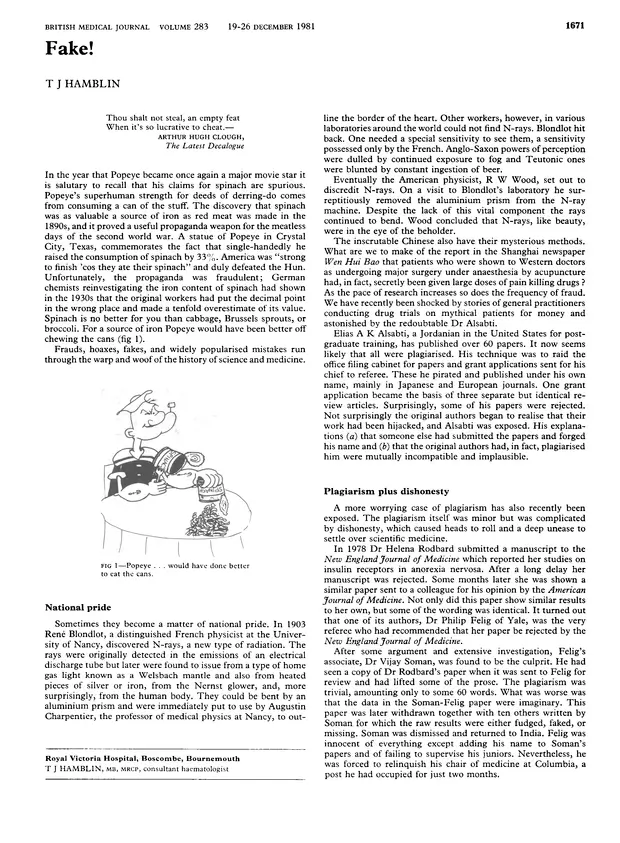
Hamblin did not invent the story, but publication in a respected medical journal helped it spread.
Later newspaper articles, books and websites cited the *BMJ* piece rather than locating an original nineteenth-century source.
The irony
A story used to warn readers about repeating unsupported information became one of the most frequently repeated unsupported stories in food history.
The original BMJ article and Sutton’s later summary of the investigation remain useful for tracing how the claim developed.
Was Spinach Considered a Health Food Before Popeye?
Yes.
Spinach already had a strong nutritional reputation before Popeye began eating it in the comic strip.
That does not prove exactly why Segar chose it. No recorded statement has been found in which he explains the creative decision.
The most reasonable interpretation is that spinach offered several advantages:
- Readers already recognized it as healthy.
- It was inexpensive and widely available.
- Canned spinach could appear instantly during a fight.
- The can gave animators a physical prop to crush, throw or squeeze.
- Children’s dislike of leafy vegetables made the choice funnier.
The timing also mattered.
Vitamins were becoming a major part of public-health messaging during the early twentieth century. Linking Popeye to a vegetable allowed the comic to mix a health message with an exaggerated superhero gag.
That explanation fits the surviving comics better than the iron story does.
Popeye himself names vitamin A, and the can becomes a visual device that works without any scientific explanation at all.
Did Popeye Really Increase Spinach Consumption?
Popeye became closely connected with the American spinach industry.
Crystal City, Texas, a major spinach-growing community, erected a statue honoring Popeye and Segar in 1937.
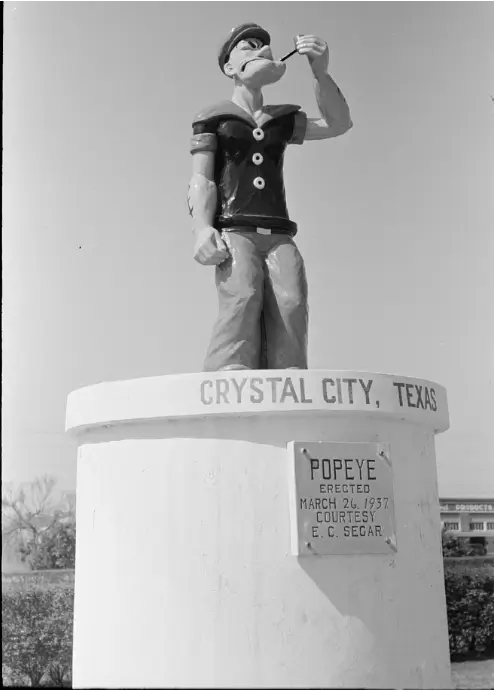
The spinach industry has long credited Popeye with increasing consumption by approximately 33%.
That number appears in official histories, newspaper articles and trivia books, but its original national data source is difficult to locate.
Sutton found evidence that spinach production in Texas increased by roughly that amount during 1936. That does not prove Popeye single-handedly caused a nationwide rise in consumption.
Other factors included agricultural policy, changing crop production and the growing popularity of the Fleischer cartoons.
The safest conclusion is simpler:
Popeye became an enormously valuable mascot for spinach, even if the precise 33% claim cannot be treated as settled fact.
The Library of Congress photograph confirms how seriously Crystal City embraced the connection.
Is Spinach Actually High in Iron?
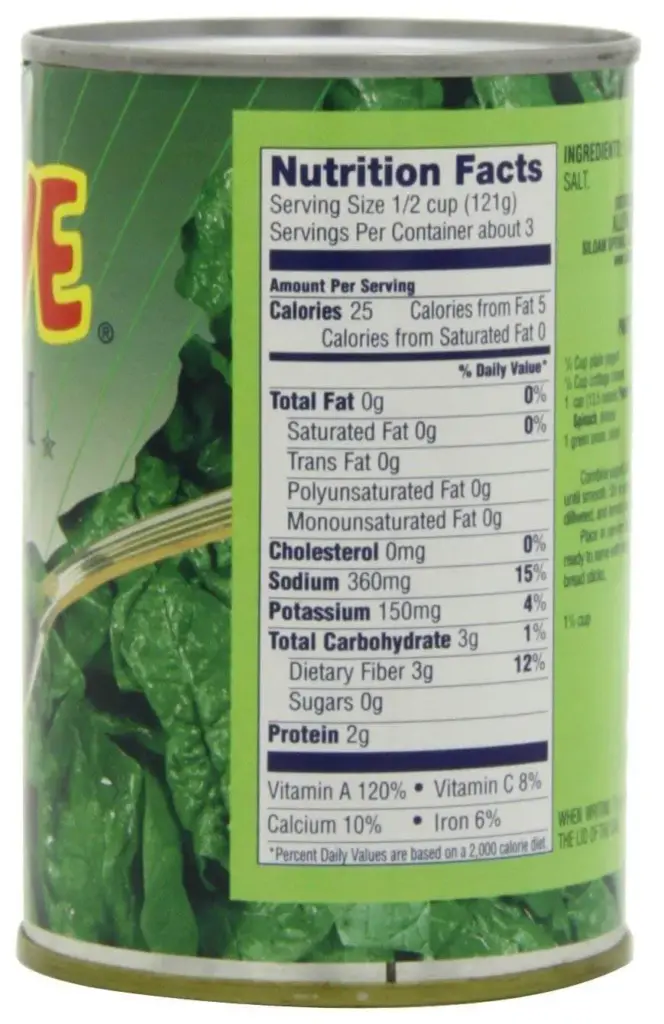
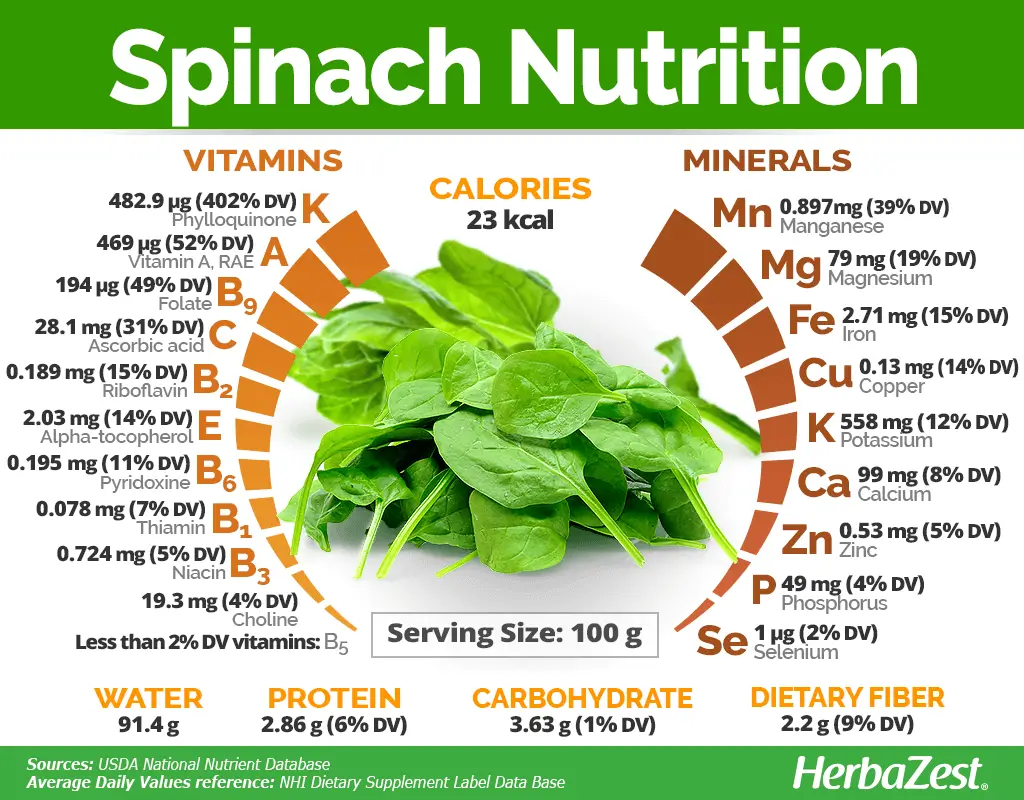
Spinach contains iron, but it is not the extraordinary iron source suggested by the old myth.
The iron in spinach is non-heme iron, which the body does not absorb as efficiently as the heme iron found in meat and seafood.
Spinach also contains oxalates that can reduce iron absorption.
This does not make spinach unhealthy or nutritionally useless. It means the vegetable’s reputation should not be reduced to one mineral.
Spinach also supplies:
- Beta-carotene and other provitamin A compounds
- Vitamin K
- Folate
- Magnesium
- Dietary nitrate
Segar’s vitamin A explanation was therefore closer to the nutritional evidence than the later iron story.
Does Spinach Really Make You Stronger?
Eating spinach will not cause an immediate increase in strength.
It can still form part of a nutritious diet that supports normal muscle, bone and cardiovascular function.
Modern sports research has examined dietary nitrate, a compound found in spinach and other leafy vegetables.
Some controlled studies have found that nitrate supplementation can slightly reduce the oxygen cost of exercise or improve certain measurements of power and muscle contraction.
The results are not universal.
Later studies have questioned whether nitrate actually improves mitochondrial efficiency, and much of the research uses measured supplements or nitrate-rich beetroot juice rather than ordinary servings of spinach.
What the research does not show
These studies do not demonstrate that eating one can of spinach produces an immediate burst of strength. They examine specific compounds, controlled doses and relatively small changes in exercise performance.
Spinach also contains small amounts of the plant compound ecdysterone.
A 2019 study reported increased muscle mass and bench-press performance among participants taking an ecdysterone-containing supplement while resistance training.
That finding is interesting, but it involved a concentrated supplement, not a normal helping of spinach. It should not be presented as proof that Popeye’s transformation is scientifically realistic.
Why the Popeye Spinach Myth Lasted
The decimal-point story survived because it connects several familiar ideas into one satisfying explanation:
- Spinach has a reputation for containing iron.
- Iron is associated with strength.
- Popeye becomes strong after eating spinach.
- A scientific mistake explains why everyone believed it.
Every piece appears to fit.
The story also has a memorable villain: one careless scientist and one badly placed decimal point.
The real history is less tidy.
Early laboratory measurements were unreliable. Later writers confused the details. A nutrition professor repeated an unsupported explanation, and a medical-journal essay gave it greater authority.
Meanwhile, the comic evidence sat in plain view.
Popeye had already supplied his own answer.
Why Popeye Eats Spinach: The Verdict
The surviving record supports three clear conclusions:
- Popeye’s strength was connected to spinach by 1931.
- When he explained the choice in 1932, he credited vitamin A—not iron.
- No primary evidence has been found for the famous misplaced-decimal story.
Some nineteenth-century measurements of spinach were too high, but that does not establish a decimal-point typo or a direct connection to E.C. Segar.
Modern research has found potentially useful compounds in spinach, including dietary nitrate, but nothing that produces the instantaneous effect shown in the cartoons.
The most likely answer is also the simplest.
Segar chose a familiar healthy vegetable and turned it into a perfect visual power-up. Fleischer Studios then repeated the transformation until the spinach can became inseparable from Popeye himself.
The science myth came later.
For more from the original comic, read my article on why Olive Oyl existed nine years before Popeye, or browse the full Popeye archive.