Depression is one of the hardest things to put on screen. It is not dramatic, it does not photograph well, and it rarely resolves in a single scene.
So the anime about depression that work best tend to build by accumulation, showing you a character who cannot get out of bed, cannot answer a text, cannot explain why any of it is hard.
These sixteen shows and films treat it with real care. Some name depression outright. Others bury it under mecha, surreal horror, or comedy so dark it loops back around.
If you want the softer end of this territory, our sad girl anime and anime anxiety roundups sit alongside this one.
All of them are worth your time, and a few of them are worth bracing for.
March Comes in Like a Lion
If you watch one title on this list, make it this one. Rei Kiriyama is a seventeen-year-old professional shogi player. He lost his family in a car accident, grew up resented in a foster home, and now lives alone in Tokyo. He plays a game he does not love because it is the only thing keeping him fed.
The series almost never says the word depression. Instead it shows you the symptoms: the unwashed apartment, the skipped meals, the inability to accept kindness. Then it introduces the Kawamoto sisters, who feed him without asking for anything. The recovery it depicts is slow and non-linear in a way that rings painfully true.
Welcome to the NHK!
Tatsuhiro Satou is a university dropout in his fourth year of unemployment. He lives as a hikikomori, convinced a shadowy conspiracy engineered his isolation. That premise sounds like a joke, and for a while the show lets you treat it as one.
Then it stops being funny. Welcome to the NHK is unusually clear-eyed about how withdrawal feeds itself. It also sees how shame keeps you indoors, and how the people trying to help can be just as lost. It is uncomfortable viewing precisely because it refuses to make its characters admirable.
A Silent Voice
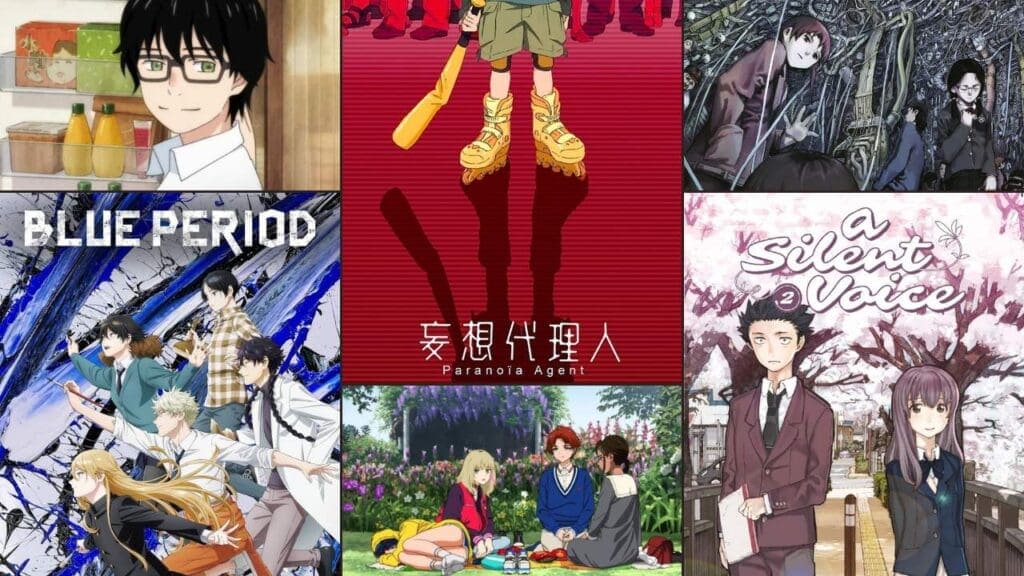
Shoya Ishida bullied a deaf classmate, Shoko Nishimiya, until she transferred schools. The class then turned on him, and five years later he cannot look anyone in the face. Kyoto Animation covers every face around Shoya with a large blue X. It is the most efficient depiction of social anxiety animation has produced.
What lifts it above a simple redemption story is that both leads carry it. Shoya is drowning in guilt, and Shoko is quietly convinced everyone would be better off without her. Neither one is fixed by the other.
Colorful
A drifting soul gets a second chance and wakes up in the body of Makoto Kobayashi, a fourteen-year-old who has just died by suicide. The catch is that he has to live Makoto’s life, which turns out to be full of things Makoto could not face.
Keiichi Hara directed it from Eto Mori’s 1998 novel, with Sunrise producing and Ascension animating. It took roughly five years to make after Sunrise’s president suggested the project. That care shows, because the film is patient enough to let its answer be small: things were survivable, and nobody told him.
Wonder Egg Priority
The title and the pastel character designs suggest something cute. It is not. Ai Ohto is a girl whose best friend died by suicide. She is offered a bargain: enter a dream world, protect other girls from the things that destroyed them, and she might bring her friend back.
Each girl she rescues carries a different real-world wound, and the series does not soften any of them. The animation is extraordinary. Still, the production ran into well-documented trouble, and the ending frustrated a lot of viewers. It is still one of the boldest things anime has done with this subject.
ReLIFE
On the surface this is a comedy: Arata Kaizaki, twenty-seven and unemployed, takes a pill that makes him look seventeen and gets sent back to high school for a year.
Underneath is something heavier. Arata quit his first job after only three months. His senior, Michiru Saiki, had been harassed by colleagues until she died by suicide, and the company simply carried on. He never processed it, froze in every interview afterwards, and drifted. The high school gimmick is the sugar coating on a story about someone rebuilding after workplace trauma.
Given
Given is filed as a boys love romance, and it is one, but it is first a story about grief. Mafuyu Sato barely speaks and carries a guitar he cannot play, because it belonged to his boyfriend, who died by suicide.
The show is at its best in the silences: the awkward pauses, the things nobody says, the way a band gives someone a reason to leave the house. When Mafuyu finally performs, the series pays off everything it has been holding back, and it earns the reaction it gets.
Your Lie in April
Kousei Arima was a child prodigy pianist, trained by a mother whose methods were abusive. After she died, he stopped being able to hear his own playing. The series treats that as a physical symptom of grief rather than a plot gimmick.
Then Kaori arrives, drags him back toward music, and the show becomes about whether he can want anything again. It is famously devastating, and it is also more careful than its reputation suggests about how trauma from a parent lingers.
Clannad: After Story
The first Clannad season is a fairly standard high school romance, which is why so many people bounce off it before reaching the part that matters. After Story follows Tomoya and Nagisa past graduation into work, marriage, and parenthood.
Then it does something few romance anime attempt. It puts Tomoya through bereavement, then shows him shutting down completely and abandoning responsibility for years. That portrait of a grieving man who cannot function is unusually unsparing for the genre. It is also why the show keeps appearing on lists like this.
Fruits Basket (2019)
The 2001 adaptation stopped early and kept things light. The 2019 remake runs the whole manga, and the whole manga is significantly darker than its reputation as a cosy zodiac romance suggests.
Nearly every Soma is carrying damage inflicted by an adult, and the series takes its time with each one. Tohru’s relentless kindness reads as sweetness at first, then gradually as a coping mechanism of its own. Watching characters slowly name what was done to them is the real engine of the show.
Blue Period
Yatora Yaguchi is a high schooler who does everything right and feels nothing, until a painting cracks something open in him. He decides to sit the entrance exam for Japan’s most competitive art university. From there the show becomes a study of what ambition costs.
The mental health content here is not dramatic. Instead it is burnout, comparison, sleep deprivation, and the dread of pouring yourself into something you might not be good enough at. If you have ever had a creative practice, parts of this will sting.
Violet Evergarden
Violet was raised as a weapon and comes out of the war with injuries, a set of mechanical hands, and no framework for understanding what she feels. She takes work as an Auto Memory Doll, writing letters for other people. A man invented the service so his blind wife could keep writing novels.
Strictly, this is post-traumatic stress and grief rather than depression. It belongs here anyway, because the whole series is about a person learning to feel things she was trained not to.
Neon Genesis Evangelion
Yes, there are giant robots and Angels. No, that is not what the show is about.
Hideaki Anno made Evangelion while working through his own depression, and it shows in every frame. Shinji is not a reluctant hero in the usual sense. He is a boy who believes he is worthless. So he pilots because it is the only way to be wanted, then withdraws again when that fails. Asuka and Misato are working through their own damage alongside him. By the final episodes, the mecha plot has almost entirely given way to an interrogation of self-loathing.
Serial Experiments Lain
Lain opens with a classmate’s death and an email she sends afterwards, which tells you what sort of series this will be. Lain Iwakura is a withdrawn schoolgirl who gets pulled into the Wired. The more time she spends there, the less certain her own identity becomes.
It was made in 1998 and predicted the isolation of online life with uncomfortable accuracy. It is slow, oblique, and often confusing on a first watch. It is also one of the few series that captures dissociation from the inside rather than describing it.
Paranoia Agent
Satoshi Kon’s only television series, which first reached many Western viewers through Adult Swim, follows a string of attacks by a boy on inline skates. Underneath, it is about what people will do rather than face their own lives.
Every victim is under unbearable pressure before the attack arrives, and the assault functions as an escape hatch. Kon builds this into a portrait of a society quietly falling apart through denial. It is funny, frightening, and considerably smarter than its premise lets on.
Sayonara, Zetsubou-Sensei
This is the outlier, and it will not suit everyone. Nozomu Itoshiki is a high school teacher whose despair is so total it has become a running joke. The series opens with a suicide attempt, interrupted by Kafuka Fuura, a student whose optimism is arguably more alarming than his gloom.
Studio Shaft turns it into rapid-fire satire about Japanese society. Each student in his class embodies a different anxiety. The despair is played for laughs, but the target is real, and the joke lands harder the worse you have felt.
Frequently Asked Questions
A few of the questions that come up most around this topic.
Which anime portrays depression most accurately? March Comes in Like a Lion is the usual answer, and for good reason. It shows the symptoms rather than naming the diagnosis, and its recovery arc moves at a realistic pace.
Is it healthy to watch anime about depression when you are depressed? That depends entirely on you. Some people find recognition steadying, while others find heavy material makes things harder. The content notes above exist so you can make that call before you press play.
What is the saddest anime on this list? Clannad: After Story, A Silent Voice, and Your Lie in April are the usual contenders. Wonder Egg Priority may be the bleakest, given its subject matter.
Are there anime about depression that end hopefully? Yes. March Comes in Like a Lion, A Silent Voice, ReLIFE, and Colorful all move toward real hope, even though none of them pretend the recovery is quick or complete.
The best of these do not offer solutions, and that is the point.
They sit with a feeling most stories rush past, and for a lot of viewers that recognition is the whole appeal.
So which one hit hardest for you?
Let me know in the comments.