

Bonkers is the 90s Disney cartoon I was obsessed with as a kid, and I will defend it to this day.
The Bonkers cartoon premiered on September 4, 1993, ran through February 23, 1994, and came straight out of Disney Television Animation. It was loud, fast, and completely chaotic, in the best way.
I still remember rushing home from school, dropping my backpack by the door, and catching the Disney Afternoon.
Everyone praises DuckTales and Gargoyles now, and rightly so, but this Disney bobcat was my personal favorite. It felt like a fever dream where a cartoon bobcat got handed a police badge.
Underneath the slapstick, Bonkers had a clever hook. It was all about the friction between two worlds crashing together: the zany animated toons and the very real humans who had to live with them.
Riding shotgun with his grumpy human partner, Detective Lucky Piquel, the show was a buddy-cop comedy unlike anything else on TV.
Where to watch: All 65 episodes of the Bonkers cartoon are on Disney+, added back in November 2019.
What Was the Bonkers Cartoon About?
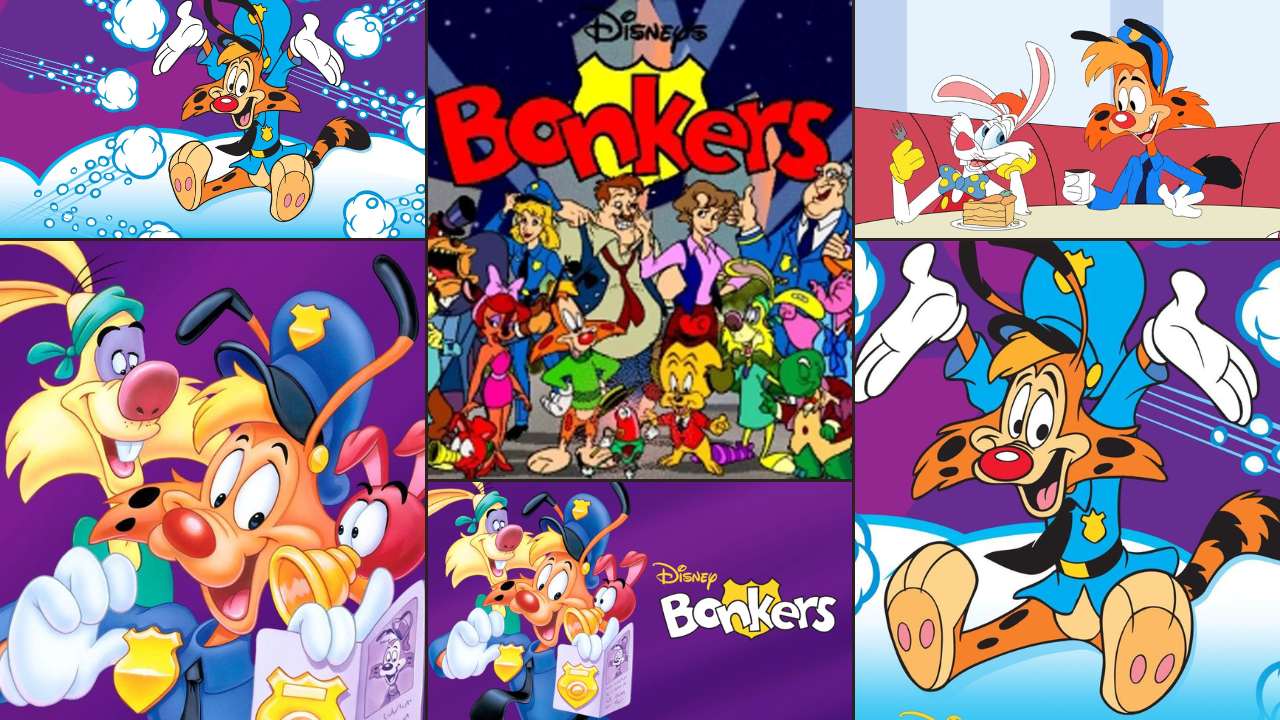
In 1990s Los Angeles, toons are not just drawings. They are a whole community living alongside humans. Bonkers D. Bobcat was a huge cartoon star, but when his show got bumped from first place, the studio fired him and his fame fizzled out.
Then luck struck. Bonkers accidentally helped save Donald Duck from a mugger, and got full credit for the arrest.
That stunt landed him a job as a cop in the Hollywood PD’s Toon Division. He was paired with Detective Lucky Piquel, a stern, toon-hating human with zero patience for his new partner. The mismatched duo solved cases in the heart of Hollywood, with Bonkers usually causing more chaos than he fixed.
What made the premise smart was the genre-blending.
One week it was a moody noir mystery about a kidnapped toon. The next it was pure slapstick about a monster truck. It was basically a police procedural for kids who ran on way too much energy, and I mean that as the highest compliment. No other Disney bonkers cartoon before or since has looked quite like it.
The Main Bonkers Cartoon Characters: Toons and Humans
The cast of the Bonkers cartoon was a strange, wonderful mix of humans and toons. The chemistry between the grounded people and the physics-defying cartoons is the whole engine of the show. Here are the key players.
Bonkers D. Bobcat

Bonkers D. Bobcat is an ex-cartoon star turned cop. He is energetic, optimistic, and completely clueless about how the real world works. He treats police work like a cartoon script, hunting for the punchline in the middle of a crime scene.
If I had to sum him up, he is basically Tigger with a badge.
He is easy to spot: orange fur, a big spot on his ear, and a uniform that never stays clean. He was voiced by Jim Cummings, the same legend behind Winnie the Pooh, Tigger, and Darkwing Duck. That manic, rubbery voice is still stuck in my head decades later.
Detective Lucky Piquel

Lucky Piquel is a grumpy, overworked slob who hates toons and just wants to eat his donut in peace. He is the perfect foil to Bonkers. While Bonkers bounces off the walls, Lucky is usually face-palming.
The irony is that despite hating toons, Lucky is the one who keeps getting flattened, stretched, and exploded. He is the everyman trying to hang on to his sanity in a cartoon world, and he might be the most relatable character for any adult watching.
Here is my favorite piece of trivia: Lucky Piquel was also voiced by Jim Cummings. That is right, one actor played both leads of a buddy-cop show and somehow made them sound like completely different people. That still blows my mind.
Fall-Apart Rabbit

Voiced by Frank Welker, Fall-Apart Rabbit was Bonkers’ old stunt double from his acting days. Exactly like his name says, he falls to pieces at the slightest touch, and wears bandages to try to hold himself together.
He shows up in the Lucky episodes and exists almost entirely for visual gags where he disassembles into a pile of limbs.
For me, he was the funniest character on the whole show, and his mumbling voice was reportedly modeled on Dustin Hoffman’s character in Rain Man.
Sergeant Miranda Wright

Miranda Wright was Bonkers’ other partner, and she is where things get confusing (more on that in a second). She was voiced by Karla DeVito. Unlike Lucky, Miranda liked Bonkers. She was patient, sharp, and treated him as a real partner instead of a nuisance. That shifted the whole show from constant conflict to actual teamwork, which some fans loved while others missed the Lucky friction.
Supporting Cast
- Chief Leonard Kanifky: the scatterbrained chief of police who is convinced Bonkers is a genius, and is usually oblivious to the chaos in his own station.
- Fawn Deer: a toon actress and Bonkers’ co-star and crush, voiced by Nancy Cartwright (yes, the voice of Bart Simpson). Bonkers would do anything for her, and she likes him back.
- Toots: Bonkers’ pet horn. A living horn that honks and behaves like a loyal dog. Frank Welker voiced him too.
- Jitters A. Dog: Bonkers’ nervous, long-suffering sidekick from his cartoon days, whose catchphrase is “I hate my life.”
- Marilyn Piquel: Lucky’s daughter, a budding artist who adores Bonkers, much to her dad’s annoyance.
Here is the whole main cast in one place, so you can match every face to its voice.
| Character | Who they are | Voiced by |
|---|---|---|
| Bonkers D. Bobcat | Toon cop and ex cartoon star | Jim Cummings |
| Detective Lucky Piquel | Grumpy, toon-hating human partner | Jim Cummings |
| Sgt. Miranda Wright | Bonkers’ later, friendlier partner | Karla DeVito |
| Fall-Apart Rabbit | Bonkers’ falling-to-pieces stunt double | Frank Welker |
| Fawn Deer | Toon actress and Bonkers’ crush | Nancy Cartwright |
| Toots | Bonkers’ living pet horn | Frank Welker |
The Two Bonkers Paradox: Lucky vs. Miranda
If you watched as a kid and felt confused when the animation and the main partner seemed to change halfway through, you were not imagining it. The Bonkers cartoon is essentially two different shows stitched together, and the story behind it is my favorite bit of Bonkers trivia.
The Miranda Wright episodes were produced first. The plan was a full 65-episode order with Miranda as the partner. But those episodes came back from the overseas animation studios looking rough, and Disney panicked. Only 19 of them survived to air. In that batch, Bonkers has a slightly different look: golf-club-shaped ears and different spots, closer to his original cartoon-short design.
So Disney brought in a new team led by Robert Taylor, who threw out the premise and created Lucky Piquel to add that Roger Rabbit style buddy-cop friction. They made 42 new Lucky episodes, redesigned Bonkers to be cuter with skinnier ears, two black spots, and Tigger-like tail stripes, and, despite being made second, aired these first to set up the origin story. A transition episode called “New Partners on the Block” tried to bridge the two timelines.
The result is a pile of continuity errors that still drive fans a little crazy. In one episode Bonkers is a rookie, in the next he is a veteran. For most of us, though, the Lucky Piquel era is the golden age of the show.
The Villains of the Bonkers Cartoon
A cop show is only as good as its criminals, and the Bonkers cartoon had some of the strangest animated villains of the decade.
The rest of the rogues’ gallery leans weird and wonderful. Mr. Doodles is the Collector’s scribbly little henchman. Ma Parker is a toon tow truck who fools Lucky into thinking she is sweet while she steals parts off their police car to build monster-truck armor.
Fun fact: Ma Parker was voiced by the legendary June Foray, the original voice of Rocky the Flying Squirrel.
And then there is Wacky Weasel, an egg-obsessed villain so feared that even Chief Kanifky was scared of him. He once broke into a prison because he heard it was full of “bad eggs.”
Was Bonkers a Roger Rabbit Spin-Off?
This is the big myth I want to clear up, because almost every Bonkers article repeats it. You will often read that Bonkers was meant to be a Who Framed Roger Rabbit spin-off that got scrapped over legal issues, so Disney made a new character instead. It is a great story. It is also not true.
Here is a bonus piece of casting trivia that I love. Jim Cummings revealed in 2025 that he was one of the final three actors up for the role of Bonkers.
The other two? Matt Frewer and a young Jim Carrey, who reportedly strolled out of the audition telling everyone he was sure he had the part. Cummings has said that if Carrey had landed the toon-cop gig, he probably never would have become a live-action movie star.
Imagine that timeline.
However you slice it, Bonkers stands proudly alongside classics like DuckTales, Chip ‘n Dale Rescue Rangers, TaleSpin, and Darkwing Duck. It was also one of the last cartoons of the era to use traditional hand-painted cel animation before digital ink and paint took over.
Bonkers Cartoon Video Games
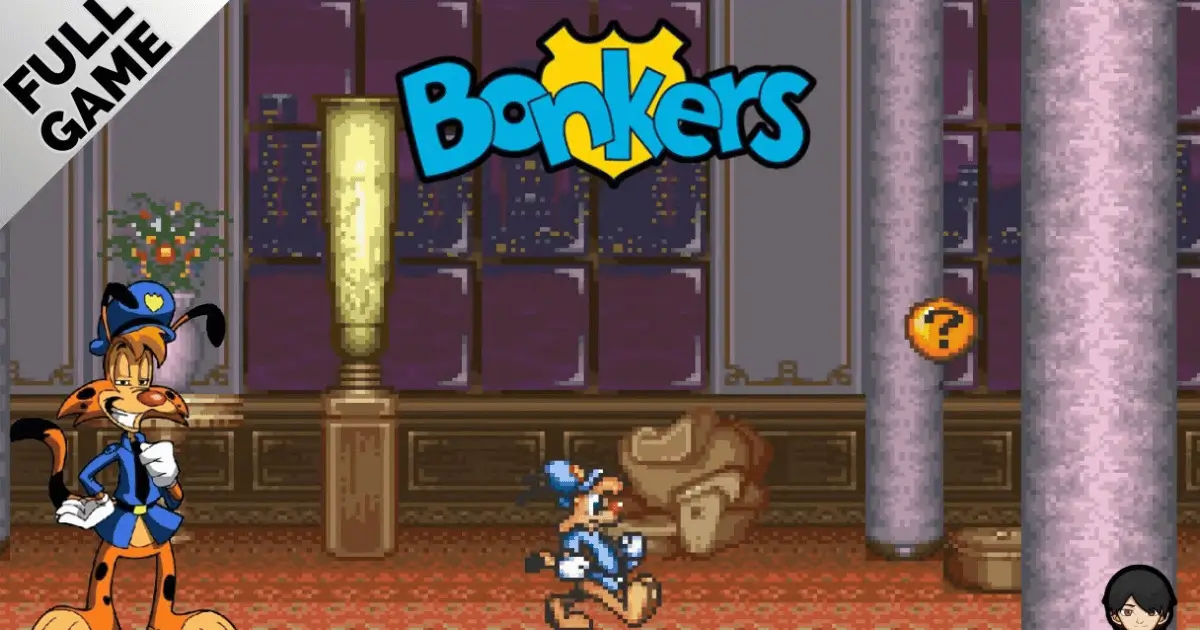
If you were a 90s gamer, you probably played one of the Bonkers games, and the funny thing is the two main ones were completely different genres.
The SNES version (Capcom, 1994) is a platformer. The setup: Lucky gets hospitalized after a car crash, so Bonkers has to crack the case solo.
His mission is to recover three stolen Toontown treasures, and each is a deep-cut Disney reference: the Sorcerer’s Hat from Fantasia, the Mermaid’s Voice from The Little Mermaid, and the Magic Lamp from Aladdin.
You dash and toss bombs across six levels, with The Collector showing up as a boss. Even better, this game was announced in early 2026 as one of the additions to The Disney Afternoon Collection on Nintendo Switch, so it is no longer locked away.
The Sega Genesis version (October 1, 1994) is a collection of mini-games. Here Bonkers enters an “Officer of the Month” competition while Lucky is on vacation, and has to capture four toon criminals to win it: Harry the Handbag, The Rat, Mr. Big, and Ma Parker.
Each crook has its own oddball mini-game, from target practice to a freeway car chase. It was brutally hard but weirdly addictive.
I was not even the only one collecting Bonkers stuff back then. In 1993, Burger King handed out a set of five crash-apart car toys featuring Bonkers, Fall-Apart Rabbit, Lucky, Jitters, and Toots. If you had the full set, you were the coolest kid at the lunch table.
Legacy and Cameos
Bonkers has been off the air for decades, but he refuses to be fully forgotten. He keeps popping up in the background of newer Disney projects:
- Aladdin (1994 TV series): in the episode “Snowman is an Island,” the Genie briefly morphs into Bonkers.
- DuckTales (2017): in the episode “Let’s Get Dangerous!,” Bonkers appears on a screen as the heroes scroll through escaped supervillains, and he is shown getting hurt by each one. It is a blink-and-you-miss-it gag for the die-hards.
- Chip ‘n Dale: Rescue Rangers (2022): this was the big one. Bonkers shows up twice. In the climax he appears as a bootleg toon fused with a walrus body, and during the end credits he is back to normal on a billboard.
He even got a jab from the competition. When Warner Bros. launched Animaniacs the same year, the writers took open shots at Bonkers in a few episodes, and one of the working titles for Animaniacs was reportedly Bonkers until Disney claimed the name first. Even Disney+ cannot quite keep him straight today, since its official listing labels him “Bonkers T. Bobcat” rather than his real middle initial, D.
How Many Episodes Are There, and Where Can You Watch Bonkers?
The Bonkers cartoon ran for 65 episodes, all packed into that 1993 to 1994 window on the Disney Afternoon. After the original run it bounced through reruns and eventually landed on Toon Disney until 2004, then disappeared for years. For a long time the only way to revisit it was grainy uploads online.
That changed in November 2019, when all 65 episodes of the Bonkers cartoon arrived on Disney+.
So if you have ever wanted to rewatch this Disney classic properly, it is finally a few clicks away, and I cannot recommend a nostalgia binge enough.
Why the Bonkers Cartoon Deserves a Reboot
In an era where everything from Animaniacs to X-Men is getting revived, I think Bonkers deserves another shot.
The toon-cop concept is timeless, and modern animation could push the contrast between the toon world and the real world even further. The Lucky Piquel friction would still land, and a fresh audience would eat it up.
Until that happens, we have Disney+, the retro games, and our memories of that hyperactive bobcat to keep the siren wailing.
So I have to ask: were you a Bonkers kid too? And which era do you prefer, the grumpy Lucky Piquel years or the smoother Miranda Wright partnership? Let me know in the comments.
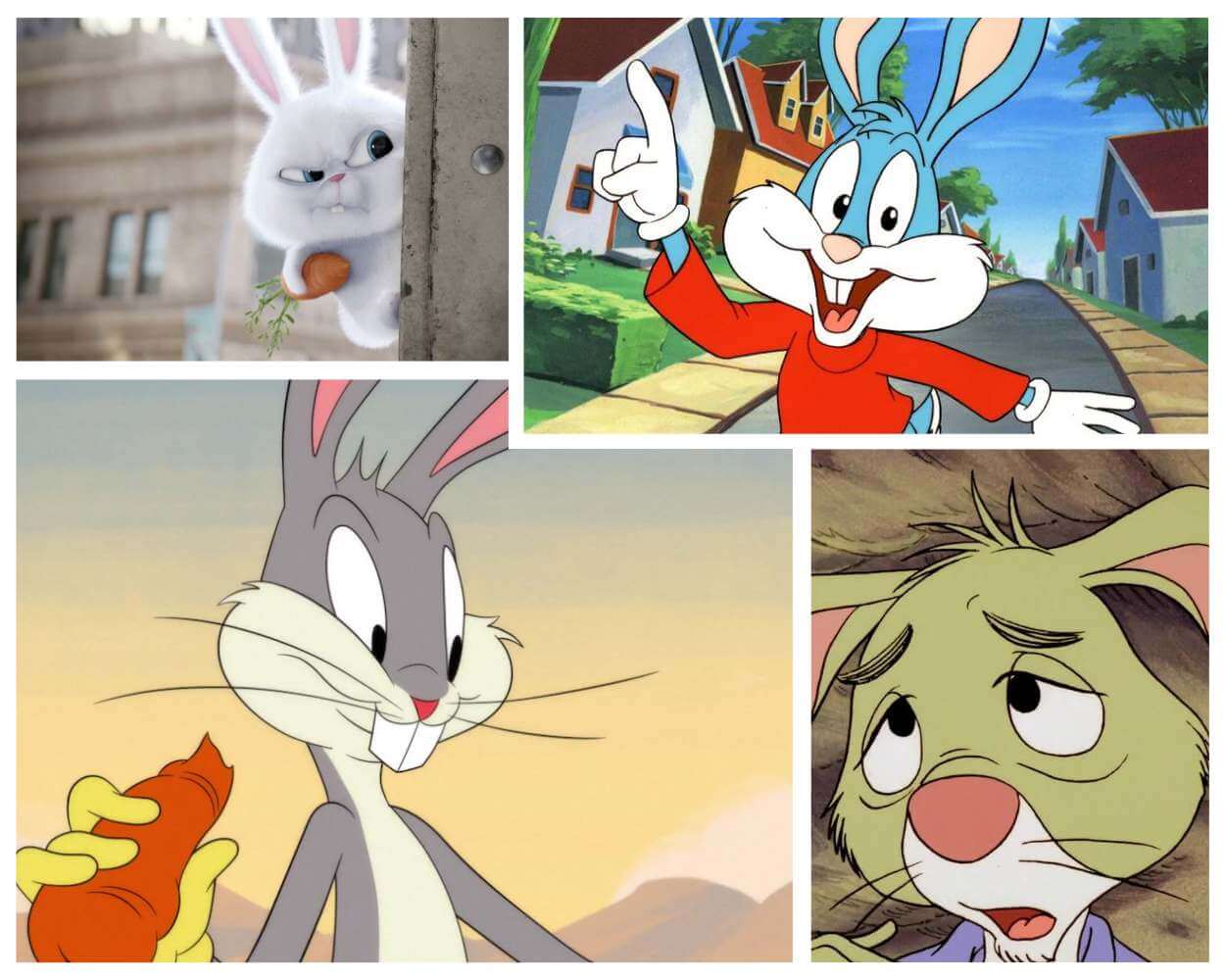
Disney’s Bonkers was created by reworking a failed attempt at a Roger Rabbit cartoon series.
I remember sprinting home just to catch the Disney Afternoon, and while DuckTales and Gargoyles get most of the nostalgia spotlight now, Bonkers was the one that felt the most unhinged and unpredictable. It really did feel like someone mashed a cartoon noir, slapstick comedy, and buddy cop show together and somehow made it work.
The Lucky Piquel era will always be my favorite, mostly because that dynamic felt so relatable even as a kid. Watching a burnt out human detective trying to survive cartoon physics was comedy gold. Lucky’s constant frustration somehow grounded the chaos, and I think that tension is why people still debate “Lucky Piquel vs Miranda Wright episodes” decades later. I am curious how others feel about this. Did you prefer the conflict driven Lucky episodes, or did the Miranda partnership feel more balanced and forward thinking to you?
I also cannot overstate how much Jim Cummings carried the show. Knowing now that he voiced both Bonkers and Lucky just makes it even more impressive. Every time I hear his voice in another Disney project, it immediately sends me down a rabbit hole of “Disney Afternoon cartoons ranked” nostalgia.
Seeing Bonkers pop up again in modern cameos hit me harder than I expected. That brief appearance in Chip ‘n Dale: Rescue Rangers felt like Disney quietly acknowledging a weird, chaotic chapter of its animation history. It made me genuinely ask why Bonkers never got the reboot treatment when so many other 90s animated shows did.
So I have to ask. If Bonkers came back today with modern animation and a slightly older audience in mind, do you think the toon cop concept would work again? And which version would you want brought back, the grumpy Lucky Piquel era or the smoother Miranda Wright dynamic?