Nick Wilde spends most of Zootopia insisting he is exactly what everyone assumes he is. A sly fox.
A hustler.
Not worth anybody’s time.
The film quietly proves him wrong using his own words, and almost nobody notices how it does it. As a kid, Nick recites an oath promising to be brave, loyal, helpful, and trustworthy.
He gets muzzled halfway through it for being a fox.
Then, across the rest of the movie, he keeps every single line of that promise for someone who has no idea he ever made it.
That is the character.
Everything else, the pawpsicles, the sunglasses, the smirk, is armour built over one bad night.
Who Nick Wilde Is
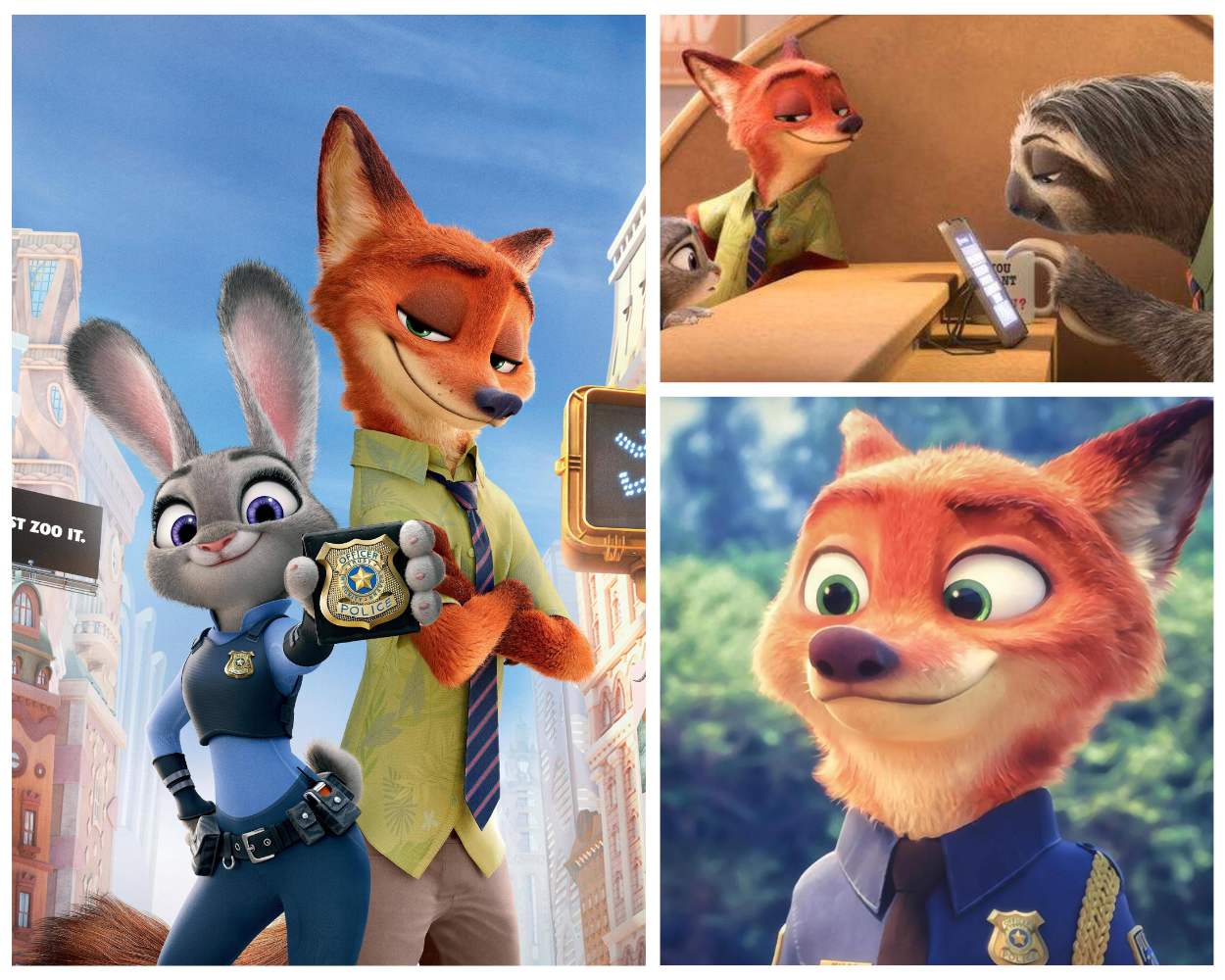
Nick is the deuteragonist of Zootopia, which is a fancy way of saying he is the second lead and the one carrying the film’s actual argument. Judy Hopps drives the plot. Nick supplies the reason the plot matters.
He is a red fox working small cons around the city with his partner Finnick, a fennec fox with the voice of a heavyweight and the build of a housecat.
Their signature scheme involves buying one enormous jumbo-pop, melting it, refreezing it into small pawpsicles, selling those to lemmings, and then reselling the used sticks as redwood lumber. It is elegant work, and it is also completely illegal.
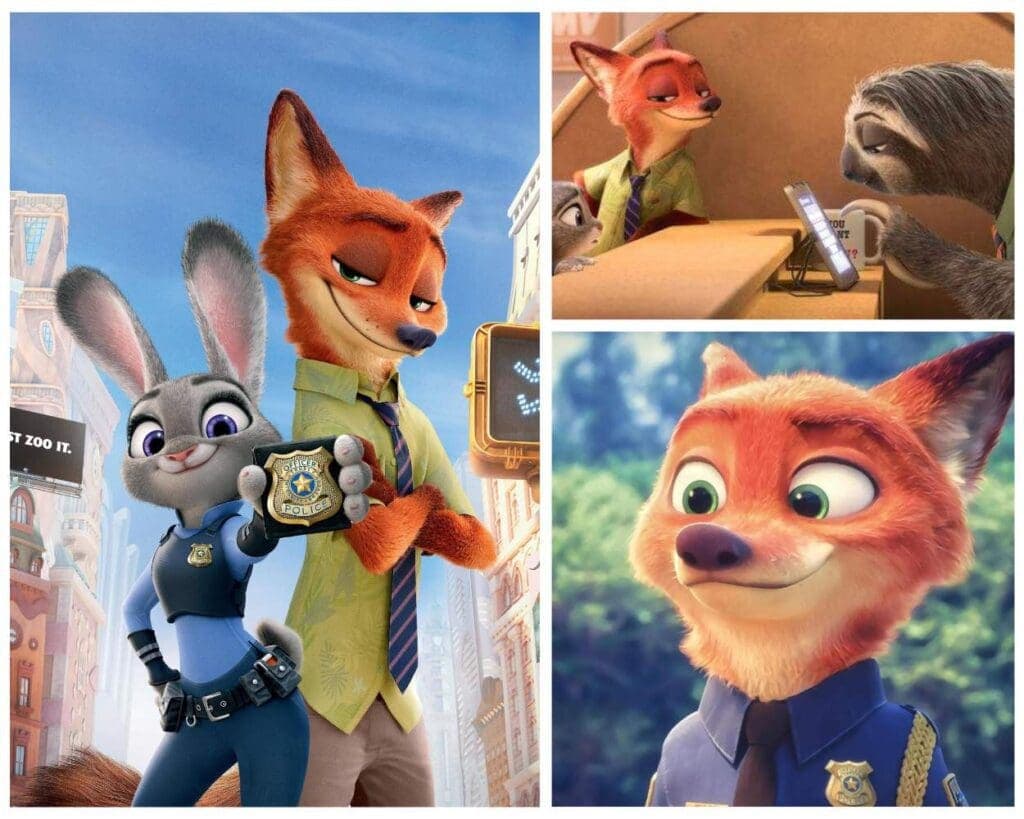
By the end of the film he is a police officer, the first fox on the force, and Judy’s partner. That arc is well known. What gets skipped is why he was hustling in the first place.
The Night That Made Him

Nick grew up poor, raised by his mother. When he was eight or nine, he wanted to join the Junior Ranger Scouts, and she scraped together enough money to buy him a brand new uniform.
He turned up to his initiation excited, proud, and completely unaware that he was the only predator in the room.
He starts reciting the oath: he promises to be brave, loyal, helpful, and trustworthy. One of the other scouts interrupts to ask whether that still counts, even though he is a fox.
Then they hold him down and strap a muzzle on him.
He runs outside, gets it off, and cries behind the steps while they laugh at him through the door.
The lesson he draws is the one the whole film argues against: if the world has already decided a fox is shifty and untrustworthy, there is no point in trying to be anything else. He decides never to let anyone see that they got to him, and he builds the smirk.
Everything charming about adult Nick is scar tissue.
The Hustle, and the Hustle Back

One of the neatest pieces of construction in Zootopia is that nearly everybody hustles somebody, and the film keeps score.

Nick cons Judy first, playing on her optimism to get his jumbo-pop and leave her looking foolish. Judy gets him back later by recording him casually admitting to years of tax evasion, then doing the arithmetic out loud and pointing out it is a felony. She blackmails him into the case.
His response is admiration as much as irritation, because she just out-hustled a professional.
The pattern completes at the climax.
To trap Assistant Mayor Bellwether, Nick swaps the serum pellet for one of Judy’s blueberries, plays savage, and pretends to go for Judy’s throat while Judy plays terrified and records the confession.
Two con artists, working as one, taking down a politician.

It is a fun structural joke, but it also does something serious: it puts Judy and Nick on the same moral footing. She is not the honest one saving the crooked one. They are both willing to bend things, and the film likes them both more for it.
The Oath He Never Stopped Keeping

Here is the part that makes Nick one of the best-built characters Disney has written this century.
That oath he never got to finish as a child lists four things: brave, loyal, helpful, trustworthy.
Watch the film again and he delivers all four, in full, without ever mentioning it.
- Brave: he stands up to Chief Bogo in the Rainforest District, which is a properly dangerous thing for a fox with no badge to do, and it saves Judy’s job.
- Loyal: at the museum, with Judy injured and telling him to run, he refuses to leave her.
- Helpful: his knowledge of the city, and his sloth friend at the DMV, are the only reasons the investigation moves at all.
- Trustworthy: the con on Bellwether only works because Judy lets a fox put his teeth around her throat and trusts him completely not to bite.

And then there is the detail that turns the whole thing devastating. During the climax, Nick bandages Judy’s injured leg with a handkerchief. It is the neckerchief from that Junior Ranger Scout uniform.
He kept it. For roughly twenty years, through every con and every night of pretending he did not care, he kept the piece of the outfit his mother bought him. And he finally uses it to help somebody.

The badge at the end is not a redemption arc. He was never a bad person who became good. He was a good person who was told, once, very violently, that he was not allowed to be one.
Nick and Judy

The partnership works because both of them are wrong about the world in opposite directions. Judy Hopps believes Zootopia is fair and that effort is always rewarded.
Nick believes it is rigged and that effort is for suckers. The film sides with neither.

Judy’s first read on Nick is a stereotype she does not know she is holding. She follows him into an ice cream parlour because a fox walking down the street looks suspicious to her. She then defends him publicly, gets conned, and takes it as confirmation.
Her real growth is not learning to trust him.
It is noticing that she profiled him before he ever did anything.

Nick’s first read on Judy is that she is a country rabbit who will be chewed up by the city within a month, and he takes some pleasure in speeding that up. What changes his mind is not her optimism.
It is watching her be wrong, own it, and keep going anyway.


Their worst moment is the best-written thing in the film. After the press conference, Judy fumbles into exactly the kind of language that muzzled him as a child, and Nick, who has spent the entire movie refusing to let anyone see that they got to him, lets her see it.
He walks.
The apology scene that follows is why the ending lands.
The Look

Nick is a slim red fox with a cream muzzle, green eyes, and dark auburn fur on his paws, ear tips, and tail tip. He wears a light green Hawaiian shirt, a dark indigo tie with red and blue stripes, and grey-tan trousers.
The outfit is doing character work.
A Hawaiian shirt reads as relaxed and unbothered, which is the impression he needs to give.
But he pairs it with a tie, which nobody does, because part of him wants to look like somebody with a respectable job.
It is a costume that cannot decide whether it is giving up or trying, which is Nick exactly.
Who Voices Nick Wilde
Jason Bateman voices the adult Nick, and the casting is the whole performance. Bateman has spent a career playing men who are the smartest person in the room and are quietly exhausted by it, which is precisely the register Nick needs. Kath Soucie voices young Nick in the Ranger Scout flashback, and the gap between the two voices does more emotional work than any line of dialogue.
Nick Wilde in Zootopia 2
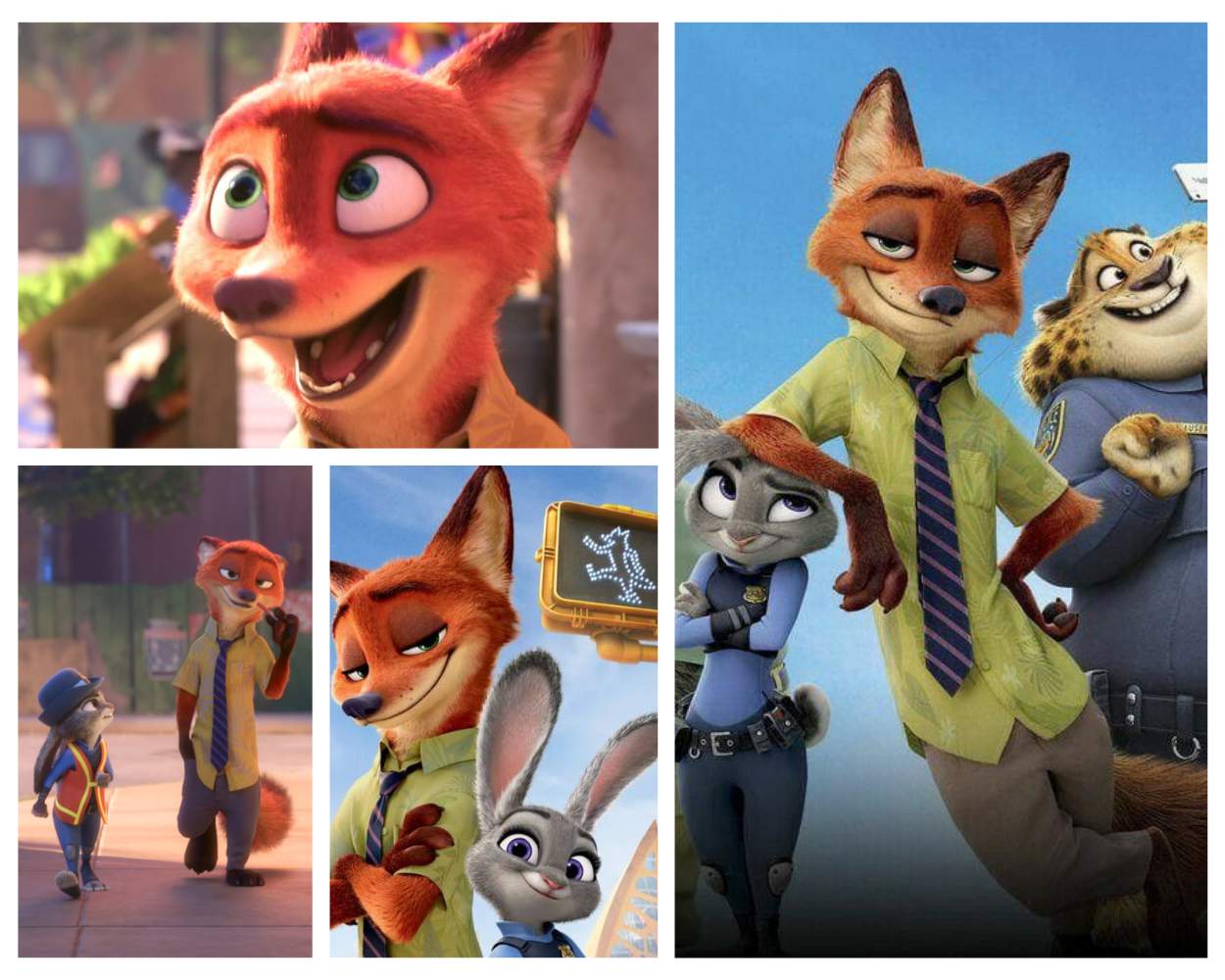
Zootopia 2 arrived in November 2025, and it picks up one week after Nick and Judy officially became partners at the ZPD. The joke is that being partners is much harder than becoming partners: their styles clash so badly that Chief Bogo threatens to split them up unless they attend partnership therapy.
The case involves a pit viper named Gary De’Snake, the Zootenial Gala celebrating the city’s hundredth anniversary, and the wealthy Lynxley family descended from Zootopia’s founder.
Nick spends the film in undercover clothes and, more interestingly, gets pushed into admitting out loud that he is bad at saying how he feels because he has been on his own his whole life.
Nine years later, the film is still unpicking that one night at the Ranger Scouts.
Nick Wilde Trivia

- His middle name is a Star Trek joke. He is Nicholas Piberius Wilde, adapted from James Tiberius Kirk.
- He was supposed to be the lead. Early versions of Zootopia followed Nick as the protagonist. The focus moved to Judy because a cynical, untrustworthy lead made the bright, optimistic city harder to sell.
- He was nearly called Jack Savage. The earliest concept was a spy story with Nick under that name. Once the plot became a mystery about animals going savage, keeping “savage” in the hero’s name stopped making sense.
- He cameos in two other Disney films. He turns up on a San Fransokyo billboard and on Honey Lemon’s phone case in Big Hero 6, two years before his own movie, and again in Ralph Breaks the Internet as a netizen on the Oh My Disney site, where Vanellope rushes straight past him.
- He is playable in Disney Infinity 3.0. His figure launched on 1 March 2016 alongside Judy’s, armed with a jumbo-pop as a melee weapon, a thrown-popsicle range attack, and a special that summons Finnick to help.

At the parks, Nick and Judy debuted at Disney’s Animal Kingdom in Florida and joined the Move It!
Shake It! street party at the Magic Kingdom in March 2016, taking over a slot previously held by Genie and Stitch.
They have since headlined Halloween and Christmas party events.
Nick Wilde FAQ
What animal is Nick Wilde? A red fox, and the film leans hard on every stereotype attached to that before dismantling them.
Who voices Nick Wilde? Jason Bateman voices the adult Nick and Kath Soucie voices him as a child.
What is Nick Wilde’s full name? Nicholas Piberius Wilde, and by the end of the first film, Officer Nicholas Wilde of the ZPD.
Is Nick Wilde a villain? No. He is a con artist when we meet him, which is a crime but not a character. The film is explicit that he chose that life after being told a fox could not have any other.
Why does Nick Wilde hate muzzles? He was muzzled as a child by other kids during a Junior Ranger Scouts initiation, purely for being a fox. Seeing muzzles later in the film visibly shakes him.
Does Nick become a police officer? Yes. He graduates and becomes the first fox officer at the Zootopia Police Department and Judy’s partner, a role he continues in Zootopia 2.
What does the name Wilde mean for the character? It is a pun the film uses against him. Everyone hears “wild” and assumes savage. What he turns out to be is resourceful, quick, and creative.
Nick Wilde works because he is not a redemption story. He is a story about a kid who was told exactly once what he was allowed to be, believed it for twenty years, and then met somebody stubborn enough to argue.
He is easily one of the best animated characters Disney has produced in the last decade, and he did it while pretending not to care about anything at all.
Go back and watch for the neckerchief.
It changes the whole film.