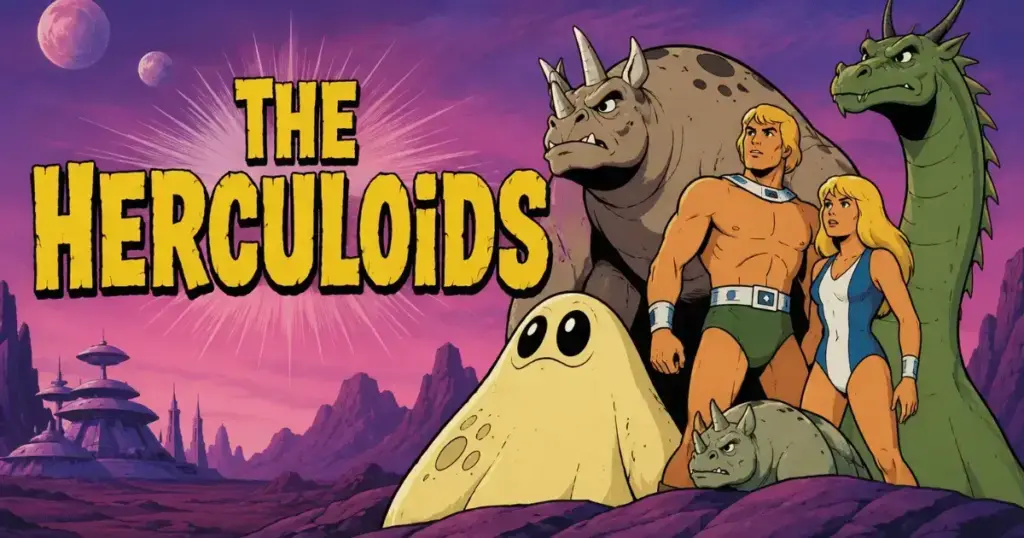
The first time I found The Herculoids in reruns, I was convinced I had landed on the wrong channel.
There was no laugh track, no wisecracking animal sidekick, and almost no interest in explaining the world. A primitive family, a laser-firing dragon, a rock ape, and two living blobs were simply defending an alien planet from another invasion.
It felt less like a conventional Hanna-Barbera cartoon and more like a comic book that had started moving.
The series premiered on CBS in 1967, and its basic formula was extremely simple. Invaders arrived. The Herculoids fought them. The planet survived.
What made it special was the visual imagination behind that formula.
Alex Toth’s designs gave every character a clear silhouette and a specific purpose, turning a limited-animation Saturday morning show into one of Hanna-Barbera’s most distinctive science-fiction worlds.
The Herculoids at a glance
Eight defenders against the galaxy
- Studio: Hanna-Barbera
- Premiere: September 9, 1967, on CBS
- Created and designed by: Alex Toth
- Original production: 18 half-hours containing 36 short stories
- 1981 revival: 11 additional stories produced for Space Stars
- The premise: A family and five super-powered creatures defend an alien world
What Was The Herculoids About?
The Herculoids live on a distant planet that combines prehistoric wilderness with advanced alien technology.
Zandor, Tara, and their son Dorno appear to be the only human inhabitants. They share the land with five powerful creatures: Zok, Igoo, Tundro, Gloop, and Gleep.
Together, they protect the planet from robots, conquerors, giant insects, energy creatures, and visitors who usually arrive with no interest in peaceful negotiation.
The original series rarely pauses to explain where the family came from, how they met the creatures, or why this planet attracts so many invaders. It begins with the team already established and treats their unusual life as completely normal.
That lack of exposition gives the show some of its appeal. The audience is dropped into a world that feels much larger than the ten-minute stories can show.
The Alex Toth Look
The first thing that separates The Herculoids from most cartoons of its era is the design.
Many Hanna-Barbera comedies relied on rounded characters, familiar settings, and reusable poses. The Herculoids uses sharp silhouettes, broad shadows, rocky landscapes, and creatures that look as though they escaped from a pulp science-fiction cover.
The show resembles a moving comic book because its creator approached animation as a master cartoonist.

Alex Toth’s Minimalist Genius
Alex Toth was already respected for his comic-book work before becoming one of Hanna-Barbera’s most important designers.
His strength was clarity.
Toth could reduce a character to a few strong lines without making the design feel empty. He avoided unnecessary detail, emphasized body language, and made sure each figure remained readable even when the animation moved quickly.
That skill was ideal for television animation, where limited budgets meant characters had to communicate instantly.
Zok reads as a flying predator before he fires a single laser. Igoo looks heavy enough to crack the ground. Tundro’s armour and horns immediately suggest a living siege weapon. Gloop and Gleep are simple blobs, but their changing shapes make them endlessly useful.
The designs are economical because they had to be. They remain memorable because Toth understood exactly which details mattered.
Building an Alien Ecosystem
The creatures are not five variations of the same monster. Each fills a different role in the team’s defence.
Zok controls the air. Igoo supplies brute force. Tundro provides ranged firepower. Gloop and Gleep can become shields, bridges, restraints, or rescue equipment.
Put them together and the family has a complete defence force without spaceships, computers, or a headquarters.

Why the team works
- Air support: Zok attacks from above and scouts ahead
- Heavy strength: Igoo breaks barriers and absorbs punishment
- Artillery: Tundro fires explosive energy rocks
- Protection and rescue: Gloop and Gleep reshape themselves as needed
- Leadership: Zandor, Tara, and Dorno coordinate the defence
A Different Kind of Hanna-Barbera Cartoon
By 1967, Hanna-Barbera was best known for comedy.
The Flintstones, Yogi Bear, Top Cat, and other hits had established the studio’s familiar mix of talking animals, suburban jokes, and repeated comic situations.
The studio was not limited to that formula. Jonny Quest had already demonstrated in 1964 that Hanna-Barbera could produce straight adventure, while Space Ghost pushed further into superhero science fiction in 1966.
The Herculoids combined those action instincts with sword-and-planet fantasy.
It had no regular comic-relief character, no secret identity, and very little domestic comedy. Most stories move directly from threat to battle.
Action Without Much Explanation
A typical story begins with an alien ship landing or an unfamiliar creature appearing.
The enemy captures someone, steals a resource, or attempts to conquer the planet. Zandor gathers the team, and the rest of the story becomes a fast series of attacks and rescues.
That simplicity is both the show’s strength and its limitation.
The episodes move quickly and rarely waste time. They can also become repetitive when watched in a long marathon. The villains change, but the basic rhythm remains familiar.
Two or three stories at a time work better than an entire season in one sitting.

Meet Zok, Igoo, Tundro, Gloop and Gleep
The five creatures are the real reason the series is remembered.
- Zok, the laser dragon: A winged dragon who fires energy beams from his eyes and tail. He can breathe fire, survive beyond the atmosphere, and use a cancelling beam against certain energy attacks.
- Igoo, the rock ape: A massive gorilla-like creature with nearly indestructible stone skin. He is gentle with the family but becomes the team’s strongest close-range fighter when the planet is threatened.
- Tundro, the living cannon: A ten-legged armoured creature with features resembling a rhinoceros and a triceratops. He launches explosive energy rocks from the horn on his head and can extend his legs to cross difficult ground.
- Gloop and Gleep, the formless wonders: Two protoplasmic creatures capable of reshaping themselves into shields, bridges, cushions, cages, and almost anything else the team needs. Gloop is the larger of the pair.
Zandor, Tara, and Dorno are not passive owners watching their creatures fight. Each carries a slingshot that fires energy rocks, and all three regularly enter dangerous situations.
The original voice cast also deserves more precise credit than it sometimes receives.
The original voice cast
- Mike Road: Zandor, Zok, and Tundro
- Virginia Gregg: Tara
- Ted Eccles: Dorno
- Ted Cassidy: Igoo
- Don Messick: Gloop and Gleep

One small detail gives the family an unusual tone. Dorno normally calls his parents Zandor and Tara rather than Mom and Dad.

The Herculoids’ Influence
The series did not invent science-fantasy adventure, but its combination of a primitive world, alien technology, and strange creature allies became a memorable model.

From Thundarr to A Boy and His Blob
Thundarr the Barbarian, which premiered in 1980, shares obvious visual and genre connections with The Herculoids. Both combine barbarian heroes, strange monsters, and science-fiction technology.
The relationship is not simply a case of one series copying the other. Alex Toth also contributed early design work to Thundarr, helping carry some of the same artistic instincts into a later generation of television adventure.
The clearest documented influence belongs to Gloop and Gleep.
Game designer David Crane later said the two shape-changing blobs inspired Blobert, the companion in A Boy and His Blob. Crane remembered how useful a shape-changing friend seemed to him as a child and turned that idea into a game mechanic.
That is a direct line from a 1967 Saturday morning cartoon to one of the Nintendo Entertainment System’s strangest games.
How Many Herculoids Episodes Were Made?
The original series produced 18 half-hour episodes, each divided into two short adventures. That created 36 original story segments.
The first episodes aired between September 9, 1967, and January 6, 1968. CBS continued repeating the series afterward, which is why some references describe the broadcast run as extending into 1969.
The show returned in 1981 as part of NBC’s Space Stars anthology. Hanna-Barbera produced 11 new Herculoids segments for that revival.
The revived stories renamed the home planet from Amzot to Quasar and used a slightly updated visual style.
The complete television history
- 1967-68: 18 original half-hours containing 36 stories
- Late 1960s onward: Repeated on CBS and later syndicated
- 1981: 11 new stories produced for Space Stars
- 1990s: Introduced to another generation through Cartoon Network
- Later years: Continued through Boomerang, physical releases, and comics
Good Episodes for First-Time Viewers
The stories are short, so it is easy to sample several without committing to the complete series.
- “Sarko the Arkman”: A strong example of the show’s alien-invasion formula
- “The Gladiators of Kyanite”: The family is forced into combat for an alien audience
- “Queen Skorra”: A memorable villain and one of the better-known stories
- “Mekkor”: A direct, creature-heavy action episode
- “The Time Creatures”: One of the stranger science-fiction threats
- “Attack of the Faceless People”: A good display of the series’ eerie visual ideas
The Herculoids Beyond Television
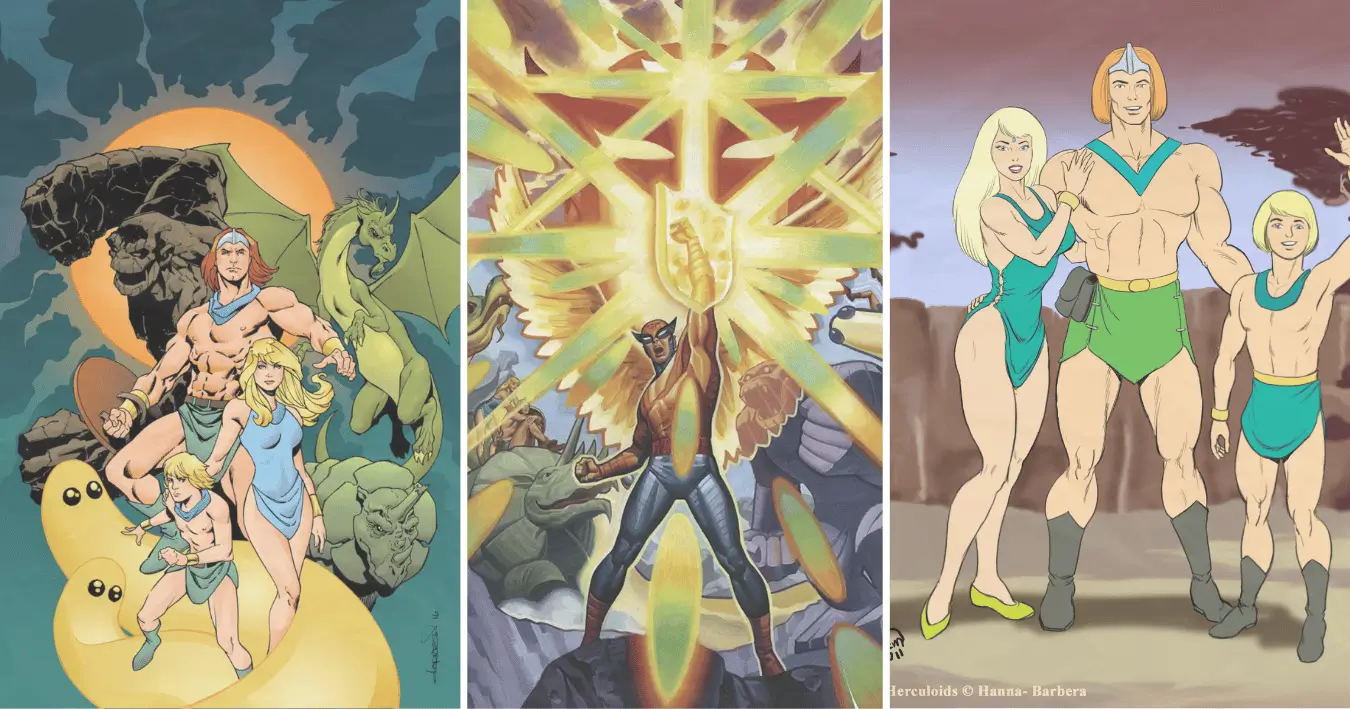
The team continued appearing in comics long after new television episodes stopped.
They appeared in Gold Key’s Hanna-Barbera Super TV Heroes, Marvel’s TV Stars, DC’s Cartoon Network Presents, and the later Future Quest series.
Future Quest was especially well suited to the characters because it brought several of Hanna-Barbera’s action properties into one connected science-fiction adventure.
Those comics gave writers more room to explore the world than the original ten-minute stories could provide.
Should You Watch The Herculoids Today?
Yes, especially if you enjoy animation history, creature design, pulp science fiction, or the work of Alex Toth.
It is important to approach the series on its own terms.
The plots are simple. Dialogue is functional. Villains often appear only long enough to attack the planet and be defeated.
The appeal comes from the designs, the direct action, and the unusual idea of a family living in complete partnership with five alien creatures.
The original stories are best watched a few at a time. That keeps the formula entertaining and allows the visual ideas to stand out.
Where to watch The Herculoids
Physical media is the reliable option
- The 18 original episodes were released on DVD through Warner Archive in 2011
- Warner Archive issued a restored three-disc Blu-ray set in 2021
- The Blu-ray presents the original series in its full-frame television format
- The 1981 Space Stars revival is not part of that original-series set
- Streaming availability varies by country and can change without notice
The current title calls The Herculoids Hanna-Barbera’s boldest science-fiction cartoon. That is subjective, but the description is defensible.
Few of the studio’s shows committed this completely to a world of alien landscapes, biological weapons, and almost nonstop invasion.
More than half a century later, Zok, Igoo, Tundro, Gloop, and Gleep still look unlike anyone else’s cartoon team.