
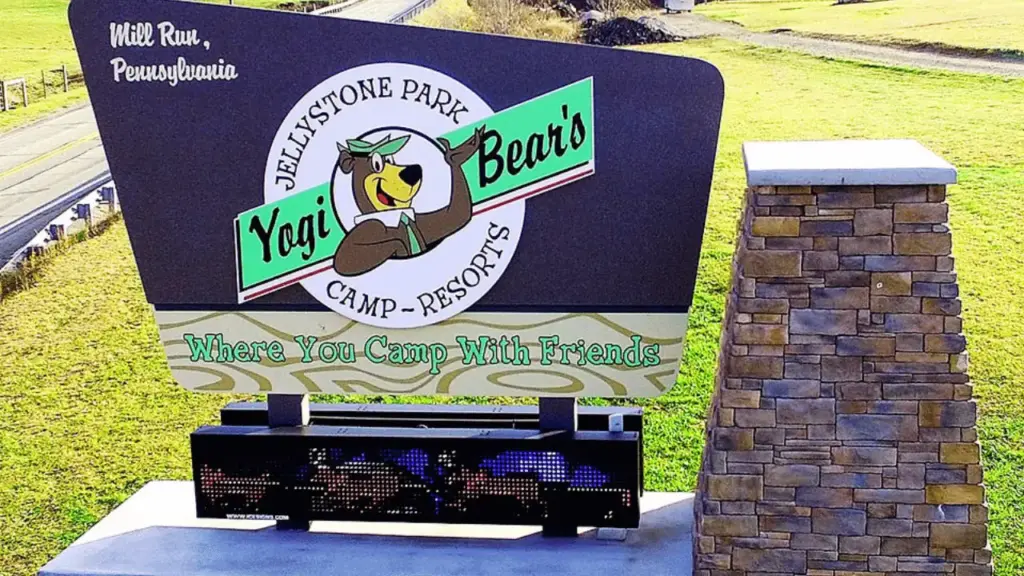
Jellystone Park is real and fictional at the same time.
The park where Yogi Bear steals picnic baskets is a cartoon setting created by Hanna-Barbera.
However, the name now belongs to a large network of licensed family campgrounds across the United States and Canada. Guests can reserve cabins, RV sites, and tent sites at many of them.
The two versions are connected by more than a name.
Cartoon Jellystone was clearly modeled on Yellowstone National Park, and Yogi’s obsession with campers’ food echoed a real problem. For decades, Yellowstone visitors fed roadside bears, left food unsecured, and watched bears eat at garbage dumps.
Yogi turned that dangerous history into comedy.
The short answer
- Cartoon Jellystone: A fictional national park introduced with Yogi Bear in 1958
- Real Jellystone Parks: Licensed family campgrounds founded in 1969
- Current network: More than 75 locations in the United States and Canada
- Yellowstone connection: Shared scenery, geysers, rangers, and food-seeking bears
The Cartoon Jellystone Park Came First
Yogi Bear debuted in 1958 as one of the recurring segments on The Huckleberry Hound Show.
His home was Jellystone Park, a peaceful national park overseen by Ranger Smith.
The basic comedy was simple:
- Campers arrived with food
- Yogi invented a plan to steal it
- Boo Boo warned him that the plan was a bad idea
- Ranger Smith tried to restore order
Yogi quickly became more popular than the show that introduced him and received his own television series in 1961.
The character became one of Hanna-Barbera’s first major stars during the studio’s rapid expansion into television. That larger history is covered in my article on the rise and fall of Hanna-Barbera.
Is Jellystone Park Based on Yellowstone?
Yes, although the cartoons never placed Jellystone inside a real state or identified it as an animated version of Yellowstone.
The connection is still difficult to miss.
Both parks have:
- Mountain and forest scenery
- Campgrounds filled with visitors
- Park rangers managing wildlife
- Bears searching for human food
- Famous geysers, including Jellystone’s Old Faceful
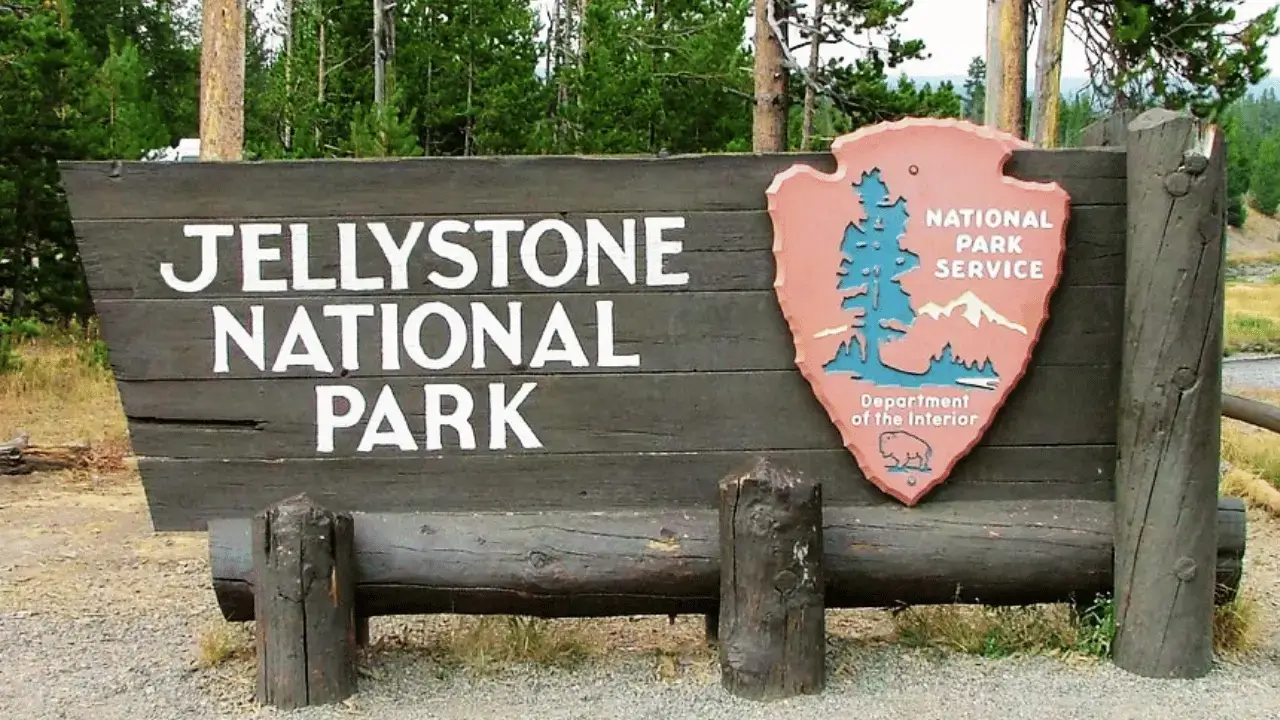
The National Park Service itself describes Jellystone as having strong similarities to Yellowstone. Yellowstone’s superintendent even invited Yogi and Boo Boo to consider the real park a second home in 1960.
The NPS history of Yogi Bear and Yellowstone explains how closely the cartoon became associated with the park.
| Feature | Jellystone | Yellowstone |
|---|---|---|
| Status | Fictional cartoon park | Real national park established in 1872 |
| Geyser | Old Faceful | Old Faithful |
| Bears | Friendly cartoon troublemakers | Wild black bears and grizzlies |
| Food problem | Stolen picnic baskets | Food-conditioned bears entering camps and approaching vehicles |
Jellystone is best understood as a cleaner, safer, comic version of the national-park experience rather than a literal animated map of Yellowstone.
The Real Bears Behind the Picnic-Basket Joke
Yogi’s food-stealing routine would have been familiar to anyone who visited Yellowstone during the first half of the twentieth century.
Bears learned that roads, campgrounds, hotels, and garbage dumps offered easy meals.
Visitors regularly fed them from car windows, even when park rules prohibited it. Some animals became known as “hold-up bears” because they stopped vehicles and waited for food.
Yellowstone also operated garbage-feeding areas where crowds gathered to watch bears eat.
The National Park Service’s bear-management history says the park averaged 48 bear-inflicted human injuries and more than 100 property-damage incidents each year from 1931 through 1969.
That is the real-world background behind Yogi’s harmless cartoon thefts.
The cartoon did not invent the idea of a national-park bear looking for human food. It made the danger look friendly.
Yellowstone Used Yogi as a Safety Mascot
The connection became official soon after Yogi became famous.
In December 1960, Yellowstone Superintendent Lemuel Garrison wrote to Yogi Bear. He thanked the character for helping educate the public and offered Yogi and Boo Boo permanent passes to the park.
Yellowstone then used Yogi in visitor-safety materials.
Cutouts placed near park entrances showed him holding signs warning people not to feed bears. Pamphlets used the familiar cartoon to remind campers to secure food and keep car windows closed.
The idea created an obvious contradiction.
In the cartoons, stealing human food was Yogi’s defining joke.
In Yellowstone, bears learning to seek human food caused injuries, property damage, and the eventual destruction of food-conditioned animals.
A historical study from the Buffalo Bill Center of the West notes that park officials later worried the humorous signs encouraged visitors to take bears less seriously.
The full account appears in the Center’s history of Yellowstone and Jellystone.
Yellowstone Changed How It Managed Bears
Yellowstone began a major bear-management program in 1960 and adopted a more intensive approach in 1970.
The park:
- Closed open garbage dumps
- Installed bear-resistant garbage containers
- Enforced rules against feeding wildlife
- Improved food-storage requirements
- Worked to return bears to natural diets and behaviour
The modern park treats food-conditioned bears as a serious safety problem.
Yogi continued stealing picnic baskets on television, but the real Yellowstone was moving away from the roadside-bear experience that made the joke recognizable.
The First Real Jellystone Park Opened in 1969
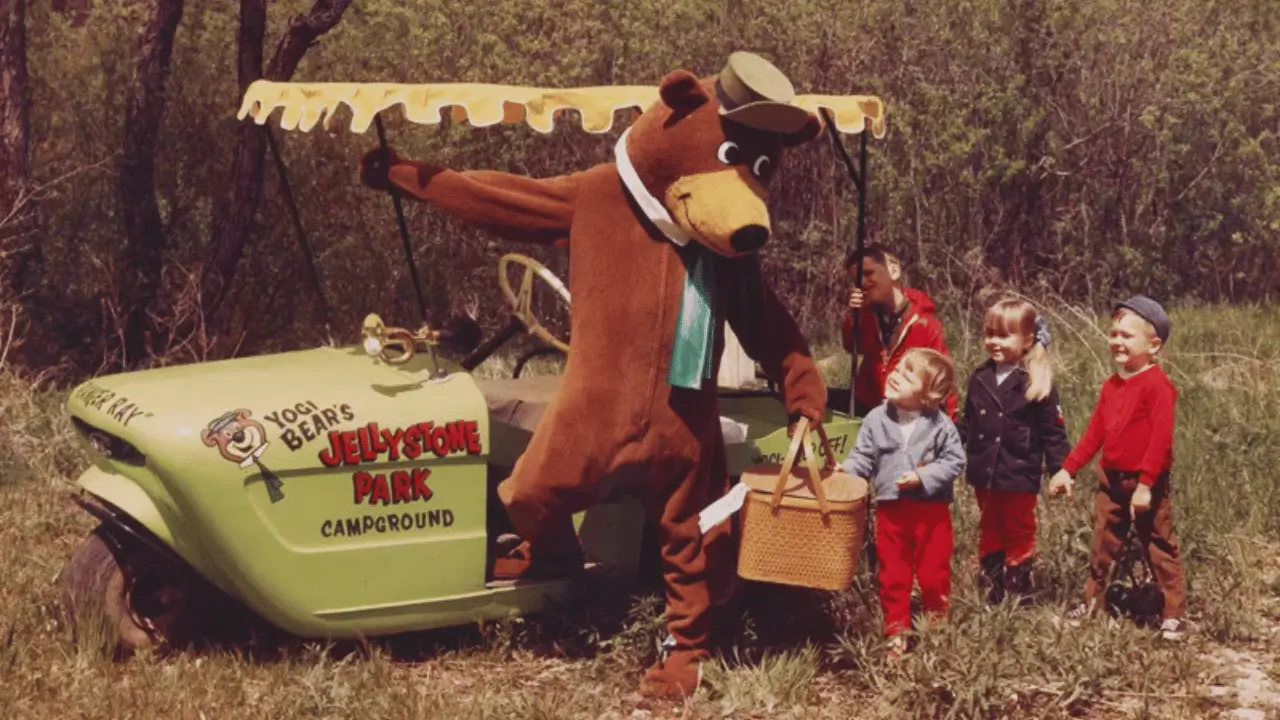
The campground business began with Wisconsin advertising executive Doug Haag.
While driving in 1968, Haag noticed families towing trailers and began thinking about a destination campground where parents and children could stay for an entire vacation.
In January 1969, he heard his children watching Yogi Bear and realized that Jellystone Park was the name he needed.
Haag travelled to New York and presented the idea to Screen Gems, which licensed the Hanna-Barbera characters at the time.
After receiving permission, Haag and his partner bought 30 wooded acres near Sturgeon Bay, Wisconsin.
They built signs, prepared park materials, and created a Yogi Bear statue from chicken wire and plaster.
The first Jellystone Park opened in July 1969.
The first campground
- Location: Sturgeon Bay, Wisconsin
- Opening: July 1969
- Original nightly rate: $3.50
- Included attractions: Swimming, fishing, and a playground
- Opening response: Roughly three times as many campers arrived as there were sites
The original location remains in operation.
The company’s official history records the full story of Haag’s idea, the licensing meeting, and the unexpectedly crowded opening weekend.
How Many Jellystone Parks Are There?
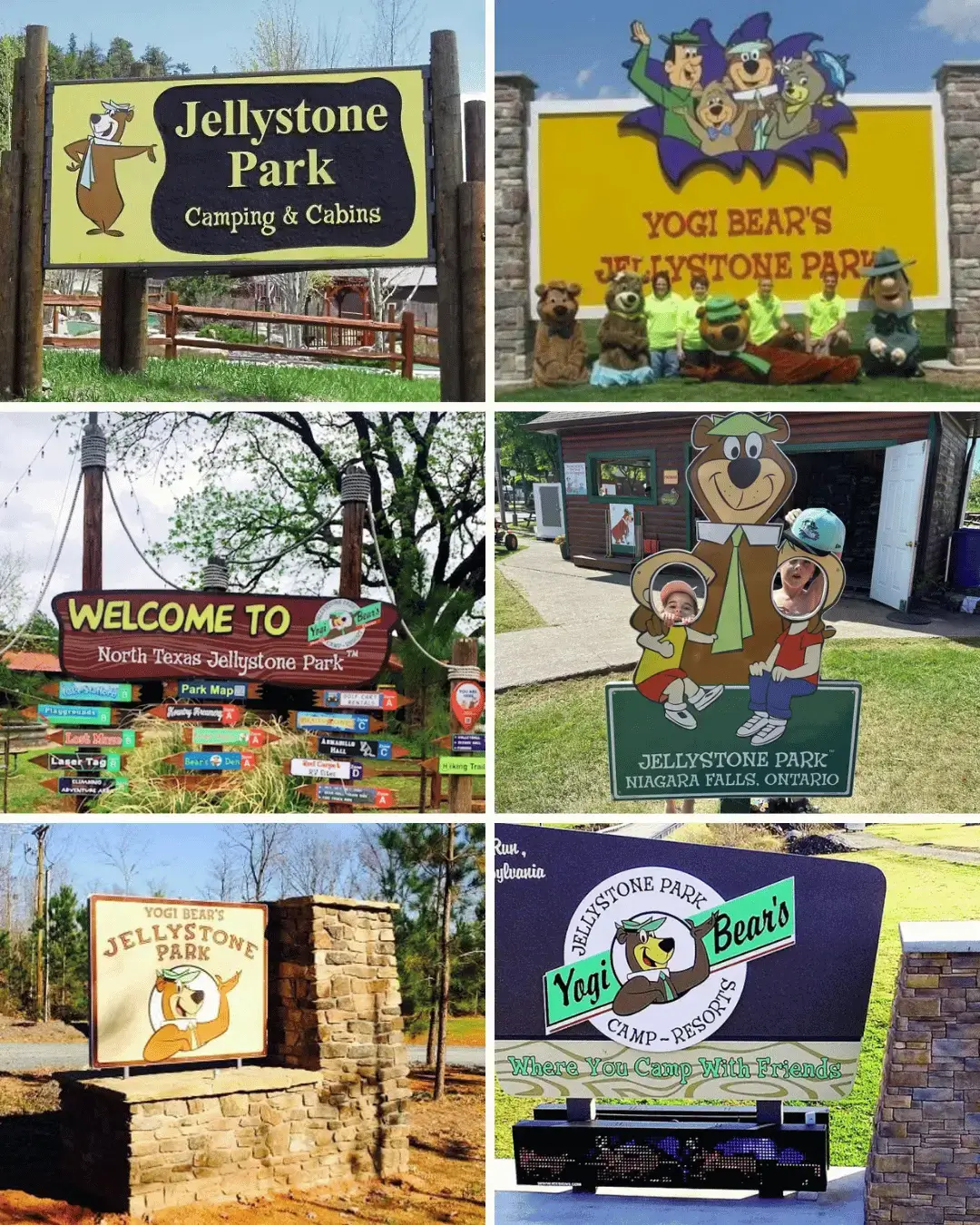
The number changes as locations join or leave the network.
As of 2026, official Jellystone sources describe a system of more than 75 Camp-Resorts across the United States and Canada. The franchise history page reports more than 78 locations.
That makes “more than 75” the safest general answer.
The locations are not identical company-owned resorts.
They operate within a franchise system, and individual properties can differ in ownership, size, lodging, attractions, schedules, and seasonal availability.
Camp Jellystone, LLC manages the franchise brand. Sun Communities acquired the franchising company in 2022, while the Yogi Bear characters remain licensed through Warner Bros. Discovery.
What Is a Real Jellystone Park Like?
Modern Jellystone locations are closer to family resorts than basic roadside campgrounds.
Depending on the property, guests may find:
- Cabins and glamping accommodation
- RV and tent sites
- Swimming pools and splashgrounds
- Water slides or floating obstacle courses
- Mini golf, laser tag, and jumping pads
- Crafts, wagon rides, and themed activities
- Appearances by Yogi, Boo Boo, Cindy Bear, and Ranger Smith
Not every location offers every feature.
Some are highly developed resorts with extensive water attractions. Others remain closer to traditional campgrounds with a Yogi Bear theme.
The official Jellystone location directory lets visitors compare parks, accommodation, attractions, and booking dates.
Can You Really Book a Night at Jellystone?
Yes, at the real Camp-Resorts.
Guests can book cabins, RV sites, tent sites, and other accommodation depending on the location.
However, “tonight” is not always realistic.
Many parks operate seasonally, popular weekends can sell out, and each independently operated location sets its own availability and minimum-stay rules.
The cartoon park remains fictional.
The reservation system is very real.
Is It Safe to Expect Real Bears?
No.
The Yogi Bear characters at Jellystone Camp-Resorts are costumed mascots and themed entertainment.
Any actual wildlife near a campground remains wild and should never be approached or fed.
A real bear entering a campsite is not part of the attraction.
Food and garbage should always be stored according to the campground’s rules, especially at properties located in bear country.
Quick Answers About Jellystone Park
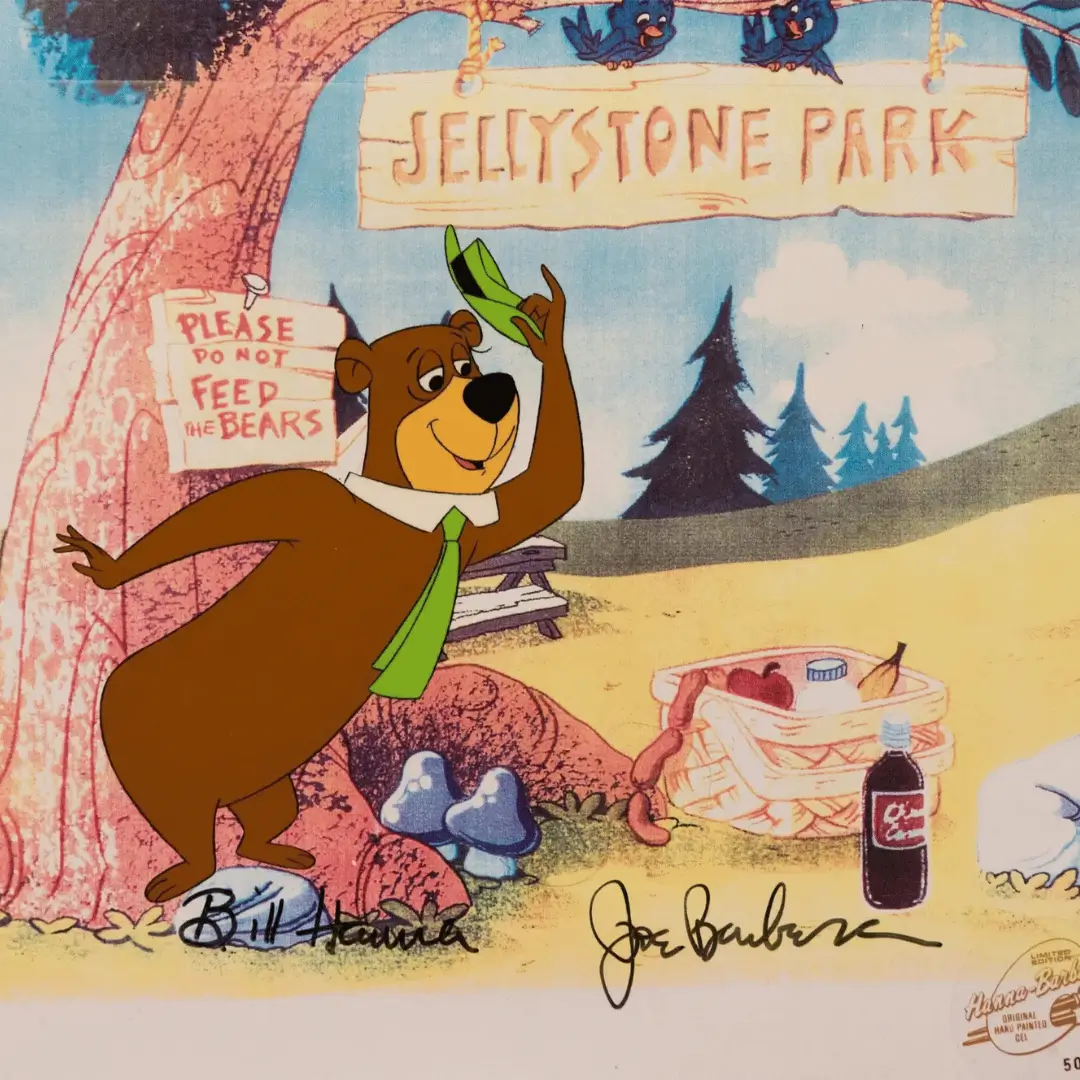
Is Jellystone Park real? The cartoon national park is fictional. Yogi Bear’s Jellystone Park Camp-Resorts are real licensed campgrounds.
Is Jellystone based on Yellowstone? Yes, in a broad and obvious way. The name, geysers, ranger setting, and food-seeking bears all mirror Yellowstone, although Jellystone has no official real-world location.
How many real Jellystone Parks are there? More than 75 operate across the United States and Canada. Official franchise material currently reports more than 78.
Where was the first Jellystone Park? Sturgeon Bay, Wisconsin. It opened in July 1969.
Can you stay overnight? Yes. Locations offer combinations of cabins, RV sites, tent sites, and glamping accommodation.
Did Yellowstone bears really steal food? Yes. Bears begged from motorists, entered campsites and vehicles, and fed at garbage dumps for decades.
Was Yogi Bear based on a specific real bear? There is no good evidence that one individual bear inspired him. His picnic-basket routine reflected a widespread national-park problem.
Who owns the real Jellystone Parks? They operate as franchises under Camp Jellystone, LLC. Individual locations can have different owners and operators.
A Fictional Park With Real Reservations
Jellystone began as a joke about national parks.
Yogi lived in an orderly cartoon wilderness where bears could steal lunch without anyone getting hurt.
The real Yellowstone had the same food problem without the harmless ending.
Then the story folded back on itself.
A Wisconsin businessman licensed the fictional park’s name and turned it into a real camping network.
Today, Yellowstone teaches visitors to keep food away from bears.
Jellystone invites families to camp with Yogi.
Both parks are real in different ways, but only one accepts online reservations.
For more Hanna-Barbera history, explore my Hanna-Barbera cartoon archive and the story behind the Yogi Berra lawsuit legend.
If anyone really wanted to go to one, The Jellystone Park Mill Run in Pennsylvania is one of the best ones. They are recognized nationally by USA Today with treehouse cabins, a new miniature golf course, an RC track, and jump pillows. The one in Utah is also really good. Zion, Utah is another top family camping resort in travel awards for its 53-acre luxury layout featuring a floating obstacle course, large pools, and giant water slides.