
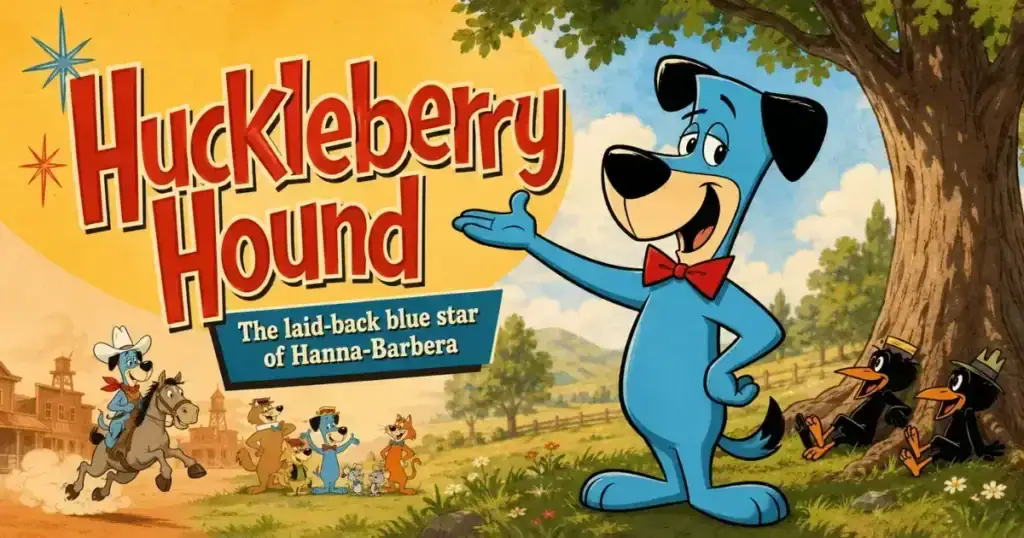
In 1960, an animated television series won an Emmy for the first time.
Its star was a slow-talking blue dog in a straw hat who could remain polite while nearly any job collapsed around him.
Huckleberry Hound is no longer the most famous face in Hanna-Barbera’s lineup. Yogi Bear, Scooby-Doo, and the Flintstones eventually became larger icons.
Huck arrived first.
His syndicated show proved that animation created specifically for television could attract a national audience, support a growing studio, and earn recognition from the television industry.
I have always had a soft spot for him. He is patient, gentle, hopeless at most jobs, and almost impossible to anger.
That quiet personality helped build one of television animation’s loudest success stories.
Huckleberry Hound at a glance
- First aired: September 29, 1958, in syndication
- Studio: Hanna-Barbera
- Sponsor: Kellogg’s
- Original voice: Daws Butler
- Claim to fame: Star of the first animated series to win an Emmy
Who Is Huckleberry Hound?
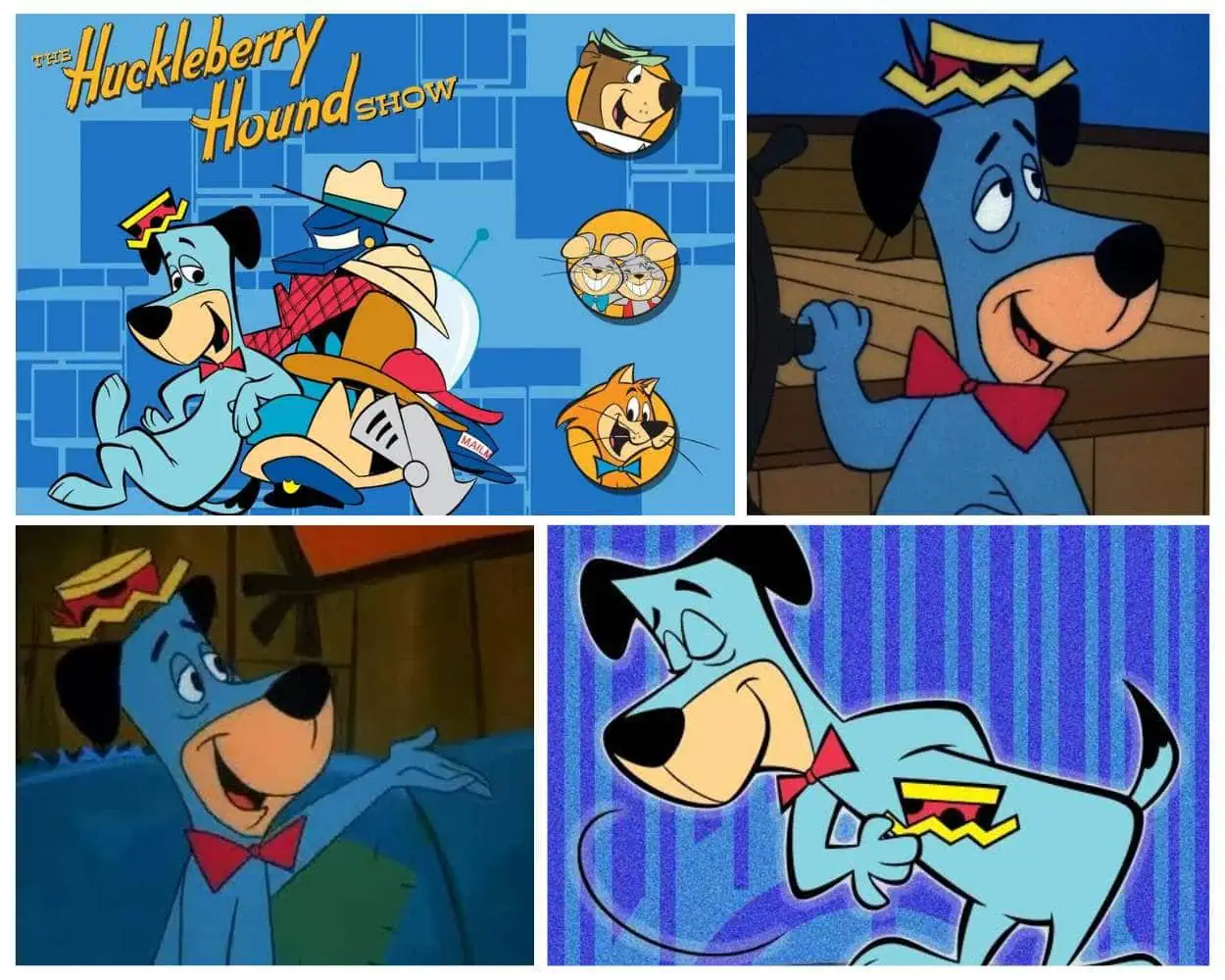
Huckleberry Hound is a calm blue dog with a soft Southern drawl, a red bow tie, and a fondness for singing “Oh My Darling, Clementine” badly.
His shorts rarely give him one permanent occupation. Huck becomes whatever that week’s story requires: a sheriff, knight, fireman, dog catcher, lion tamer, astronaut, or reluctant hero.
The details change, but his personality does not.
- He is gentle and good-natured rather than aggressive.
- He remains calm even while being chased, crushed, or outsmarted.
- He speaks directly to the audience when a plan goes wrong.
- He treats every ridiculous assignment as honest work.
That consistency lets Huck function like a comic actor playing a different role in every short. He can live in the Old West one week and medieval England the next without needing a complicated explanation.
His name is generally understood as a reference to Mark Twain’s Huckleberry Finn.
His voice and manner also grew from characters Daws Butler had already performed in theatrical animation, including a slow-talking Southern wolf used in Tex Avery’s Droopy cartoons. The final Huckleberry voice, however, came from someone Butler knew in real life.
Huck was Hanna-Barbera’s first major breakout character. See where he lands in my guide to the most iconic Hanna-Barbera characters.
Why Is Huckleberry Hound Blue?

Huck’s blue coat is now inseparable from the character.
The colour makes him immediately recognizable beside Hanna-Barbera’s more naturally coloured dogs and bears. His straw hat and red bow tie complete a design that can be understood from a small television image or a simple piece of merchandise.
The exact production reason for making him blue is not well documented. A common online explanation says the colour was chosen to work on both colour and black-and-white televisions, but I could not find a reliable statement from the original designers confirming that story.
What the finished design demonstrates is Hanna-Barbera’s talent for simple visual branding:
- The blue coat separates Huck from ordinary cartoon dogs.
- The red bow tie creates a strong contrasting accent.
- The straw hat reinforces his relaxed rural personality.
- The clean shapes remain readable in limited animation.
If you enjoy unusual character colours, my blue cartoon character roundup has more examples.
The Huckleberry Hound Show Changed Television Animation
The Huckleberry Hound Show premiered in syndication on September 29, 1958.
It was Hanna-Barbera’s second television series after The Ruff and Reddy Show. Kellogg’s sponsored the new program, while Screen Gems distributed it to local stations instead of placing it on one national network schedule.
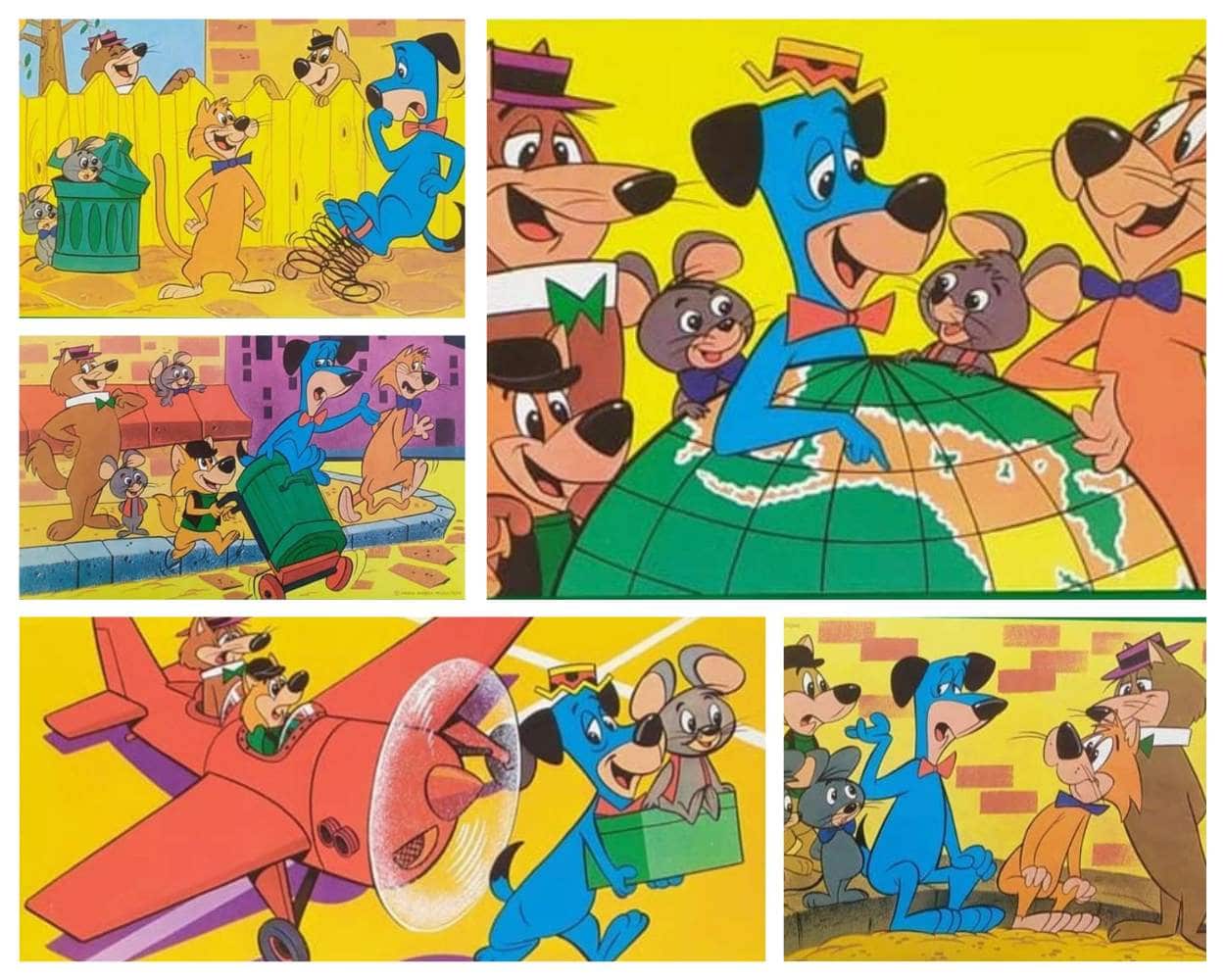
Each half-hour combined three short cartoons:
- Huckleberry Hound: Huck took on a different occupation, location, or historical role.
- Pixie and Dixie and Mr. Jinks: Two mice repeatedly outsmarted a cat who hated “those meeces to pieces.” More of that crew appears on my mouse cartoon characters list.
- Yogi Bear: Yogi became so popular that he moved into his own series in 1961. Hokey Wolf later occupied the third slot.
The format became one of Hanna-Barbera’s basic television models. A recognizable host carried the title, while several short features filled the half-hour.
How Limited Animation Made the Show Possible
Hanna and Barbera had spent years producing theatrical Tom and Jerry cartoons at MGM. Television could not support the same budgets or production schedules.
The studio responded with what it called planned animation, now generally described as limited animation.
Characters did not move continuously. An animator might hold the body still while changing only the mouth, head, or arm. Backgrounds could be reused, and dialogue carried scenes that theatrical cartoons might have built around elaborate movement.
The approach was sometimes criticized as “illustrated radio,” but it made weekly television animation financially possible.
Why the production model mattered
- It reduced the number of new drawings required for each short.
- It placed greater importance on dialogue, voice acting, music, and character design.
- It allowed Hanna-Barbera to produce animation on a television schedule.
- It helped turn made-for-TV cartoons into a sustainable business.
The First Animated Series to Win an Emmy
In 1960, Huckleberry Hound won the Emmy for Outstanding Achievement in the Field of Children’s Programming.
The Television Academy identifies it as the first animated series to win an Emmy.
That wording is more precise than saying it was the first “cartoon” to win. The award recognized the complete television program, not one individual Huckleberry short.
The victory mattered because it placed a low-budget syndicated animated series beside established live-action children’s programs such as Captain Kangaroo, Lassie, and Watch Mr. Wizard.
It also confirmed that the industry saw television animation as more than inexpensive filler.
The milestone: The Huckleberry Hound Show did not win in a special animation category. It won the general children’s-programming award against live-action competition.
The Drawl, the Asides, and That Off-Key Song

Much of Huck’s appeal comes from the contrast between his voice and the chaos around him.
He drawls. He mispronounces words. He remains polite to villains, animals, and complete strangers who are actively trying to hurt him.
Huck rarely conquers a problem through strength. He survives through patience, persistence, and an almost supernatural refusal to become angry.
His familiar expressions include:
- “Wal, I do declare.”
- “And a Huckleberry Hoooooound dog howdy to ya!”
- “Now jus’ a cotton-pickin’ minute!”
- “That’s jus’ jim-dandy!”
- “Great day in the mornin’!”
- “Dawww, shucks!”
The real voice inspiration: Daws Butler said Huck’s drawl came from William Harwood, a veterinarian who lived beside the family of Butler’s future wife in Albemarle, North Carolina. Butler remembered Harwood’s slow, welcoming speech years later when developing Huck.
Why Huck Talks to the Audience
Watch several shorts and another part of the performance becomes clear. Huck regularly turns toward the viewer and comments on the disaster unfolding around him.
Those asides make him feel less like a distant cartoon character and more like a dry comedian sharing the joke.
Voice director Andrea Romano later remembered that this direct address made her feel as though Huck was speaking personally to her when she watched as a child.
The technique also works well with limited animation. A held pose and a perfectly timed line can be funnier than a complicated action sequence.
“Oh My Darling, Clementine”
Then there is the song.
Huck repeatedly sings “Oh My Darling, Clementine” off-key, usually while walking toward a problem he does not yet understand.
The running gag gives him instant personality. He is cheerful, unselfconscious, and completely unaware of how badly he sings.
It also demonstrates how Hanna-Barbera turned production limits into character comedy. A simple walk cycle, a familiar song, and Daws Butler’s performance could fill several memorable seconds without expensive movement.
Who Voiced Huckleberry Hound?

Daws Butler created Huck’s voice and remained the character’s defining performer until his death in 1988.
Butler also voiced Yogi Bear, Mr. Jinks, Dixie, Quick Draw McGraw, Snagglepuss, and many other Hanna-Barbera characters.
You can see the wider show credits on IMDb. Later productions passed Huck’s straw hat to several performers.
| Voice actor | Selected projects |
|---|---|
| Daws Butler | Original series and later appearances through 1988 |
| Greg Burson | Late-1980s and early-1990s appearances |
| Greg Berg | Yo Yogi! (1991) |
| Jeff Bergman | Cartoon Network promotions and other appearances |
| Billy West | Wacky Races revival |
| Jim Conroy | Jellystone! |
The Supporting Cast

Huck was the host, but the show introduced several characters who developed followings of their own:
- Pixie and Dixie: Two mice who repeatedly outsmart Mr. Jinks.
- Mr. Jinks: The cat who hates “those meeces to pieces.”
- Yogi Bear and Boo-Boo: The Jellystone Park residents who became the show’s breakout supporting stars.
- Hokey Wolf: A fast-talking con artist who replaced Yogi in the third segment.
Yogi’s success sometimes overshadows the show that introduced him. His departure is actually evidence of how effective the anthology format was. The Huckleberry Hound Show could test several characters in front of the same audience and turn the strongest response into another program.
All 57 Huckleberry Hound Shorts
Traditional episode guides count 57 individual Huckleberry Hound shorts. The complete-series Blu-ray uses studio broadcast records to reconstruct 68 half-hour programs, some of which contain repeated segments.
Here are the 57 Huck shorts for completists:
- Huckleberry Hound Meets Wee Willie
- Sir Huckleberry Hound
- Lion-Hearted Huck
- Rustler Hustler Huck
- Sheriff Huckleberry
- Hookey Daze
- Tricky Trapper
- Cock-a Doodle Huck
- Two Corny Crows
- Freeway Patrol
- Dragon-Slayer Huck
- Fireman Huck
- Sheep-Shape Sheepherder
- Skeeter Trouble
- Hokum Smokum
- Bird House Blues
- Barbecue Hound
- Postman Panic
- Lion Tamer Huck
- Ski Champ Chump
- Little Red Riding Huck
- The Tough Little Termite
- Grim Pilgrim
- Ten Pin Alley
- Jolly Roger and Out
- Nottingham and Yeggs
- Somebody’s Lion
- Cop and Saucer
- Pony Boy Huck
- A Bully Dog
- Huck the Giant Killer
- Pet Vet
- Piccadilly Dilly
- Wiki Waki Huck
- Huck’s Hack
- Spud Dud
- Legion Bound Hound
- Science Friction
- Nuts Over Mutts
- Knight School
- Huck Hound’s Tale
- The Unmasked Avenger
- Hillbilly Huck
- Fast Gun Huck
- Astro-nut Huck
- Huck and Ladder
- Lawman Huck
- Cluck and Dagger
- Caveman Huck
- Huck of the Irish
- Jungle Bungle
- Bullfighter Huck
- Ben Huck
- Huck de Paree
- Bars and Stripes
- The Scrubby Brush Man
- Two For Tee Vee
Huckleberry Hound Beyond His Own Show
Huck continued appearing for decades after his original shorts ended.
- Yogi’s Gang (1973)
- Laff-A-Lympics (1977-1979)
- Yogi’s Treasure Hunt (1985-1988)
- The Good, the Bad, and Huckleberry Hound (1988)
- Yo Yogi! (1991)
- Wacky Races revival
- Jellystone!
The Good, the Bad, and Huckleberry Hound gave him a rare feature-length starring role. Huck becomes a reluctant frontier sheriff, confronts the Dalton Gang, and marries Desert Flower by the ending.
It was also one of Daws Butler’s final performances as the character.
Jellystone! later reinvented Huck as the town’s soft-spoken mayor. Jim Conroy’s performance leans into the same gentle calm that made the original character memorable.
Huck also became a merchandising success, appearing on lunchboxes, toys, comics, records, and other products. That commercial reach helped demonstrate how valuable an original television cartoon character could become outside the program itself.
Where to Watch Huckleberry Hound
Physical media is currently the most dependable way to watch the series in a consistent order.
- DVD: Warner Home Video released the first season through the Hanna-Barbera Classics Collection in 2005.
- Blu-ray: Warner Archive released The Huckleberry Hound Show: The Complete Series on August 26, 2025.
- What the Blu-ray includes: 68 reconstructed half-hour programs across 11 discs, presented according to studio broadcast records.
- Restoration: Much of the material was restored from 4K scans of original camera negatives, with surviving elements used where original materials were unavailable.
Why Huckleberry Hound Still Matters
Huckleberry Hound was not television’s first animated character or the first cartoon created for television.
His achievement was different.
He helped prove that a modestly produced syndicated cartoon could become a national hit, create valuable characters, and compete for the same television awards as live-action programming.
The limited animation can look simple today. The voice acting, timing, and personality explain why the show succeeded anyway.
Huck never needed to shout for attention.
He arrived in a straw hat, sang badly, spoke directly to the audience, and quietly helped build Hanna-Barbera’s television empire.
Do yourself a favour and spend an afternoon with a few of his shorts.
Just do not ask him to sing.

Did you know Huckleberry Hound was the first cartoon to receive an Emmy Award? I didn’t see you mention it, so I thought I’d make a comment for you. I knew he was one of Hanna-Barbera’s early stars, but I didn’t realize how important the Emmy win was or that there were 57 original Huck shorts.