Mickey Rat looks like the version of Mickey Mouse that Disney would never allow near one of its theme parks.
He has the familiar round black ears and buttoned shorts, but that is where the resemblance ends.
Mickey Rat is unshaven, sharp-toothed, frequently intoxicated and interested mainly in whatever benefits him at that particular moment. He is not cheerful, heroic or even especially likable.
That was the entire point.
Cartoonist Robert Armstrong created Mickey Rat in Southern California around 1971, turning one of America’s cleanest corporate mascots into a grubby underground-comix antihero.
The character began as a T-shirt design, appeared in L.A. Comics #1 and eventually starred in four solo comic books published between 1972 and 1982.
What makes the story especially interesting is what apparently did not happen.
Disney took other underground cartoonists to court for using recognizable versions of its characters. Yet I could find no verifiable public record of Disney suing Robert Armstrong over Mickey Rat.
That does not prove Disney approved of the parody or never complained privately. It means Mickey Rat appears to have remained beneath the threshold of a documented legal battle.
Mickey Rat at a glance
- Created by: Cartoonist Robert Armstrong
- Early writer: Chester C. Crill
- Created: Around 1971
- Original format: T-shirt design
- First known comic appearance: L.A. Comics #1 in 1971
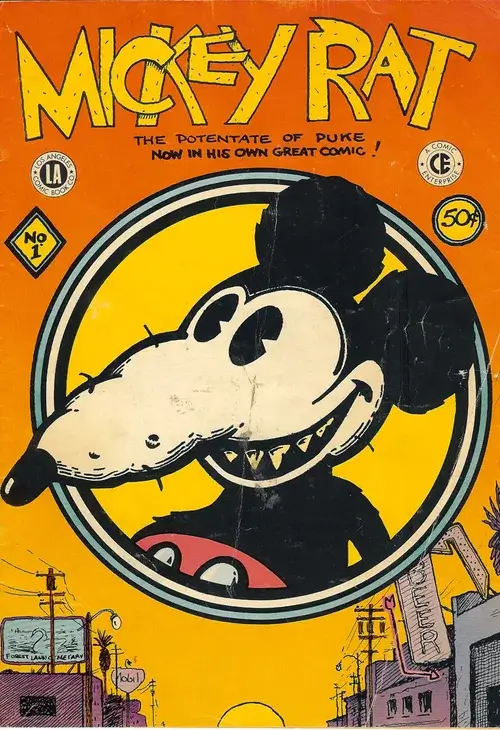
- First solo comic: Mickey Rat #1 in 1972
- Solo issues: Four, published from 1972 to 1982
- Disney lawsuit: No verified Mickey Rat-specific lawsuit located
- Collector status: A niche underground-comix collectible
Who Is Mickey Rat?
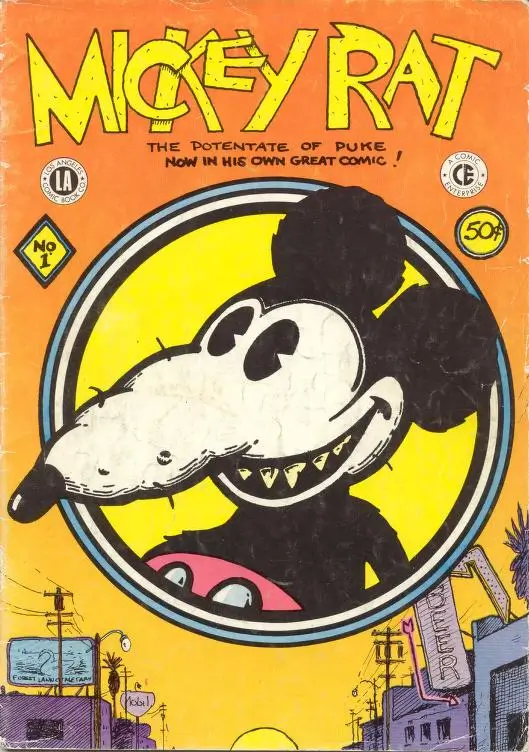
Mickey Rat is an adult underground-comix character created as a deliberately filthy reflection of Mickey Mouse.
The visual joke is immediate.
Armstrong kept enough of Mickey Mouse’s basic design language to make the target obvious:
- Large circular black ears
- A black upper body
- Bright shorts with two buttons
- An anthropomorphic cartoon-animal body
He then pushed everything else in the opposite direction.
Mickey Rat has stubble, a long pointed snout, damaged teeth and the exhausted expression of someone who has been awake for several days for all the wrong reasons.
His personality is just as unpleasant.
Where Mickey Mouse came to represent optimism, family entertainment and corporate polish, Mickey Rat represents appetite, disorder and contempt for respectability.
The parody works through reversal
- Mickey Mouse: Cheerful, controlled and commercially polished
- Mickey Rat: Grubby, opportunistic and proudly antisocial
- Mickey Mouse’s world: Built around order and happy endings
- Mickey Rat’s world: Built around selfish decisions and urban decay
That reversal is why the character works.
Armstrong did not merely draw Mickey Mouse behaving badly. He created a visibly different rodent who looks as though the Disney ideal was abandoned on the streets of Los Angeles and left there for several rough years.
Mickey Rat Started as a T-Shirt
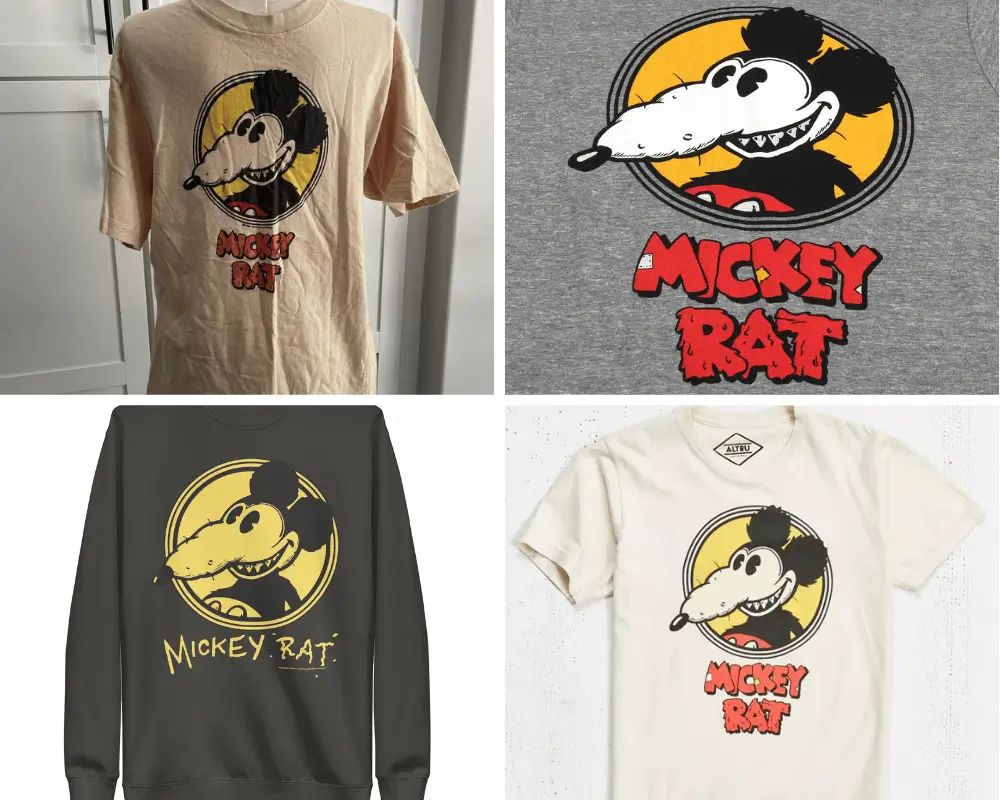
The earliest Mickey Rat was not designed for a comic book.
Armstrong reportedly created the character as a T-shirt image around 1971. The shirt attracted enough attention that musician and writer Chester C. Crill suggested turning the rat into a comic-strip character.
Crill was an unusual collaborator.
He was a member of the psychedelic band Kaleidoscope and performed under several names, including Fenrus Epp and Max Buda. His involvement helped turn Armstrong’s single visual joke into a character capable of carrying a story.
The most accurate division of credit:
- Robert Armstrong: Created the Mickey Rat image and drew the comics.
- Chester C. Crill: Encouraged the move into comics and wrote the earliest stories.
The National Gallery of Art’s catalog for Mickey Rat #1 makes a similar distinction, identifying Armstrong as the artist and Crill as the author.
Some booksellers and databases call Armstrong and Crill co-creators. That is understandable because Crill helped shape the character’s early personality.
Armstrong, however, is consistently identified as the cartoonist who originated the image.
Mickey Rat’s First Comic Appearance
Mickey Rat’s first known sequential-comics appearance came in L.A. Comics #1 in 1971.
The National Gallery of Art catalogs the anthology as a 1971 publication and includes Robert Armstrong among its contributing artists.
The Mickey Rat story is generally identified as the seven-page “The King of Rotten Stuff.” The issue was published by the Los Angeles Comic Book Company, a small operation tied to Southern California’s growing underground-comix scene.
That appearance matters for two reasons:
- It predates the first solo Mickey Rat comic.
- The story does not appear to have been widely reprinted.
Original copies of L.A. Comics #1 can therefore be harder to find than some of the later solo issues.
The first standalone Mickey Rat comic followed in 1972.
Both the National Gallery of Art and the Rhode Island School of Design’s Adler Archive identify it as a 1972 Los Angeles Comic Book Company publication.
The Four Mickey Rat Comic Books
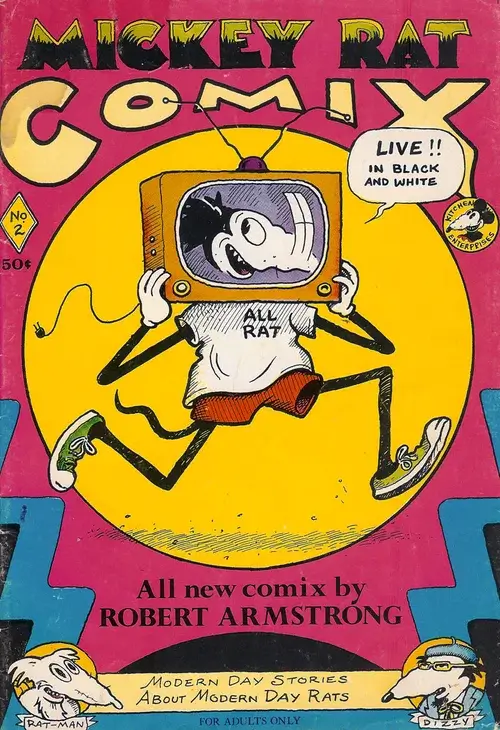
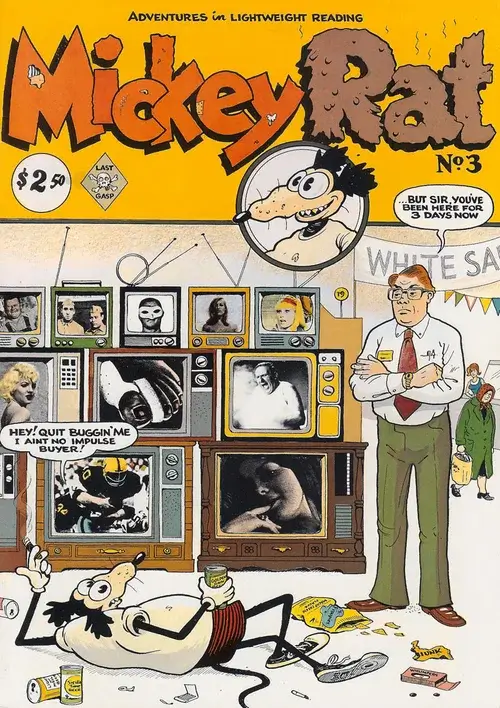
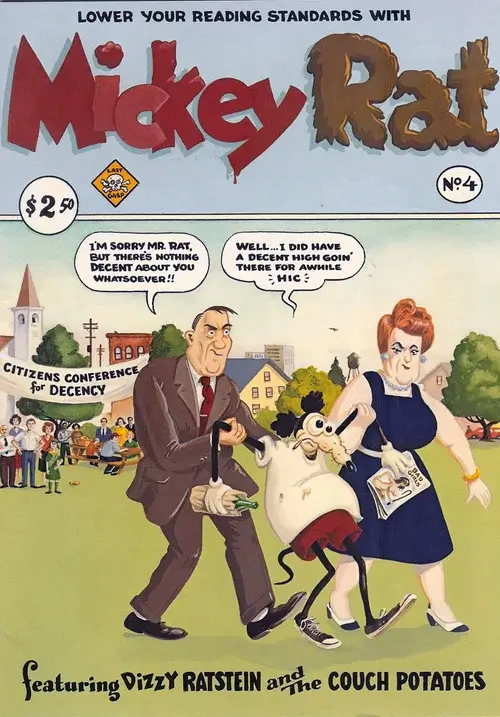
Only four main solo issues were published, and they appeared irregularly across a ten-year period.
| Issue | Year | Publisher | Why it matters |
|---|---|---|---|
| Mickey Rat #1 | 1972 | Los Angeles Comic Book Company | First solo issue |
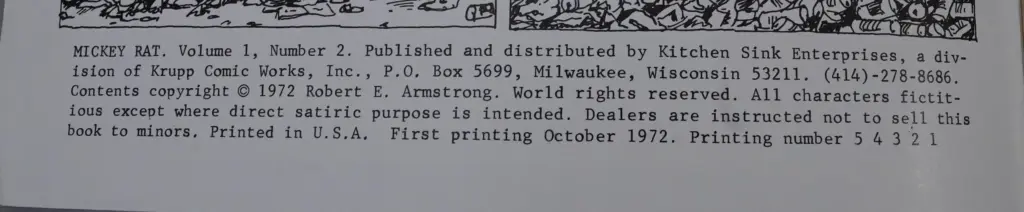
| Mickey Rat #2 | October 1972 | Kitchen Sink Enterprises | Armstrong took on more of the writing |
| Mickey Rat #3 | 1980 | Last Gasp | Revived the series after an eight-year gap |
| Mickey Rat #4 | 1982 | Last Gasp | Final main solo issue |
Publisher information can become confusing because some dealer listings place the entire run under Last Gasp.
The Grand Comics Database record confirms that issue #2 was published by Kitchen Sink Enterprises and continued the numbering from the Los Angeles Comic Book Company’s first issue.
The long gap between issues two and three says a great deal about underground-comix publishing.
Mickey Rat had a recognizable design and a small audience, but recognition did not guarantee a stable income. Crill reportedly lost interest in comics because the financial return was limited, while Armstrong continued working as an artist and musician.
Last Gasp eventually revived the title in 1980 and published the fourth issue in 1982.
Collectors should also pay attention to later variants. The Grand Comics Database records a later $2.50 edition of issue #3 carrying a 1989 copyright notice.
That does not necessarily make every differently priced copy a distinct printing, but it does mean buyers should examine the indicia rather than trusting a seller’s description.
Why Was Mickey Rat Created?
Mickey Rat emerged at exactly the right moment for a character designed to insult corporate perfection.
Underground comix had expanded rapidly during the late 1960s and early 1970s. Unlike mainstream comic books, they were often sold through:
- Head shops
- Independent bookstores
- Record stores
- Mail-order catalogs
- Counterculture newspapers
These publications were aimed primarily at adults and openly addressed sex, drugs, politics and social hypocrisy.
The spelling “comix” helped distinguish the movement from conventional newspaper and superhero comics while calling attention to its adult material.
Artists including Robert Crumb, Gilbert Shelton, Spain Rodriguez, Trina Robbins and many others rejected the editorial limits imposed by mainstream publishers.
The results could be clever, crude, politically sharp, self-indulgent or deliberately offensive—sometimes all on the same page.
Mickey Mouse was an obvious target in that environment.
By 1971, Mickey was no longer merely a cartoon star. He was one of the most recognizable pieces of commercial imagery in American culture.
Disney carefully managed his public personality and appearance. To artists suspicious of sanitized mass entertainment, he represented the polished corporate surface they wanted to scratch through.
Mickey Rat turned that symbolism inside out.
My take
Mickey Rat is more interesting as an image than as a fully developed character. He works like anti-advertising: one glance takes a familiar symbol of corporate cleanliness and makes it look diseased, selfish and impossible to market to families.
That simplicity is both the character’s strength and limitation.
Mickey Rat is not especially nuanced. He exists mainly to be everything Mickey Mouse is not.
As social criticism, however, the visual joke remains effective more than five decades later.
Mickey Rat Outside His Own Comic
Mickey Rat did not disappear completely after the fourth solo issue.
Armstrong returned to the character in several alternative-comics publications.
Known appearances include:
- A one-page Mickey Rat story in Arcade: The Comics Revue #6
- A small appearance in Weirdo #8
- The three-page story “Pissing It All Away” in Weirdo #21
- A reprint from issue #4 in Fantagraphics’ The Best Comics of the Decade
The Grand Comics Database record for Arcade #6 credits Armstrong with the script, pencils, inks and lettering for the Mickey Rat page.
In Weirdo #21, Mickey wins the California Lottery after taking someone else’s forgotten tickets.
That is about as morally appropriate a victory as the character could receive.
A one-page story from Mickey Rat #4 was later included in Fantagraphics’ The Best Comics of the Decade in 1990.
The reprint helped place Armstrong’s work within the larger history of alternative comics rather than leaving Mickey Rat as forgotten head-shop material.
No authorized, comprehensive collection containing every Mickey Rat story appears to have been published.
Scanned copies circulate online, but a user-uploaded scan should not automatically be treated as an official digital edition or as something posted with the artist’s permission.
Did Disney Sue Mickey Rat?
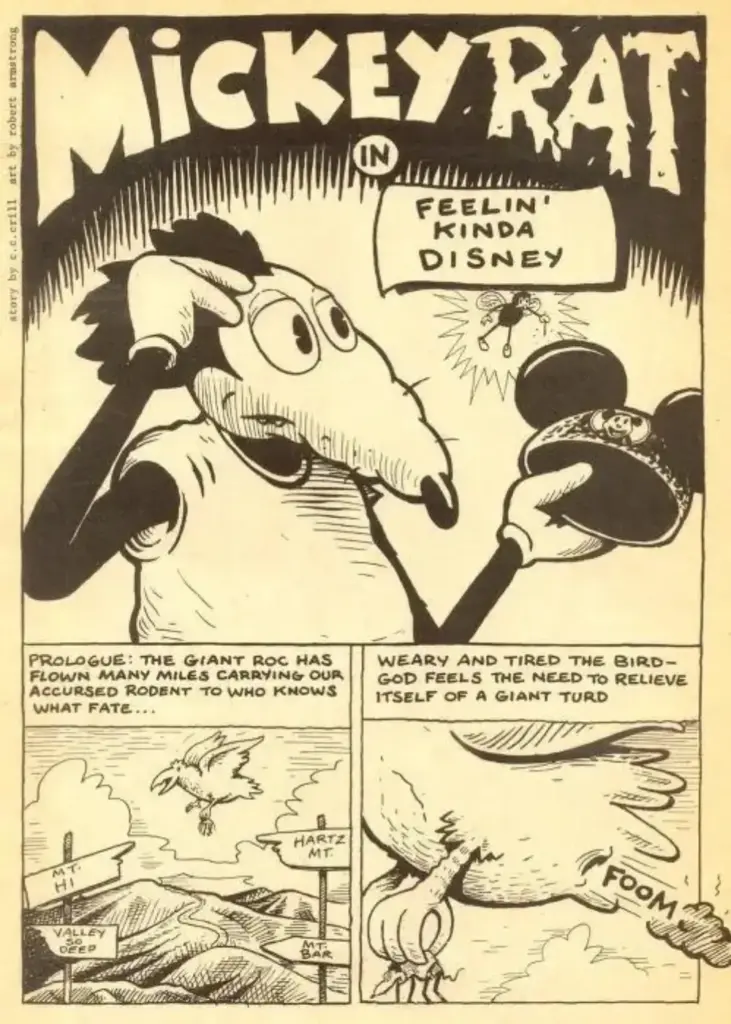
This is the question that follows Mickey Rat almost everywhere online.
The character resembles Mickey Mouse, uses a name built around “Mickey” and appeared in adult comics while Disney’s copyrights remained active.
It is natural to assume that Disney’s lawyers must have become involved.
The available public evidence does not confirm that assumption.
A search of publicly accessible court opinions, trademark records and historical reporting produced:
- No confirmed Disney lawsuit against Robert Armstrong over Mickey Rat
- No reported court decision involving the character
- No located Disney trademark opposition against Armstrong’s comic
- No authenticated cease-and-desist letter
- No evidence that Armstrong defeated Disney in court
What “no lawsuit found” actually means
- It does not mean Disney officially approved Mickey Rat.
- It does not prove that no private complaint was ever made.
- It does not mean Armstrong won a fair-use ruling.
- It only means no Mickey Rat-specific public case has been verified.
Private correspondence could have existed without becoming part of a public court record. Documentation from a small 1970s underground publisher can also be incomplete.
Still, the popular claim that Mickey Rat survived a famous courtroom victory appears to be a myth.
For another cartoon controversy in which legal action was threatened but apparently never filed, read my fact-check on the Kirward Derby and Durward Kirby.
The Air Pirates Lawsuit Shows the Real Legal Risk
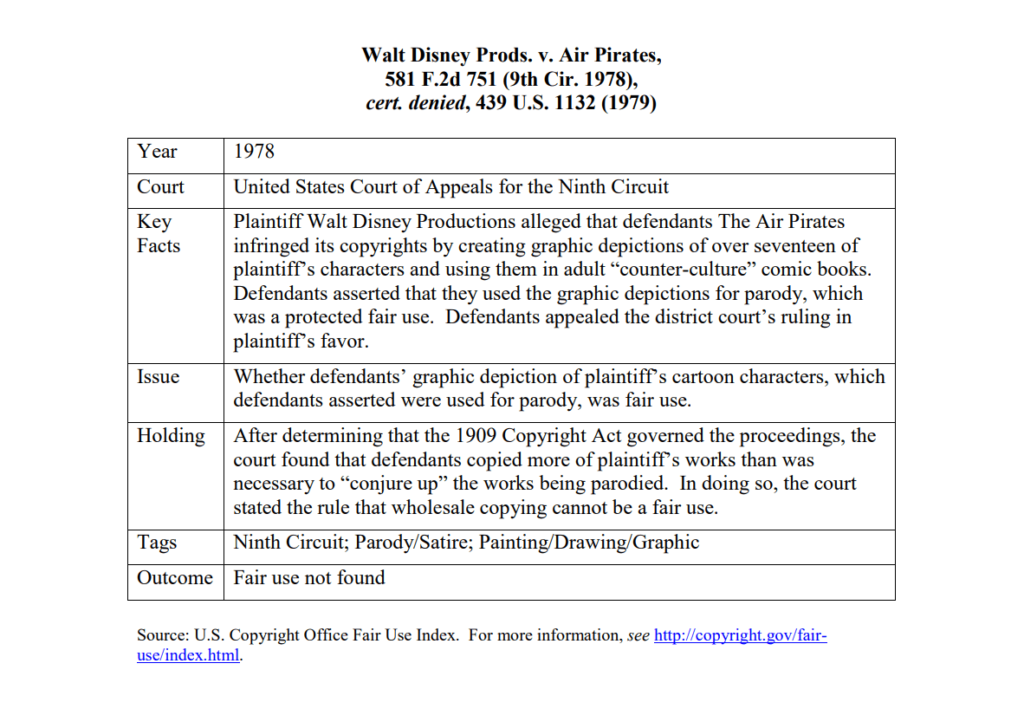
Although Mickey Rat did not produce a known lawsuit, Disney did take legal action against other underground cartoonists during the same period.
The most important comparison is Walt Disney Productions v. Air Pirates.
The Air Pirates artists used highly recognizable versions of Mickey Mouse and other Disney characters in adult counterculture stories involving drugs and sexual behavior.
Disney sued for copyright infringement.
In 1978, the U.S. Court of Appeals for the Ninth Circuit affirmed the copyright ruling against the cartoonists.
The court accepted that the comics were intended as parody but concluded that the artists had copied more of Disney’s protected visual expression than was necessary to call the original characters to mind.
The complete Air Pirates appellate decision remains available through Justia.
Why Mickey Rat Was Different
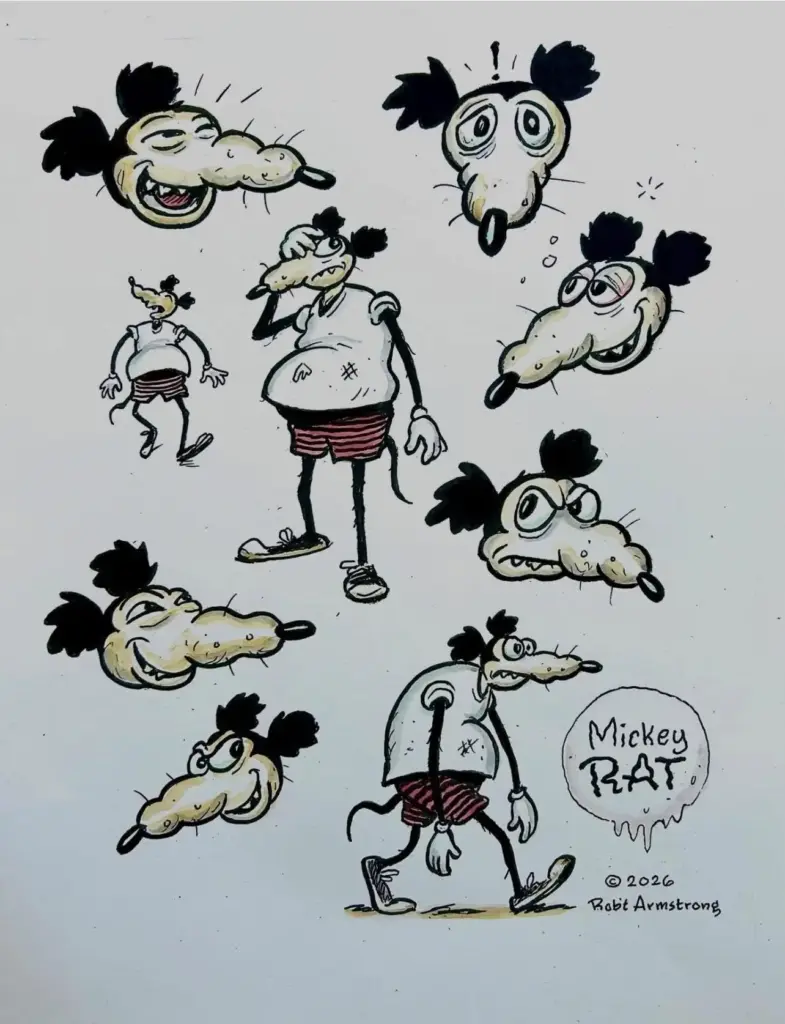
Armstrong’s character differed from the Air Pirates drawings in several visible ways.
He changed:
- The species from mouse to rat
- The length and shape of the snout
- The teeth and facial structure
- The character’s posture and expression
- The personality and fictional identity
- The name itself
Mickey Rat evokes Mickey Mouse without reproducing the Disney design as precisely as the Air Pirates artists did.
That may have reduced the legal risk.
It would still be speculation to claim this was the documented reason Disney did not sue. Other possibilities include Mickey Rat’s limited commercial reach, the expense of pursuing a small publisher or concern that litigation would provide free publicity.
Those are reasonable explanations, not established facts.
What the Air Pirates Case Actually Decided
The Air Pirates case is sometimes summarized too broadly as “Disney proved parody was illegal.”
That is not what the court held.
The dispute turned largely on how much protected expression the artists copied.
The court wrote that a parody could use enough of an original work to bring it to mind, but the Air Pirates drawings tracked Disney’s character images more closely than the court considered necessary.
The legal distinction
- Parody can qualify as fair use.
- Calling something a parody does not automatically make every use legal.
- Courts examine how much protected material was copied and why.
- Mickey Rat never received a public ruling applying those principles to Armstrong’s design.
This is why the absence of a Mickey Rat case remains so interesting.
There is no judicial answer explaining exactly where Armstrong’s rat would have fallen on that line.
Did Steamboat Willie Entering the Public Domain Change Mickey Rat?
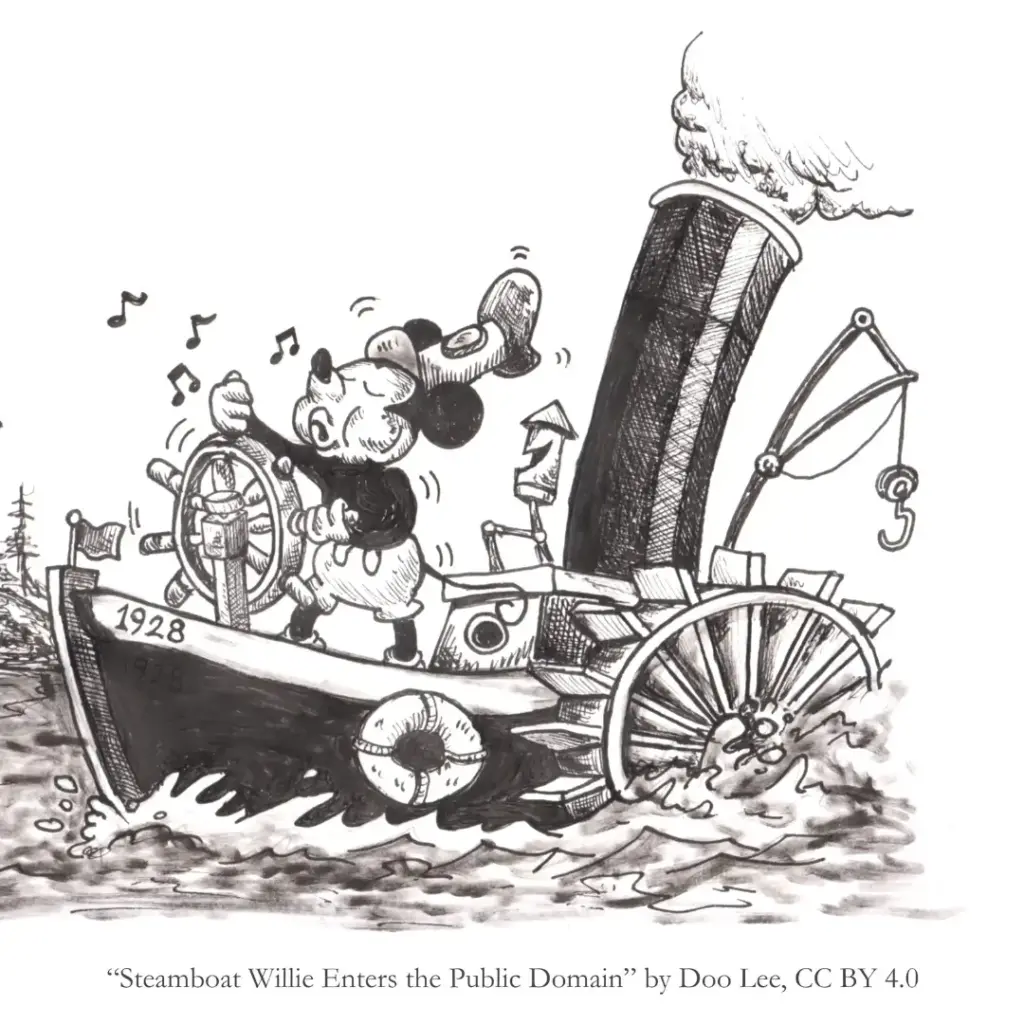
The legal landscape changed on January 1, 2024, when the 1928 films Steamboat Willie and the silent version of Plane Crazy entered the public domain in the United States.
That change allows creators to use material found in those 1928 works without asking Disney for copyright permission.
It does not place every version of Mickey Mouse in the public domain.
Disney still retains:
- Copyrights in later Mickey Mouse designs and stories
- Copyright protection for new material added after 1928
- Trademark rights identifying Disney as the commercial source
- The ability to challenge uses likely to imply Disney sponsorship
Duke Law’s analysis of Mickey Mouse and the public domain offers a particularly clear explanation of the difference between expired copyrights and continuing trademark protection.
The 2024 expiration also does not rewrite Mickey Rat’s history.
When Armstrong created the character in 1971, the original Mickey Mouse films were still protected by copyright.
Mickey Rat therefore remains an example of a parody created while the Disney material was unquestionably protected not a character made possible by Mickey’s later arrival in the public domain.
Are Mickey Rat Comics Worth Money?
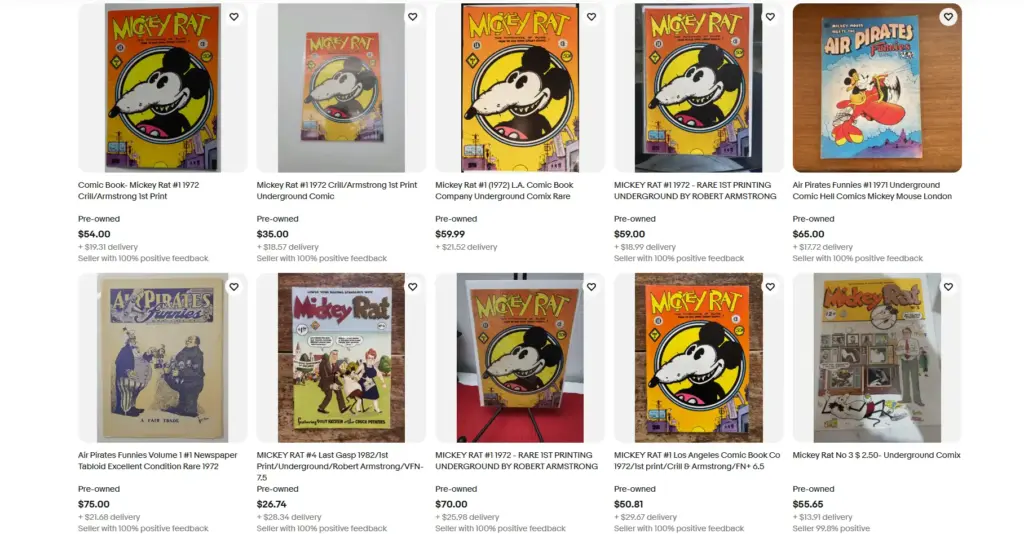
Mickey Rat comics are collectible, but most copies are not worth enormous amounts.
The first issue receives the most attention because it is the character’s first solo comic and was published by a small Los Angeles underground company.
Its value depends heavily on:
- Condition
- Page quality
- Printing or variant
- Professional grading
- Whether the cover and centerfold remain attached
Completed auction results provide a better guide than ambitious online asking prices.
| Item | Sale | Reported price |
|---|---|---|
| Mickey Rat #1, CGC 9.4 | Heritage Auctions, November 2005 | $259.90 |
| Mickey Rat #1, CGC 9.2 | Heritage Auctions, October 2006 | $131.45 |
| Original back-cover artwork from Mickey Rat #2 | Heritage Auctions, April 2024 | $1,320 |
Heritage maintains a Robert Armstrong auction archive containing sales of both printed comics and original art.
These results reveal two important things.
First, a high numerical grade does not guarantee a steadily rising price. Underground comics have a much smaller collector base than mainstream superhero keys, and individual auctions can vary substantially.
Second, original Armstrong artwork belongs in a different market. A unique piece may attract stronger bidding because only one original exists.
What Makes a Mickey Rat Comic More Valuable?
The approximate collector hierarchy is:
- Original Robert Armstrong Mickey Rat artwork
- L.A. Comics #1 containing the first comic appearance
- High-grade or professionally graded Mickey Rat #1 copies
- Complete four-issue sets
- Earlier copies or verified variants of issues two through four
- Lower-grade individual issues and later merchandise
Current asking prices should never be confused with completed sales.
A seller can list Mickey Rat #1 for several hundred dollars. That does not establish that another collector has paid that amount.
What to Check Before Buying
Underground comics were often read, folded and stored without any expectation that they would become collectibles.
Before purchasing a copy, check for:
- Rust or discoloration around the staples
- A detached cover or centerfold
- Writing, stamps or old price marks
- Moisture staining
- Brittle or heavily browned pages
- Missing pages
- Tears along the spine
- Printing information in the indicia
A complete mid-grade copy is usually a better collectible than a bright-looking cover attached to an incomplete book.
Why Mickey Rat Still Matters
Mickey Rat’s publication history was short, but the character remains an efficient piece of visual criticism.
Armstrong did not need a long explanation of corporate culture.
One glance communicates the idea: this is the diseased underside of a carefully protected American icon.
Mickey Rat can be understood as:
- A crude visual joke
- An adult cartoon
- An underground-comix collectible
- A parody of corporate entertainment
- A small artifact of 1970s counterculture
He works in all those roles at once.
The character also occupies a peculiar place in legal history. He was recognizable enough for everyone to understand the Mickey Mouse reference, yet altered enough and perhaps commercially small enough, that no public Disney case has surfaced.
That mystery should not be exaggerated into a courtroom victory. Mickey Rat was never publicly declared fair use, and Disney never publicly blessed the character.
The absence of a case is interesting precisely because Disney successfully pursued the Air Pirates during the same period.
The comics may never become major investment pieces. Their historical value is easier to defend.
Mickey Rat represents a moment when underground artists realized that familiar corporate imagery could be borrowed, dirtied up and handed back to readers in a form completely incompatible with the original brand.
For a character who began as a T-shirt gag, that is a surprisingly durable legacy.