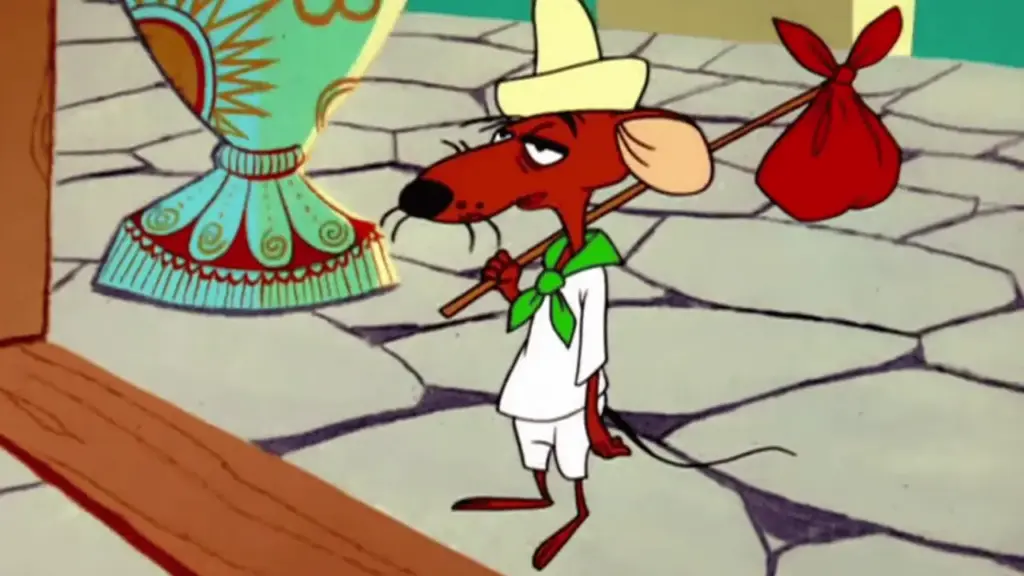
Slowpoke Rodriguez appeared in only two classic Looney Tunes shorts.
Two.
Bugs Bunny starred in more than 160.
Speedy Gonzales appeared in doz and a proper starring role three years later. Somehow, that was enough to make him one of the most recognizable mice in animation.
I have a soft spot for characters like this, the deep cuts that remain memorable long after better-known stars fade from view.
So this is the story of the slowest mouse in all Mexico: the gun, the song, the hypnosis and the controversy that followed Speedy Gonzales and his entire supporting cast.
- Who he is: Speedy Gonzales’ cousin and the slowest mouse in all Mexico.
- Classic cartoons: Mexicali Shmoes (1959) and Mexican Boarders (1962).
- Special skills: A pistol, hypnosis and complete immunity to panic.
- Personality: Sleepy, hungry and never in enough of a hurry to worry.
- Later appearances: Space Jam, The Looney Tunes Show, video games and commercials.
How Many Cartoons Was Slowpoke Rodriguez In?
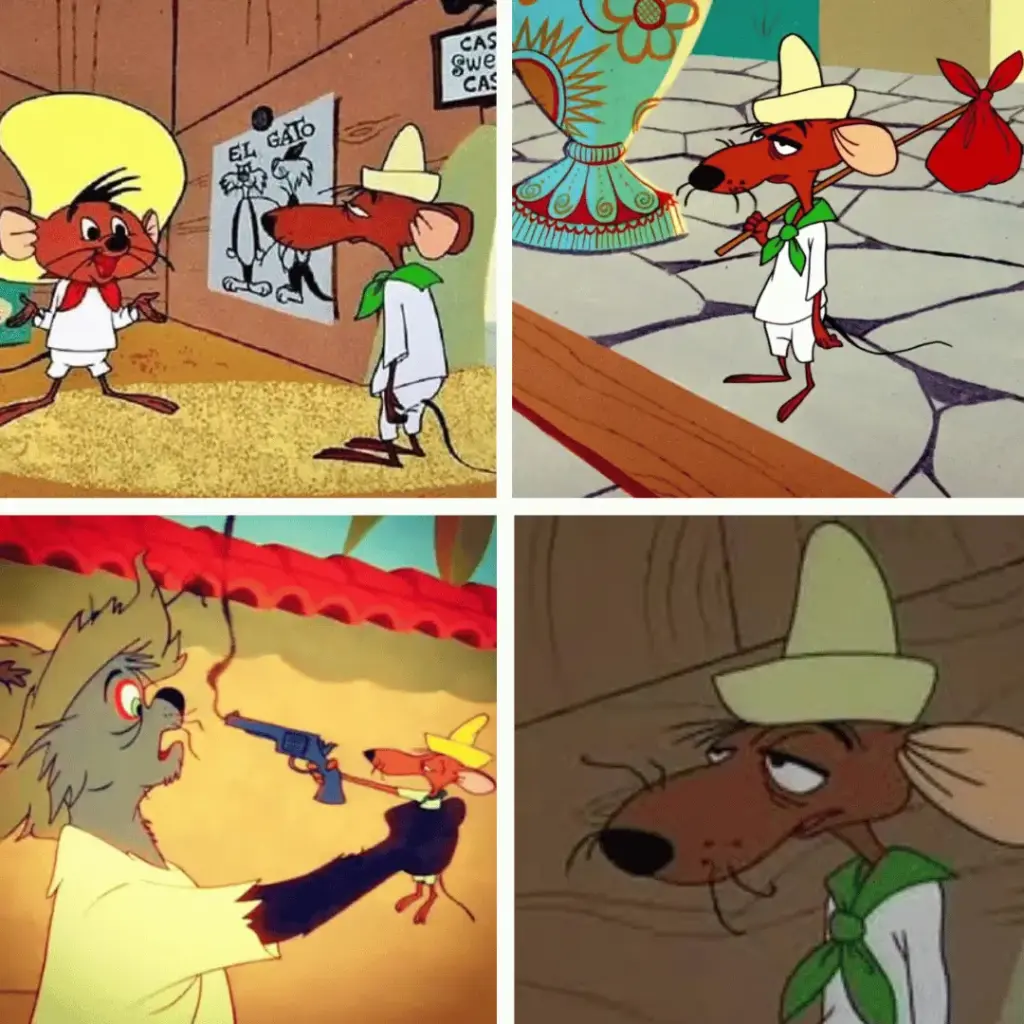
Slowpoke Rodriguez appeared in two original theatrical cartoons: Mexicali Shmoes in 1959 and Mexican Boarders in 1962.
That is his entire golden-age filmography.
He later returned in movies, television, games and advertising, but the character people remember was built from those two shorts.
Most minor Looney Tunes characters eventually disappear into trivia lists. Slowpoke went the other way.
His name became shorthand for anyone who moves too slowly. His cartoons continued appearing in television packages and compilation movies, while clips of his best scenes now circulate through short-form video and meme pages.
The secret is that Slowpoke is not simply a slower version of Speedy. He is his cousin’s opposite in nearly every way.
Speedy escapes trouble by moving faster than anyone else. Slowpoke cannot outrun anything, so he has to rely on a completely different set of talents.
Slowpoke Rodriguez Debuted in 1959
Slowpoke exists because director Friz Freleng needed an ending.
Mexicali Shmoes, released in 1959, follows two lazy cats named José and Manuel as they try—and repeatedly fail—to catch Speedy Gonzales.
By the finale, the exhausted cats are sitting on a wall when Manuel mentions that Speedy has a cousin named Slowpoke Rodriguez, the slowest mouse in all Mexico.
José hears “slowest mouse” and immediately runs off in search of an easy meal. Manuel races after him, desperately trying to finish his warning.
He arrives too late.
There is a gunshot, a scorched José and Manuel’s famous explanation:
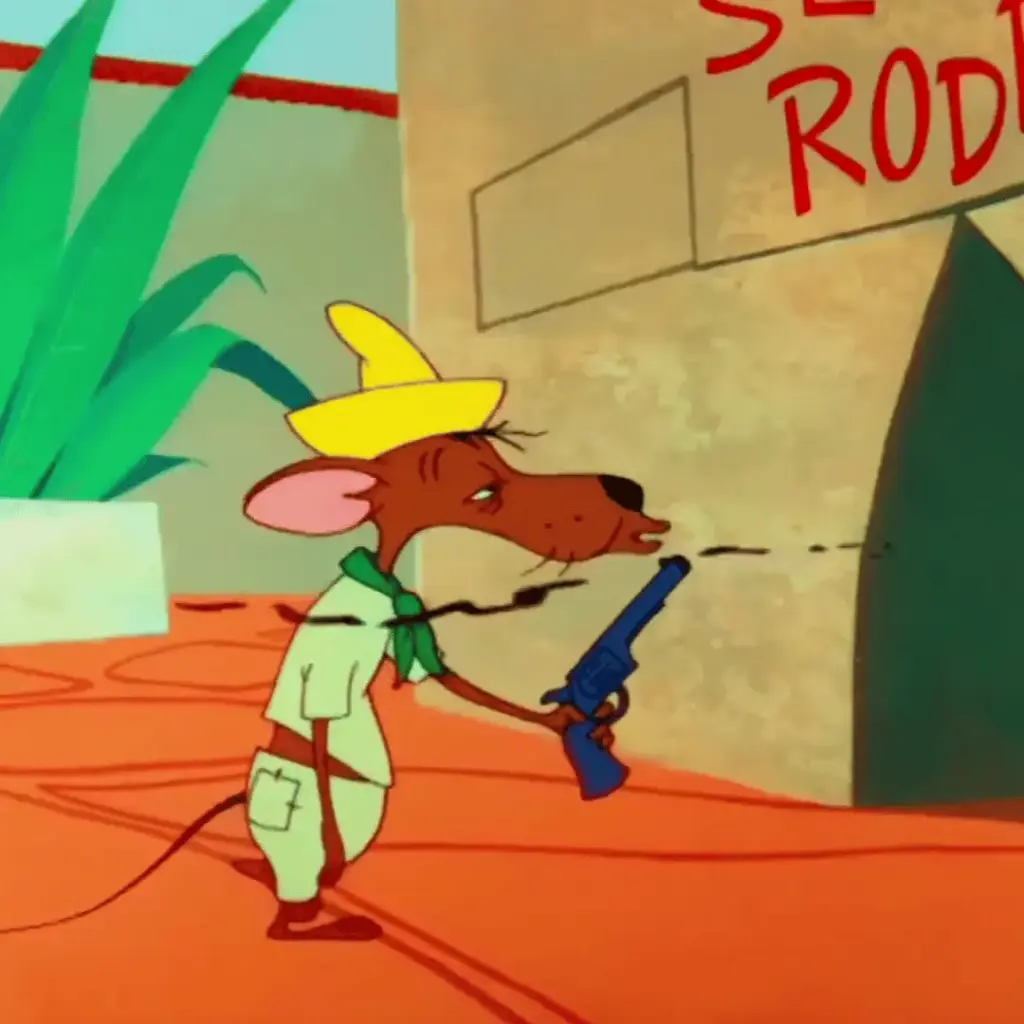
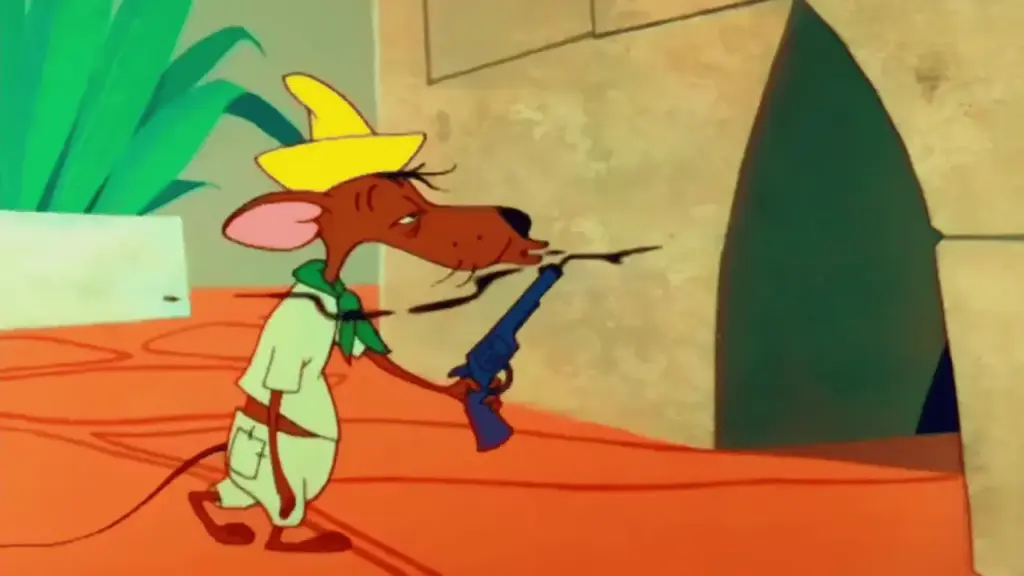
That is almost the entire debut. Slowpoke never says a word. He shoots the cat, blows the smoke from his pistol and calmly walks back into his mouse hole.
The joke lasts only a few seconds, but it became the most famous thing about him.
Mexicali Shmoes also received an Academy Award nomination for best animated short, losing to John Hubley’s Moonbird.
Slow in the Feet, Not in the Head
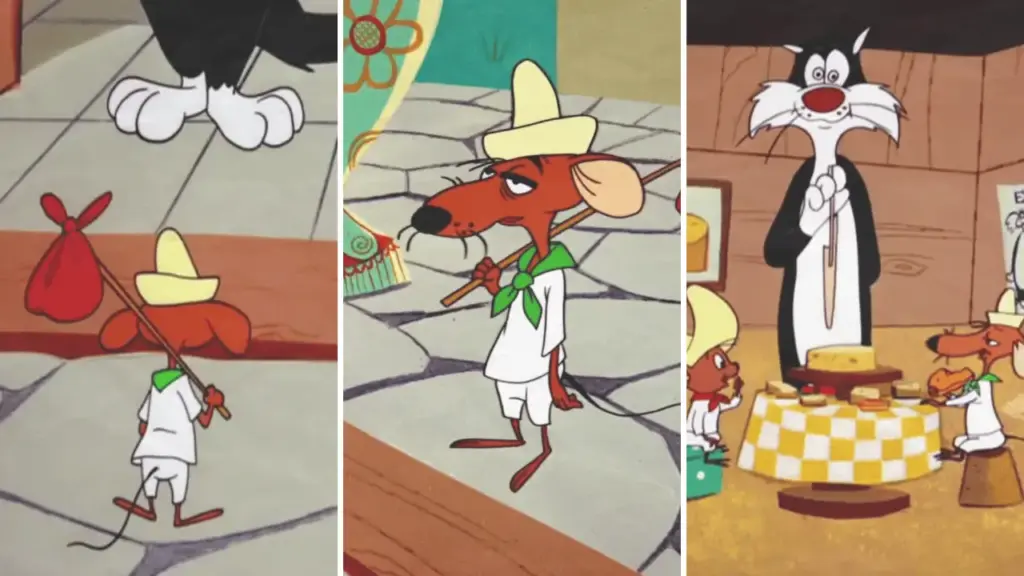
The fully developed version of Slowpoke arrived three years later in Mexican Boarders.
Slowpoke comes to stay with Speedy in Sylvester the Cat’s territory. Sylvester takes one look at the slowest mouse in Mexico and assumes he has found the easiest meal of his life.
Speedy knows better.
His cousin will not hurry for anyone. Slowpoke wanders into danger at a relaxed stroll and spends most of the cartoon thinking about food, leaving Speedy to repeatedly pull him away from Sylvester.
Then the ending turns the whole setup around.
When Sylvester finally corners Slowpoke alone, the supposedly helpless mouse calmly hypnotizes him. Sylvester becomes completely obedient and carries Slowpoke away like a servant.
The other mice explain that Slowpoke may be the slowest mouse in all Mexico, but he has “the evil eye.”
That one scene completes the character. Slowpoke is slow in the feet, not in the head.
Warner Bros. later incorporated parts of Mexican Boarders into the 1982 compilation film Bugs Bunny’s 3rd Movie: 1001 Rabbit Tales, introducing him to another generation of viewers.
Does Slowpoke Rodriguez Really Have a Gun?
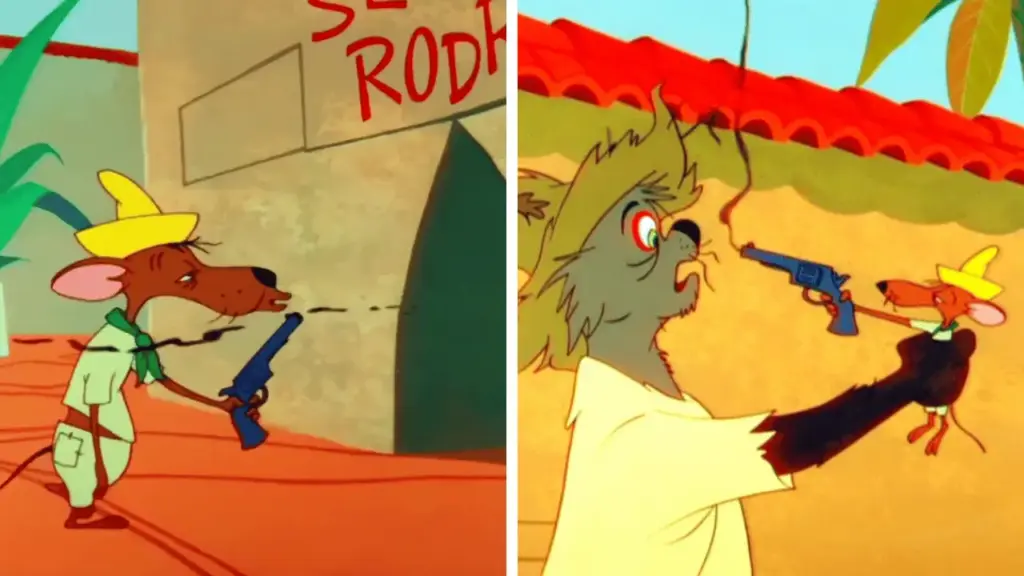
Yes. Slowpoke Rodriguez really does pack a gun.
It is not a fan invention or a detail people added to the story later. The pistol appears on screen in his first cartoon, and he fires it at José seconds after the cat grabs him.
The gun is also the perfect joke for the character.
Every other mouse in the series survives by running. Slowpoke cannot move quickly, so the cartoon gives him a much louder equalizer.
He never panics, pleads or tries to escape. He simply waits for the cat to make the mistake of coming too close.
The gag also became one of the hardest parts of the cartoon to show on children’s television. Some later broadcasts reportedly shortened or removed the shooting, leaving viewers with an ending that no longer made much sense.
Without the gunshot, Manuel’s warning has no payoff. Slowpoke simply becomes a sleepy mouse who wanders back into his hole.
Did Slowpoke Rodriguez Sing About Marijuana?
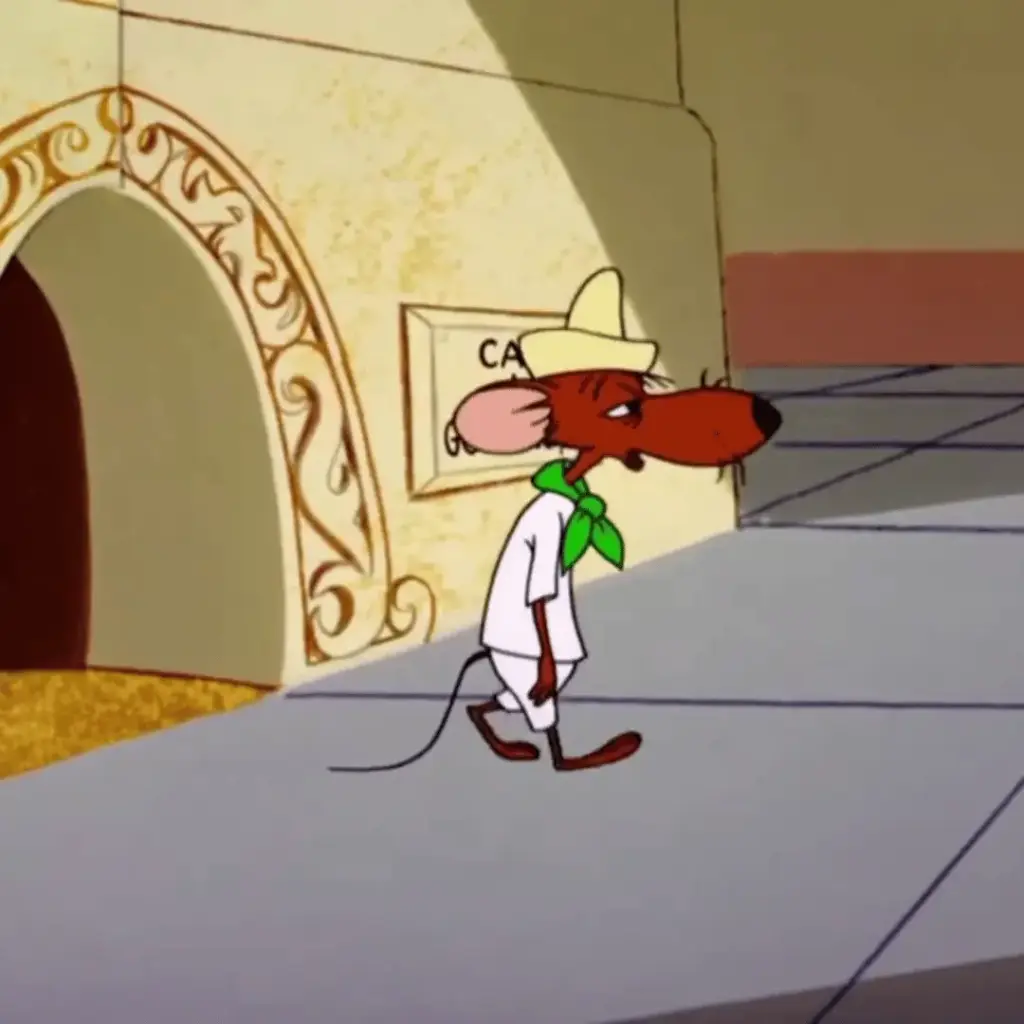
Ask longtime fans about Slowpoke and someone will eventually mention the song.
In Mexican Boarders, Slowpoke drowsily sings “La Cucaracha,” the traditional Spanish-language folk song associated closely with Mexico and the Mexican Revolution.
There is no single definitive set of lyrics. Like many folk songs, “La Cucaracha” developed countless political, comic and regional verses over the years.
The version Slowpoke sings is the famous verse about a cockroach that cannot walk because it lacks marijuana to smoke.
Warner Bros. did not invent that lyric for the cartoon. It was already a well-known variation of the song.
Still, putting those words in Slowpoke’s mouth created an entirely different reading.
He moves at half speed, speaks in a sleepy drawl, keeps his eyes partly closed and spends much of the cartoon thinking about food. Add a marijuana lyric and it is easy to understand why later viewers began calling him a stoner character.
There is no solid evidence that Freleng or the writers intended Slowpoke to be under the influence. The “Slowpoke Rodriguez stoner theory” is a fan interpretation that became more popular long after the cartoon was released.
It has also done a great deal to keep the character alive online.
Was Slowpoke Rodriguez Part of the Speedy Gonzales Ban?
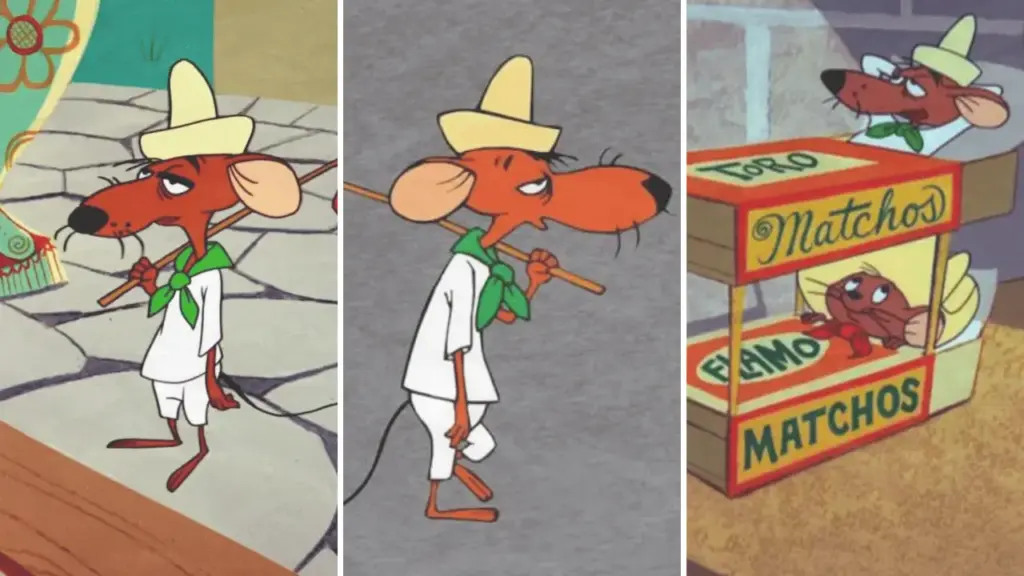
This is where Speedy’s sleepy cousin becomes part of a much larger animation controversy.
After Cartoon Network became the main US television home of Warner Bros.’ classic cartoon library in late 1999, Speedy Gonzales largely disappeared from the channel’s schedule.
A network spokeswoman later acknowledged that concerns about ethnic stereotypes were one reason the cartoons had remained off the air.
Speedy himself was the easiest part of those shorts to defend. He was fast, clever, brave and almost always the winner.
The supporting characters were more difficult.
Many of the village mice were portrayed as poor, sleepy, drunk or helpless. Slowpoke combined several of those ideas in one character: a drowsy Mexican mouse with a heavy accent, an endless appetite and a pistol.
There is no surviving statement from Cartoon Network naming Slowpoke as the reason the cartoons were shelved. However, he clearly represented the kind of caricature that made the network uneasy.
Mexican-American fans pushed back. The League of United Latin American Citizens, the country’s oldest major Latino civil rights organization, publicly supported Speedy’s return in 2002.
Cartoon Network eventually put several of the shorts back into rotation.
I covered the full dispute in my article explaining why Speedy Gonzales was banned.
Slowpoke’s defenders also have a fair argument. The character may be built from dated stereotypes, but the joke does not end with the Mexican mouse being helpless.
Slowpoke wins both times.
Sheriff Slowpoke Rodriguez of Tacapulco
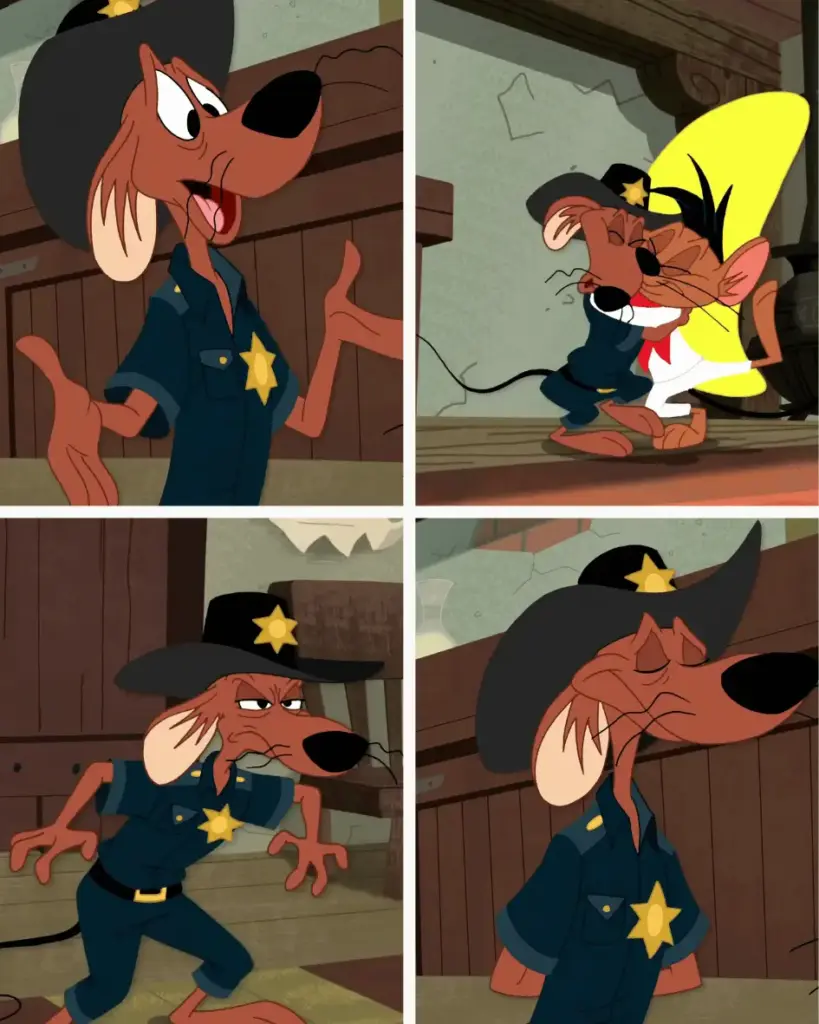
Slowpoke’s best modern appearance came in the 2013 episode of The Looney Tunes Show titled “The Black Widow.”
Daffy Duck and Porky Pig travel to Mexico and land in trouble with the law. The sheriff who processes them is none other than Slowpoke Rodriguez, now voiced by Hugh Davidson.
It is a clever reversal.
The character once criticized as a lazy Mexican stereotype returns as the man in charge. He runs the town at his own pace, handles the paperwork and lets the frantic visitors wait.
Slowpoke’s later appearances remained scattered, but he never disappeared completely:
- Space Jam: He appears silently among the large crowd of Looney Tunes characters.
- Video games: Slowpoke escapes the kidnapping that begins the SNES game Speedy Gonzales: Los Gatos Bandidos and calls Speedy for help.
- Advertising: He appeared with Speedy in a British Virgin Broadband campaign, naturally representing the slower connection.
How Slowpoke Rodriguez Became a Meme
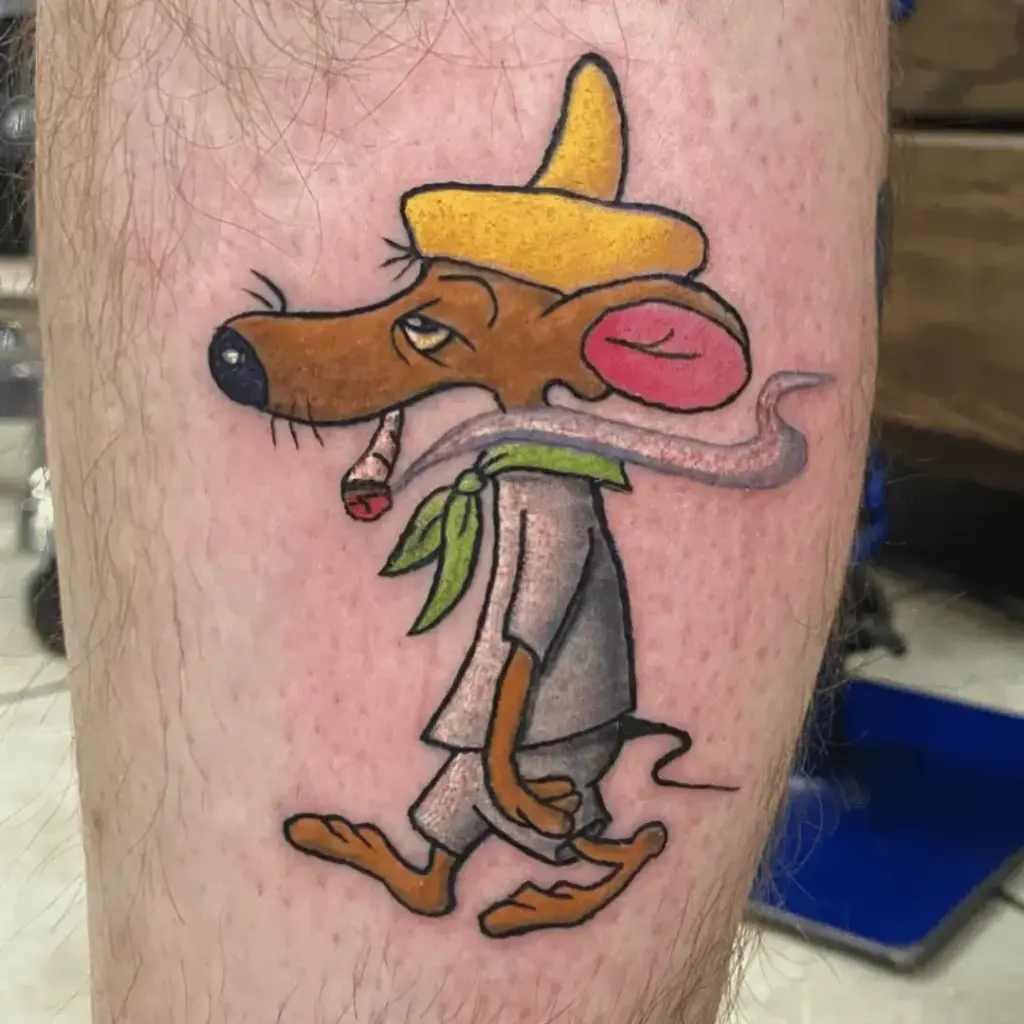
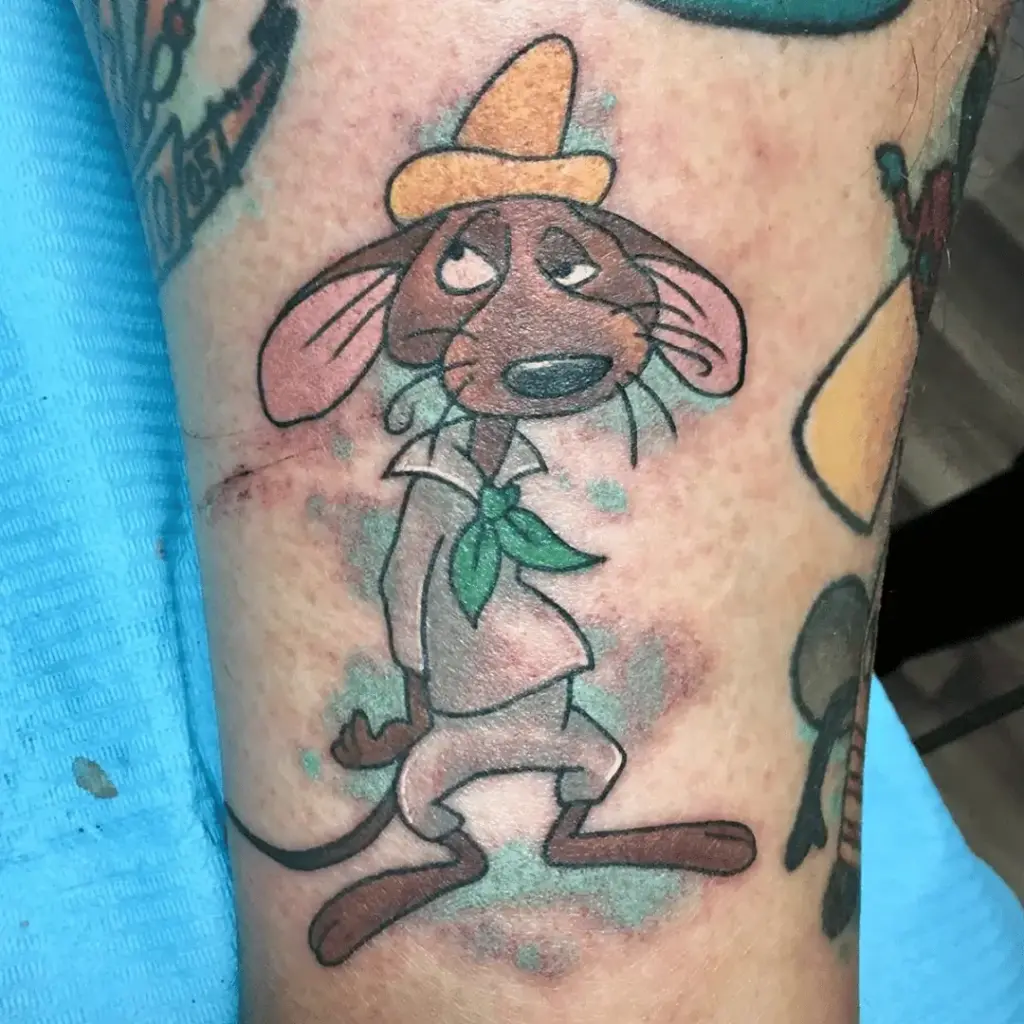
Slowpoke’s fan following is much larger than his filmography has any right to support.
He appears on shirts, stickers and tattoos. Some fans adopted “Slowpoke” as a childhood nickname and carried it for the rest of their lives.
It is the same kind of devotion I have been collecting in my gallery of Speedy Gonzales tattoos. These two mice seem to inspire more permanent ink than characters with far more screen time.
Short-form video has given Slowpoke another life.
The final scene from Mexicali Shmoes regularly resurfaces with captions about the mouse who may be slow on his feet but is never slow on the trigger.
Other clips focus on his sleepy voice, appetite or “La Cucaracha” performance, introducing him to viewers who have never watched a complete Looney Tunes short.
The appeal is easy to understand.
Slowpoke is the tortoise from the old fable, except he does not bother entering the race. He wins without changing his pace for anyone.
Why Slowpoke Rodriguez Is Still Remembered
Warner Bros. built entire cartoon careers around characters who starred in dozens of shorts.
Slowpoke got two.
It turned out to be enough because he is such a complete idea. One glance tells you who he is. One scene reveals why catching him is a terrible mistake.
The gap between his appearance and his actual abilities powers every joke. He looks sleepy, vulnerable and almost too slow to function, but he is armed, intelligent and completely capable of protecting himself.
Some parts of the character have aged poorly.
Others still work exactly as intended.
More than six decades after his debut, Slowpoke has survived changing television standards, arguments about ethnic stereotypes and the disappearance of most other one-scene Looney Tunes characters.
Not bad for a punchline with a pistol.
For more from this corner of cartoon history, start with my roundup of iconic Mexican cartoon characters, then keep the era going with my guide to the best cartoons of the 1950s.