
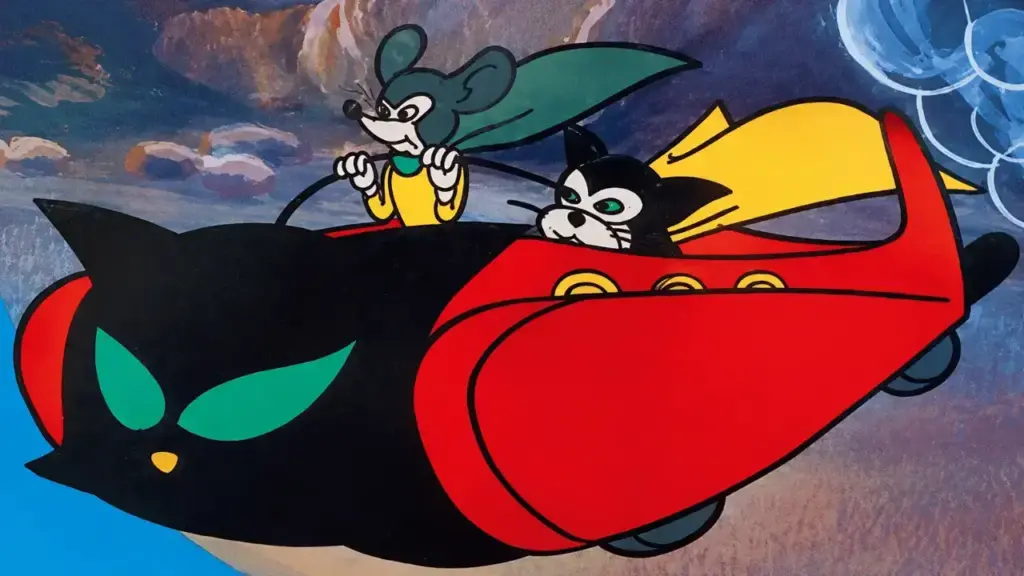
Bob Kane helped create Batman. About two decades later, his name appeared on a cartoon that turned the same basic idea into a joke: Batman, but as a cat.
In 1960, Kane put his name to an animated series about a masked feline crimefighter and his undersized mouse sidekick.
It had:
- A hidden Cat Cave
- A bright red Catmobile
- An all-purpose Catgun
- A police chief who was literally a dog
- A recurring villain who sounded like an old Hollywood gangster
The show was called Courageous Cat and Minute Mouse, and it remains one of the strangest footnotes in superhero and animation history.
Calling it “the Batman parody made by Batman’s creator” is accurate, but only up to a point. As with much of Bob Kane’s career, the name in the credits does not tell the entire story.
Courageous Cat at a glance
- Full title: Courageous Cat and Minute Mouse
- Debut: September 14, 1960
- Format: 130 cartoons running roughly five minutes each
- Setting: Empire City
- Creator credit: Bob Kane
- Major uncredited contributor: Sheldon Moldoff
- Main villain: Chauncey “Flat-Face” Frog
What Was Courageous Cat and Minute Mouse?
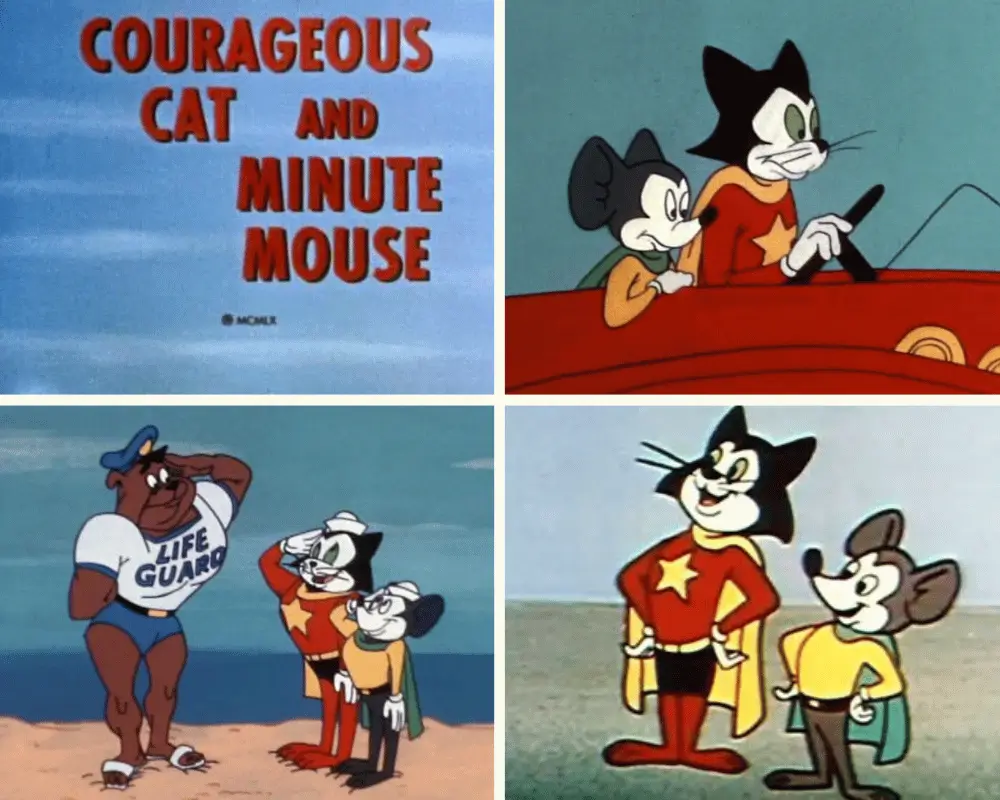
Courageous Cat and Minute Mouse was a low-budget animated superhero comedy produced for television syndication.
The series came from Trans-Artists Productions and was distributed by Tele Features. It eventually generated 130 separate five-minute cartoons.
That short runtime made the series extremely useful to local television stations.
Why five-minute cartoons worked on local television
- Several shorts could be combined into a half-hour program.
- A cartoon could be inserted into a locally hosted children’s show.
- Stations could use one when a movie or program ended early.
- The episodes were inexpensive and could be rerun repeatedly.
The premise was essentially Batman with fur.
Courageous Cat and Minute Mouse protected Empire City from an assortment of animal criminals. They operated from the Cat Cave and raced into action in the Catmobile, a bright red vehicle with a large cat’s head mounted on the front.
The gadgets were part of the joke.
Instead of Batman’s utility belt, Courageous Cat carried a Catgun that could produce whatever tool, ray or solution the story required.
Depending on the episode, the Catgun could:
- Shrink or enlarge objects
- Freeze criminals in place
- Create unusual rays and beams
- Produce the exact gadget needed to end the story
There was little interest in explaining how any of it worked. The Catgun worked because the five-minute plot needed it to work.
Did Bob Kane Really Create Courageous Cat?
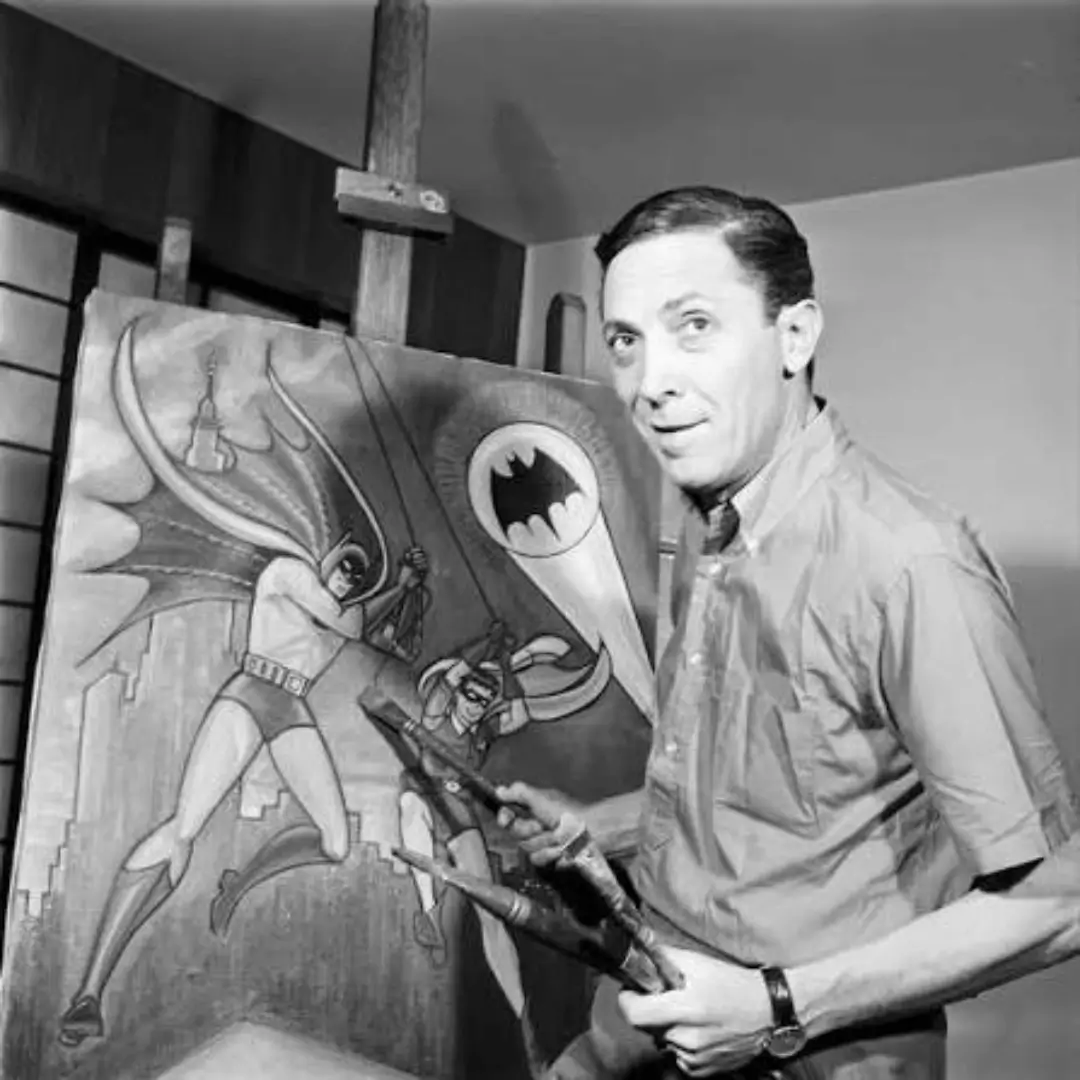
Bob Kane is the name most closely connected to Courageous Cat, and Kane openly admitted that he reused the Batman and Robin formula.
In an interview with writer Will Murray, Kane described the connection in unusually direct terms.
“Courageous Cat and Minute Mouse were a miniature Batman and Robin. I readapted Batman and Robin.”
Bob Kane, quoted in Will Murray’s history of Courageous Cat
According to Kane, he was living in Hollywood when he met animation producer Sam Singer, who was searching for new ideas.
Kane proposed a cat and mouse designed around the same basic relationship as Batman and Robin.
The pitch included:
- A masked cat hero
- A smaller mouse sidekick
- A Cat Cave headquarters
- A Catmobile
- A Penguin-inspired villain called the Frog
Kane later admitted that the process was simple: he reused the Batman format.
That much appears clear. Kane supplied the recognizable central idea and attached his famous name to it.
The harder question is how much of the finished cartoon he personally created.
What we can say with confidence
- Bob Kane pitched the Batman-inspired concept.
- His name was used to promote the series.
- He did not create all 130 cartoons by himself.
- Sheldon Moldoff and other animation professionals handled substantial creative work.
Sheldon Moldoff: The Ghost in the Cat Cave
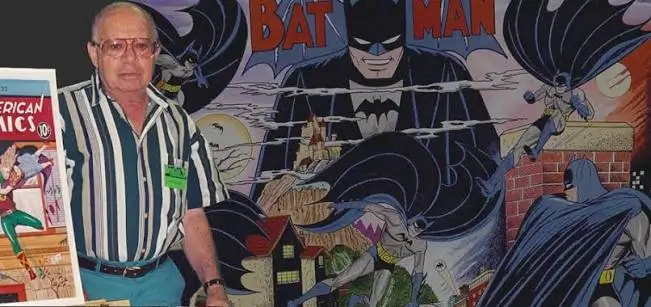
The production history of Courageous Cat closely resembles the credit controversy that followed Bob Kane throughout his comics career.
Batman is now officially credited as having been created by Bob Kane with Bill Finger.
Finger helped establish many of the elements now considered essential to Batman, including:
- Bruce Wayne’s identity and personality
- Gotham City
- Batman’s costume and visual direction
- The character’s tragic origin
- Several major villains and supporting characters
For decades, however, Kane received the official creator credit while Finger’s contributions remained largely unknown to the public.
Kane also employed ghost artists to produce Batman artwork under his name. One of the most important was Sheldon “Shelly” Moldoff.
Moldoff drew Batman stories and covers for years without receiving the same public recognition.
He apparently performed a similar role on Courageous Cat.
Sheldon Moldoff’s reported contributions
- Designed Courageous Cat and other characters
- Produced conceptual artwork for the series
- Wrote and storyboarded at least 65 cartoons
- May have worked on considerably more than half the series
- Received little or no onscreen recognition
Comics historian Mark Evanier described Moldoff as the main artist and designer of the animated series.
Michael Uslan, a longtime Batman producer and historian, has also said that Moldoff created Courageous Cat conceptual artwork that Kane later gave him.
An obituary published by The Comics Journal reported that Moldoff wrote and storyboarded 65 Courageous Cat cartoons on Kane’s behalf.
There is still uncertainty over the exact division of work.
Moldoff reportedly claimed that he wrote and storyboarded every episode, while other sources associate writer Gerald J. Rappoport with the stories and characters.
The safest conclusion is that Kane supplied the marketable concept and creator name, while Moldoff and other animation professionals handled much of the design, writing and production work.
That arrangement was not unusual in television animation, but it was especially characteristic of Kane’s career.
Why Did Batman’s Creator Parody Batman?
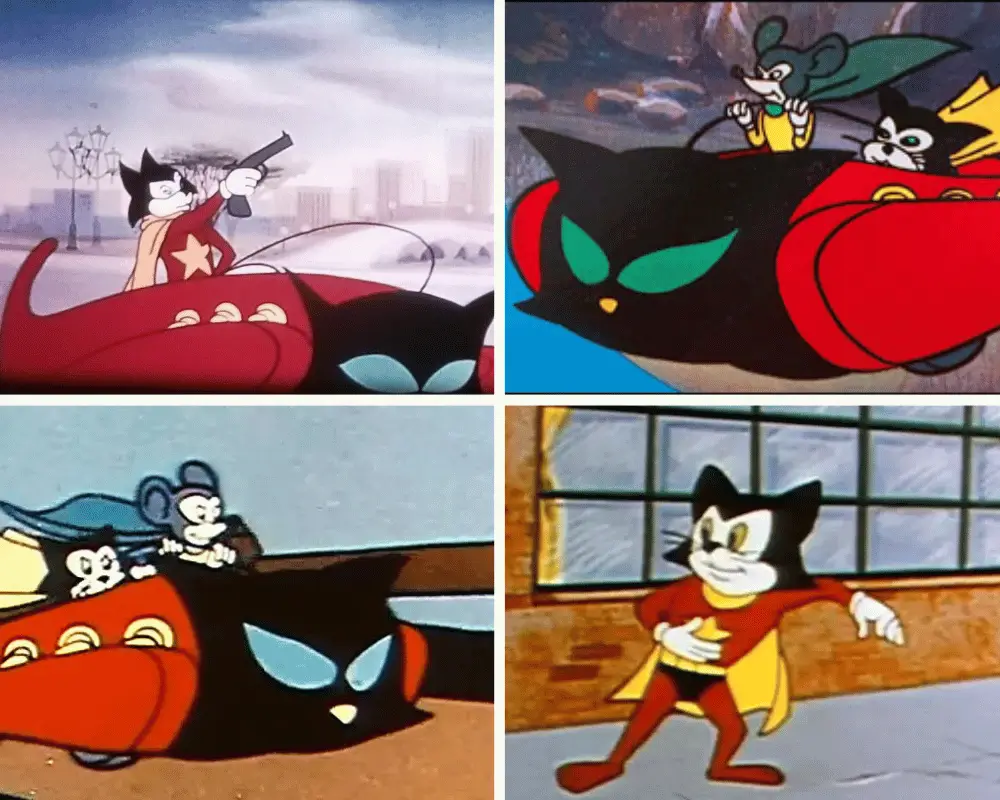
Looking back from the era of billion-dollar Batman movies, it is easy to assume that Kane created Courageous Cat as a playful victory lap.
The reality was probably more practical.
Batman was not yet the nearly indestructible entertainment franchise it would eventually become. The character’s popularity had cooled by the late 1950s and early 1960s, and the comics had moved far away from their darker detective roots.
Animation historian Jerry Beck described Courageous Cat as a project “born out of necessity.”
It gave Kane another way to sell a variation of the character and formula for which he was already famous.
Batman and Courageous Cat timeline
- 1939: Batman debuts in Detective Comics #27.
- 1960: Courageous Cat and Minute Mouse reaches television.
- 1964: DC introduces Batman’s “New Look” as sales decline.
- 1966: The live-action Batman television series becomes a national craze.
The timing requires some clarification.
Courageous Cat premiered in 1960. Batman’s better-documented sales crisis came several years later.
By 1964, declining sales pushed DC to modernize the comics under editor Julius Schwartz. The company removed some of the stranger science-fiction elements and gave Batman a cleaner, more contemporary appearance.
Jerry Beck has said DC was considering cancelling Batman before the deal for the 1966 ABC television series. Whether cancellation was genuinely imminent remains debated, but the larger point is valid: Batman was going through a commercially weak period.
It would therefore be too simple to claim that Kane created Courageous Cat because Batman was about to disappear in 1960.
A more accurate interpretation is that Kane repackaged the Batman formula at a time when its popularity was fading.
Courageous Cat gave him a new television property while still trading heavily on the connection that had made him famous.
Kane returned to parody again with Cool McCool, a 1966 animated spy comedy created with producer Al Brodax for King Features.
The Frog, the Voices and That Memorable Theme
For such a cheaply produced cartoon, Courageous Cat had several elements that made it unexpectedly memorable.
Chauncey “Flat-Face” Frog
The most prominent villain was Chauncey “Flat-Face” Frog, a green gangster who spoke in an Edward G. Robinson-style voice.
Kane openly compared the character to Batman’s Penguin when describing his original pitch.
The Frog appeared frequently enough to become the cartoon’s most recognizable villain. His relationship with the heroes was also strangely flexible.
In some stories, he even cooperated with Courageous Cat and Minute Mouse when a more dangerous criminal threatened Empire City.
Who Voiced Courageous Cat?
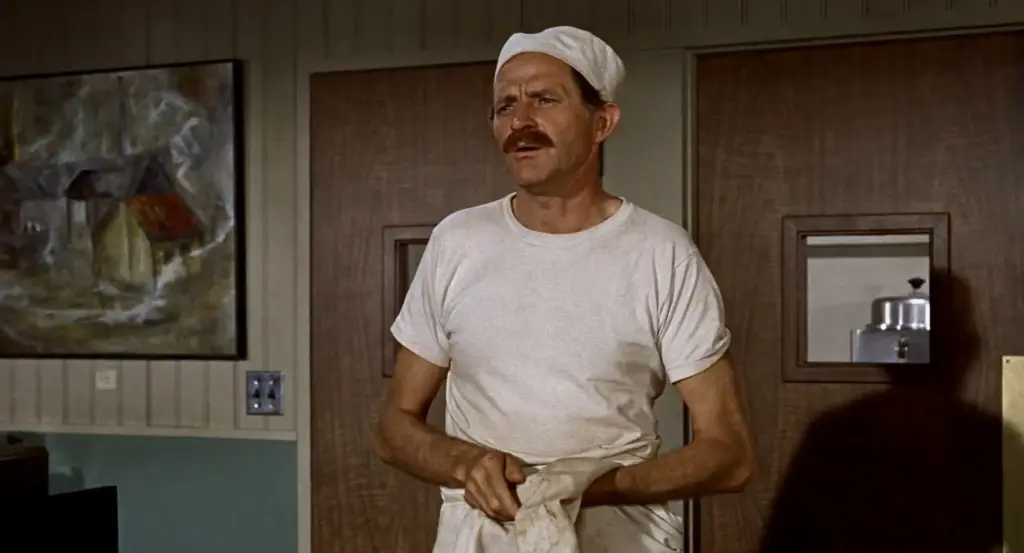
The show’s onscreen voice credits were limited, making it difficult to assign every character with complete certainty.
Dallas “Dal” McKennon is the performer most strongly associated with Courageous Cat and Minute Mouse.
Other Dal McKennon roles
- Gumby
- Archie Andrews
- Cincinnatus on Daniel Boone
- Several voices in Disney animated productions
- The frightened diner cook in Alfred Hitchcock’s The Birds
A 1960 Courageous Cat record album credited McKennon with most of its voices. Music supervisor Johnny Holiday was credited with voicing the Frog.
The Courageous Cat Theme Song
The cartoon’s strongest element may be Holiday’s theme music.
Its walking bass and crime-jazz sound clearly evoke Henry Mancini’s famous Peter Gunn theme.
Even people who remember almost nothing about the plots often remember the opening.
The theme later developed a small life of its own. The New York Dolls recorded a rock version that appeared on their 1994 compilation album Rock ’n Roll.
My take
I understand why the music lasted longer than the cartoon. It gives Courageous Cat an energy and confidence that the actual animation does not always manage to deliver.
When Did Courageous Cat First Air?
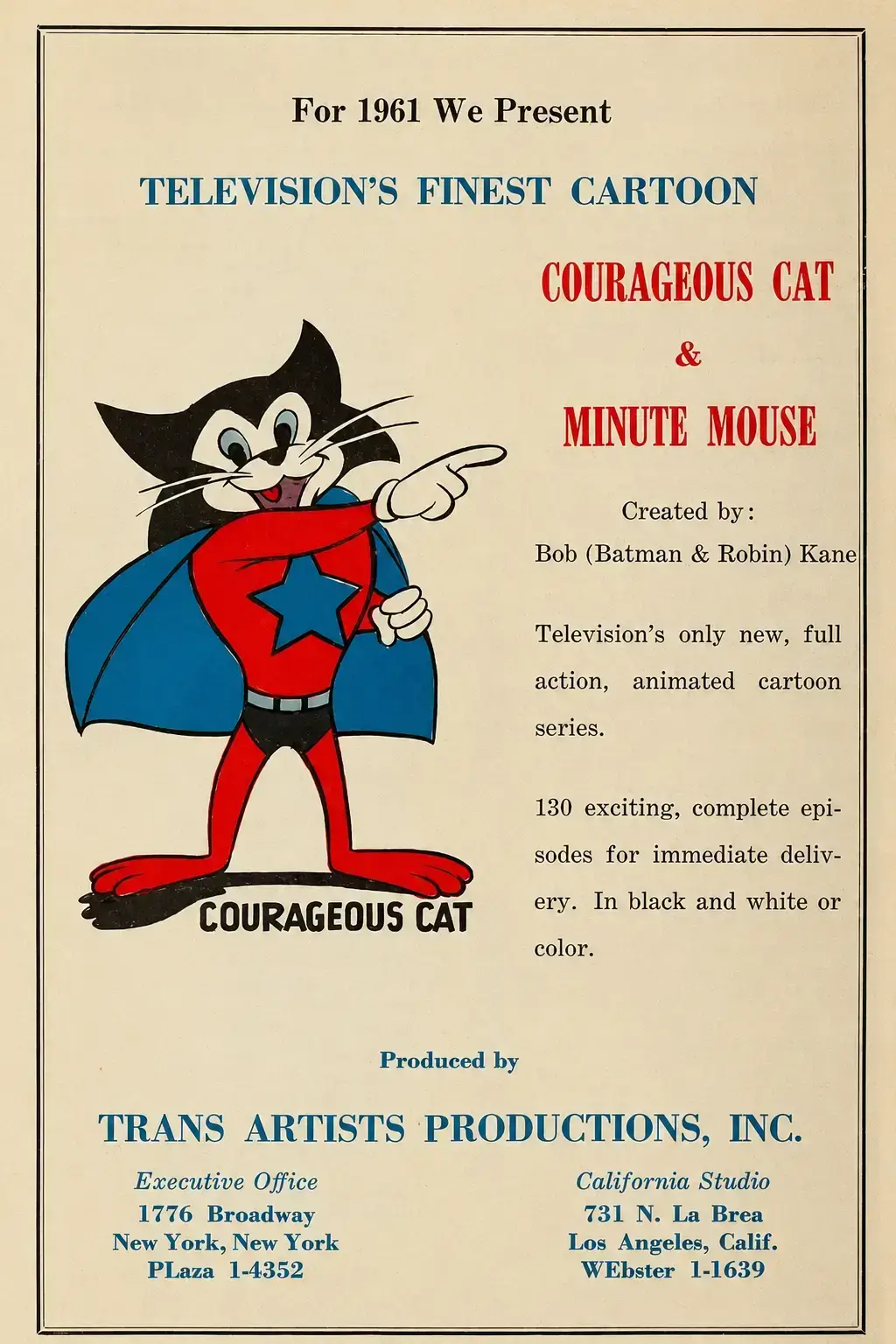
The documented New York television debut of Courageous Cat and Minute Mouse took place on September 14, 1960.
The first short, “Disguise the Limit,” appeared as part of The Tommy Seven Show on WABC-TV Channel 7.
It opened with Courageous Cat and Minute Mouse racing out of the Cat Cave in their red Catmobile.
That entrance established a formula the series would repeat across its collection of five-minute adventures.
Original broadcast details
- First documented airdate: September 14, 1960
- First short: “Disguise the Limit”
- Original New York program: The Tommy Seven Show
- Station: WABC-TV Channel 7
- Production period: Generally dated from 1960 to 1962
Because the series was syndicated, stations could broadcast the cartoons in different orders and at different times.
Many viewers therefore discovered Courageous Cat through reruns rather than during its original production period.
Once the live-action Batman series became a national phenomenon in 1966, the similarities must have seemed even more obvious.
Courageous Cat suddenly looked less like an isolated animal comedy and more like a bargain-bin preview of the campy superhero boom that followed.
Around the World in a Daze
Courageous Cat and Minute Mouse was well before my time, but I eventually stumbled across the cartoon through a 1980s VHS tape.
The stories were chaotic, and the animation could shift from surprisingly expressive to extremely crude.
The Catgun also felt like a shortcut that allowed the writers to end almost any story immediately.
Still, there was something fascinating about it.
What stood out to me
- The cartoon was stranger than I expected.
- The art ranged from stylish to extremely rough.
- The theme music was better than many of the stories.
- The Batman similarities were impossible to miss.
- The production history was more interesting than the plots.
This was not simply another forgotten animal cartoon.
It was a Batman parody bearing Bob Kane’s name, produced before the 1966 television series made colourful superhero camp fashionable across American television.
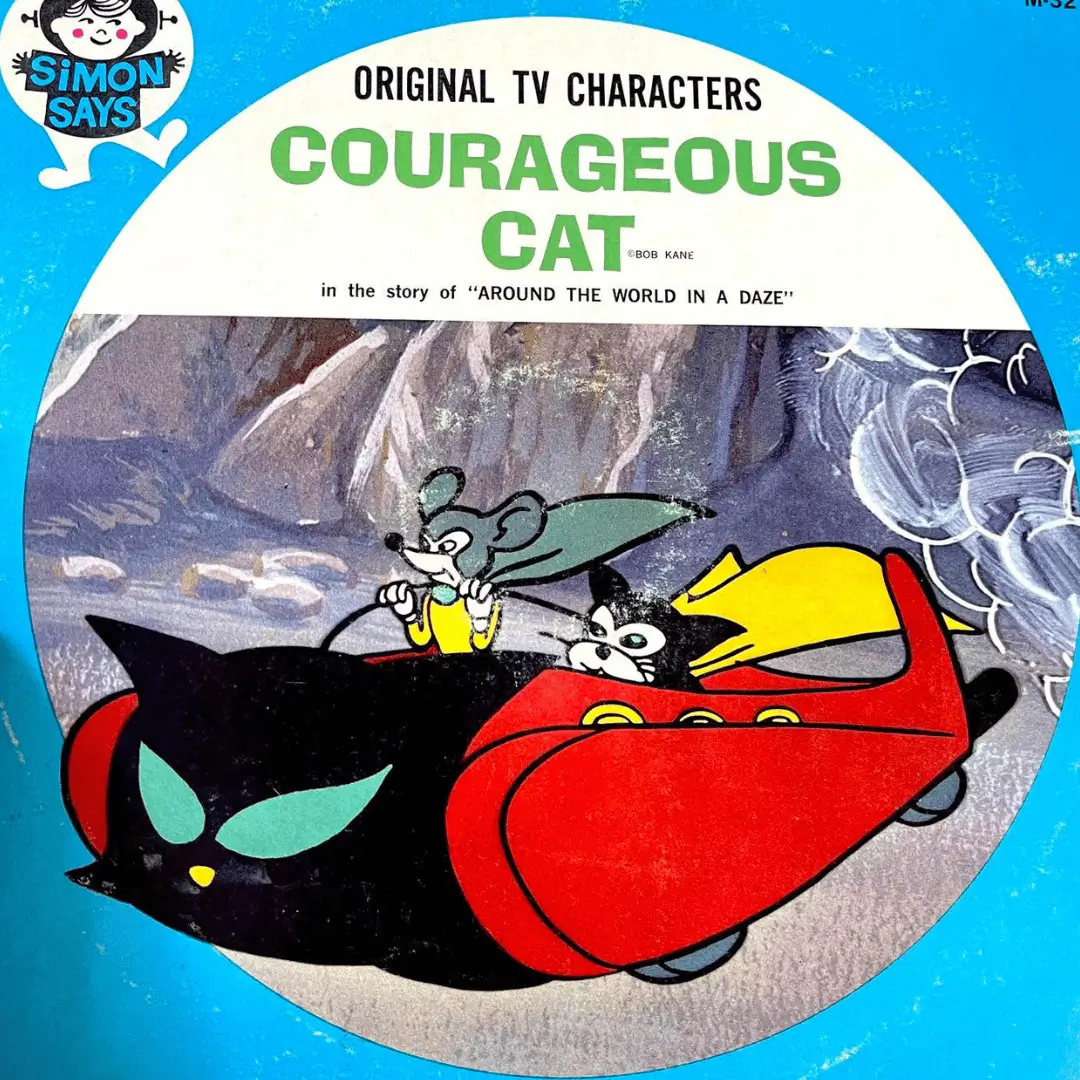
The tie-in record Around the World in a Daze is another odd piece of that history.
Released in 1960, it expanded the five-minute cartoon format into an approximately 24-minute audio adventure loosely inspired by Jules Verne’s Around the World in Eighty Days.
Dal McKennon handled several characters on the album, while Johnny Holiday was credited as the Frog.
Like the cartoon itself, it feels cheap, strange and historically irresistible.
The Batman Parody Bob Kane Signed His Name To
Courageous Cat is an entertaining curiosity, but its real significance goes beyond the Cat Cave, the Catmobile and the endlessly adaptable Catgun.
It was:
- A direct parody of Batman and Robin
- Created during a weaker commercial period for Batman
- Promoted under Bob Kane’s famous name
- Developed with substantial uncredited work from Sheldon Moldoff
- Released six years before Batman became a television phenomenon
In other words, Courageous Cat did not merely borrow the Batman formula.
Its production also repeated the same complicated system of credit that had defined Batman’s early history.
That is what makes it more than just another forgotten 1960s cartoon.
The gadgets are the obvious joke. The more interesting story is how Bob Kane repackaged his greatest success while other artists once again worked behind the name everyone recognized.
For more animation history, explore my Hanna-Barbera cartoon archive.
You can also read how a failed 1966 superhero helped build Adult Swim decades later.
haha, rememebrring Bob Kane created this to spoof his own Batman comics, only for the 1966 Adam West Batman series to turn around and adopt this exact same campy tone six years later.