
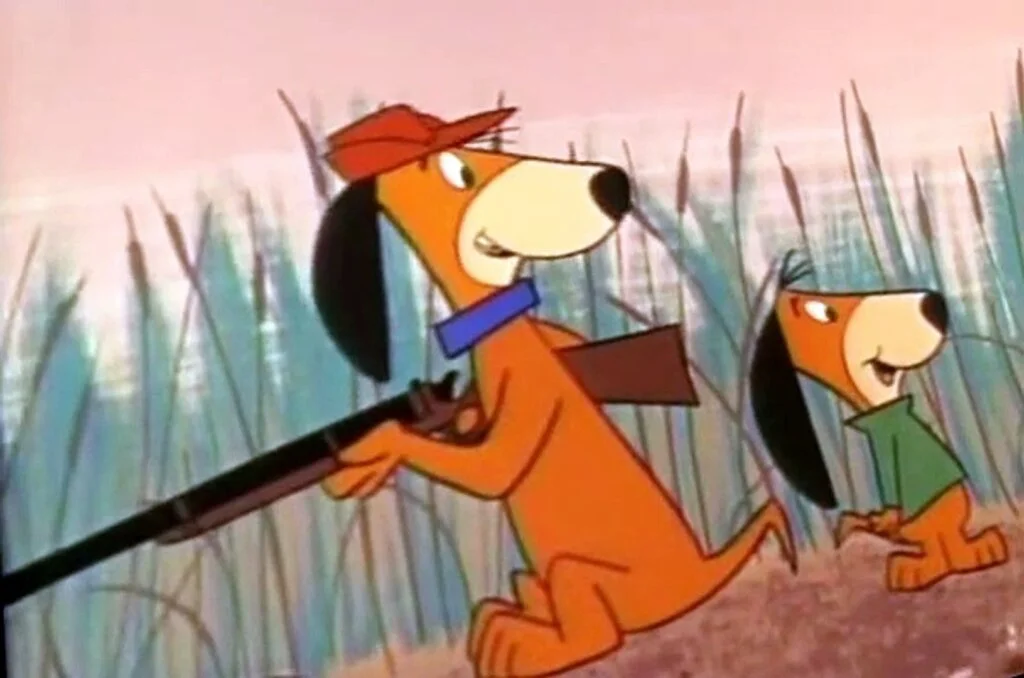
Most 1960s cartoons were chasing gadgets, monsters, or slapstick.
Augie Doggie and Doggie Daddy went a different way. It went for heart.
Tucked inside The Quick Draw McGraw Show, this little segment was not about space-age gags or rubber-mask mysteries. It was about the quiet, funny, deeply relatable pull between a father trying to do right by his son and a son who just wanted to explore the world.
For me, that is exactly why it still lands. It was a masterclass in gentle storytelling, and proof that animation could be about family as much as it was about the jokes.
Today, we’re looking back at why this golden-age duo still resonates with us decades later.
Debuted: 1959, on The Quick Draw McGraw Show
Run: 45 shorts across three seasons (1959 to 1962)
Studio: Hanna-Barbera
Written by: Mike Maltese, of Looney Tunes fame
Voices: Daws Butler (Augie) and Doug Young (Doggie Daddy)
The species: officially dachshunds, though you would never guess it from the design
The “Doggie Daddy” Archetype: The Original Overprotective Parent

Doggie Daddy is a loving parody of the buttoned-up 1950s dad. He talks smooth, hands out strict rules, and worries about his boy constantly, yet his warm heart gives in almost every time.
That is the whole engine. A parent who wants to protect, a kid who wants to grow, and the comedy that lives in the gap between them.
The duo did not come from nowhere. Joe Barbera reworked them from Spike and Tyke, the father-son bulldogs he and Bill Hanna made at MGM in the Tom and Jerry days. Fun trivia: when the segment was first announced in Variety in January 1959, the pair were named Pete and Repete. The scripts came from Hanna-Barbera writer Mike Maltese, one of the sharpest pens in animation, and Disney veteran Al Bertino handled the animation.
A Legacy of “Dear Old Dad”

The catchphrases are the emotional core, not just gags.
- Augie calls his father “dear old Dad,” pure affection in three words.
- When Augie lets him down, Doggie Daddy sighs “Augie, my son, my son.”
- When Augie makes him proud, Doggie Daddy turns to us and beams, “Dat’s my boy who said dat!”
Listen closely and that last one is Doggie Daddy validating his own role as a parent, out loud, to the audience. It is a dad who needs you to know his kid turned out great.
There is a real-world root to it, too. Doug Young built the voice as a Jimmy Durante impression, and “Dat’s my boy who said dat” borrows straight from Durante’s old radio bit with Garry Moore.
Augie’s Unending Optimism

Augie is the flip side of that coin: a bright, curious, science-loving pup with a bottomless “I can do it!” streak.
He tinkers, he experiments, he even chats with other animals, and his innocent questions constantly put his dad on the spot. Where Doggie Daddy sees risk, Augie sees an adventure worth trying.
That contrast is the perfect motor for a short, punchy cartoon. Augie charges ahead, Doggie Daddy frets and follows, the plan goes sideways, and the two of them patch it up with a hug and a catchphrase. Wholesome, and kind of soothing to boot.
Early TV animation ran on tight budgets and tighter schedules, so a repeatable catchphrase was pure gold. It built instant character, it was cheap to write and reuse, and it handed kids something to shout on the playground. “Dat’s my boy who said dat!” pulled off all three at once and lodged Doggie Daddy in your memory in a single line.
Why It Still Matters in 2026

The Art of the “Gentle” Sitcom
Modern kids’ media is loud. It is fast cuts, jump scares, and a joke every four seconds, all fighting for attention.
These old shorts are the opposite, and that is their secret weapon now.
The stakes are tiny.
Nobody is saving the world. It is just a dad and his boy working out a small problem, which makes them a truly calm, low-stimulation watch in a way very little on TV is anymore.
You can draw a straight line from here to Bandit in Bluey, the modern patron saint of warm, patient cartoon parenting. The gentle sitcom never really died. Augie Doggie and Doggie Daddy just did it first, and the format only changed collars.
The Visual Design of the 60s

Then there is the look, which collectors adore for good reason.
This is peak mid-century Hanna-Barbera: bold flat colors, warm mustards and teals and oranges, clean angular backgrounds, and characters built to be instantly readable. Limited animation forced simple, striking shapes, and the result is a style that still feels stylish today.
The design also hides a fun quirk. Augie Doggie and Doggie Daddy are officially dachshunds, but you would be hard-pressed to guess that from a single frame. The design chose personality over breed accuracy every time.
Watch these two and you can see the DNA of Finding Nemo. Marlin the overprotective dad, Nemo the kid desperate to explore: it is the exact same push and pull, just under the sea. Augie Doggie and Doggie Daddy were telling that story more than forty years before Pixar did.
Essential Viewing: Episodes That Defined Them
If you want to sample the good stuff, start with these three. Each one nails a different side of the father-son dynamic.
- “Talk It Up, Pup” – after a bad umpire call at his little-league game, Augie gives his dad the silent treatment for a full day, and it is the sweetest, funniest look at how these two get under each other’s skin.
- “Cat-Happy Pappy” – Doggie Daddy sets out to teach Augie how to handle a vicious cat, only for the tiny kitten he tried to shoo away to save the day, so his lesson lovingly backfires.
- “Gone to the Ducks” – essential for history buffs, since this is the short that introduced Yakky Doodle, who went on to his own segment on The Yogi Bear Show.
Behind the Voices
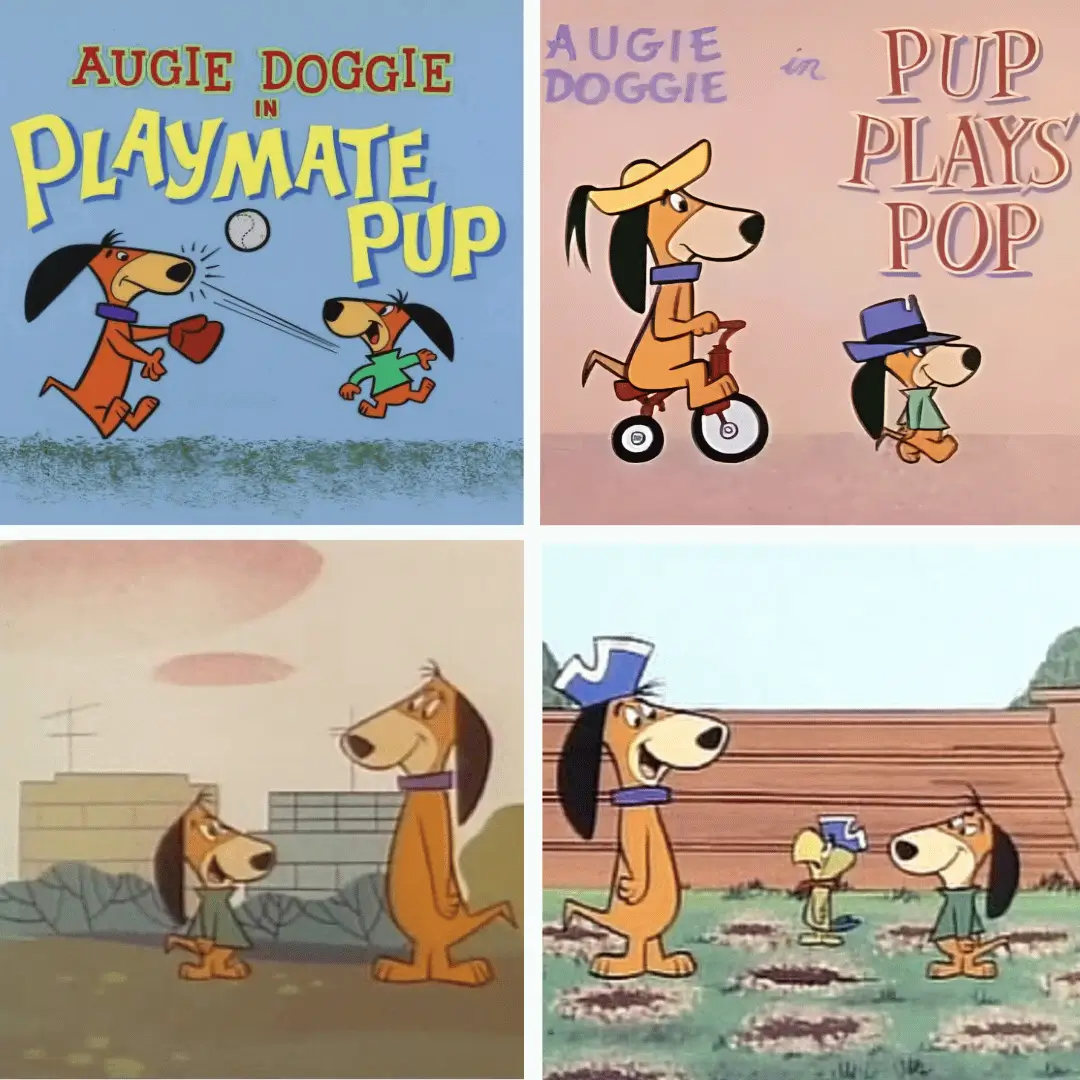
Here is a myth worth clearing up, because a lot of write-ups get it wrong. Daws Butler did not voice both dogs.
Butler voiced Augie, full stop. Doggie Daddy belonged to radio actor Doug Young, who built the character as that gravelly Jimmy Durante impression.
The backstory is great. Barbera first asked Butler to do the Durante voice, but Butler said it wore out his throat and turned it down, so auditions were held.
Young, who had bumped into Butler in a bookstore and got talked into cutting a demo tape, won the role. Later, John Stephenson took over Doggie Daddy for the Yogi ensemble shows while Young was caring for his ailing wife.
In the 2021 reboot Jellystone!, the pair get reinvented again, with Georgie Kidder as Augie (now written as a girl) and C.H. Greenblatt as Doggie Daddy.
Casting History
Augie Doggie
- Daws Butler, from The Quick Draw McGraw Show (1959) through The Good, the Bad, and Huckleberry Hound (1988)
- Greg Berg, in the 1989 50th-anniversary special
- Patric Zimmerman, in Fender Bender 500 (1990) and Yo Yogi! (1991)
- Chris Edgerly, in Harvey Birdman, Attorney at Law (2004)
- Georgie Kidder, in Jellystone! (2021 to present)
Doggie Daddy
- Doug Young, the original (1959 to 1962)
- John Stephenson, across the Yogi ensemble era (1972 to 1991)
- Maurice LaMarche, in Harvey Birdman, Attorney at Law (2004 to 2007)
- C.H. Greenblatt, in Jellystone! (2021 to present)
Beyond the Segment
For a pair of supporting players, Augie Doggie and Doggie Daddy got around. After their original run they stayed part of the Hanna-Barbera family, popping up in Yogi’s Ark Lark, Yogi’s Gang, Laff-A-Lympics, and Yogi’s Treasure Hunt, plus holiday specials like Casper’s First Christmas and Yogi’s First Christmas.
A few highlights worth knowing:
- They raced a doghouse-shaped monster truck called the Lucky Trucky in the “Fender Bender 500” segment of Wake, Rattle, and Roll.
- Both turned up in several episodes of Adult Swim’s Harvey Birdman, Attorney at Law.
- They even headlined their own video game, a 1991 release for the Commodore 64.
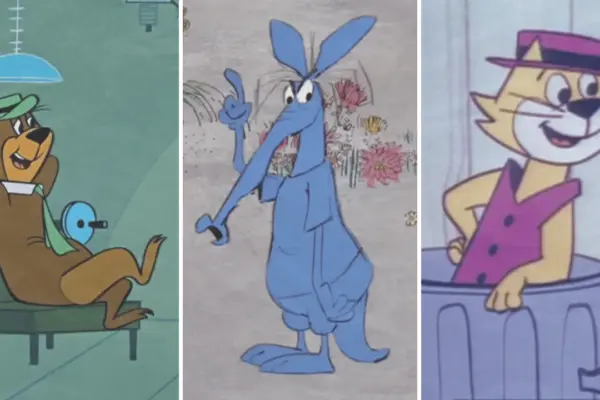
Want the wider studio picture? They sit comfortably alongside stablemates like Snagglepuss and Huckleberry Hound, all part of that same golden Daws Butler era.
Watch a Classic Augie Doggie and Doggie Daddy Short
Strip away the space-age fads of the era and Augie Doggie and Doggie Daddy is still just a dad and his kid, figuring it out together. That is why it aged better than almost anything around it.
Which side are you on, cautious Doggie Daddy or fearless Augie?
Tell me in the comments.
Interesting Facts About Augie Doggie and Doggie Daddy: A 60s Classic 🐶📺
1. I love that Augie Doggie and Doggie Daddy started as part of The Quick Draw McGraw Show in 1959, which makes them part of Hanna-Barbera’s early TV cartoon boom. 📺
2. I find it funny that the whole cartoon is built around a simple father and son setup, with Doggie Daddy constantly trying to guide Augie through his wild little ideas. 🐾
3. One thing I really like is how Augie always wants to make his dad proud, which gives the cartoon a surprisingly sweet family feeling. ❤️
4. Doggie Daddy’s famous voice was inspired by Jimmy Durante, which gave him that old-school comic personality that stands out right away. 🎙️
5. I think the catchphrase “Augie, my son, my son” is one of those classic cartoon lines that instantly gives the show its charm. 😄
6. Augie was voiced by Daws Butler, one of the legendary voices behind many classic Hanna-Barbera characters. 🎧
7. Doggie Daddy was originally voiced by Doug Young, who helped make the character sound warm, goofy, and slightly dramatic. 🐶
8. The series ran for 45 cartoon segments across three seasons, which is pretty impressive for a supporting Hanna-Barbera segment. 🎞️
9. I like that Augie was not just a normal little dog character, because he often had clever plans, inventions, and big ambitions. 🧠
10. The cartoons often had a simple formula, where Augie gets excited about something and Doggie Daddy gets pulled into the chaos. 😂
11. The father and son dynamic feels similar to Hanna and Barbera’s earlier Spike and Tyke cartoons from their MGM years. 🎬
12. I think part of the show’s appeal is that Doggie Daddy can be strict, but he is also loving and proud of Augie. 💛
13. Augie often calls his father “dear old Dad,” which adds to the wholesome 1960s cartoon feeling. 🐕🦺
14. The characters later showed up in other Hanna-Barbera projects, including Yogi’s Ark Lark, Yogi’s Gang, Laff-A-Lympics, and Yogi’s Treasure Hunt. 🚢
15. A modern version of Augie appeared in Jellystone!, where the character was reimagined as female, giving the classic cartoon duo a fresh update. 🌈
16. I think Augie Doggie and Doggie Daddy still work today because the comedy is simple, the characters are memorable, and the father-son bond gives it real heart. ⭐